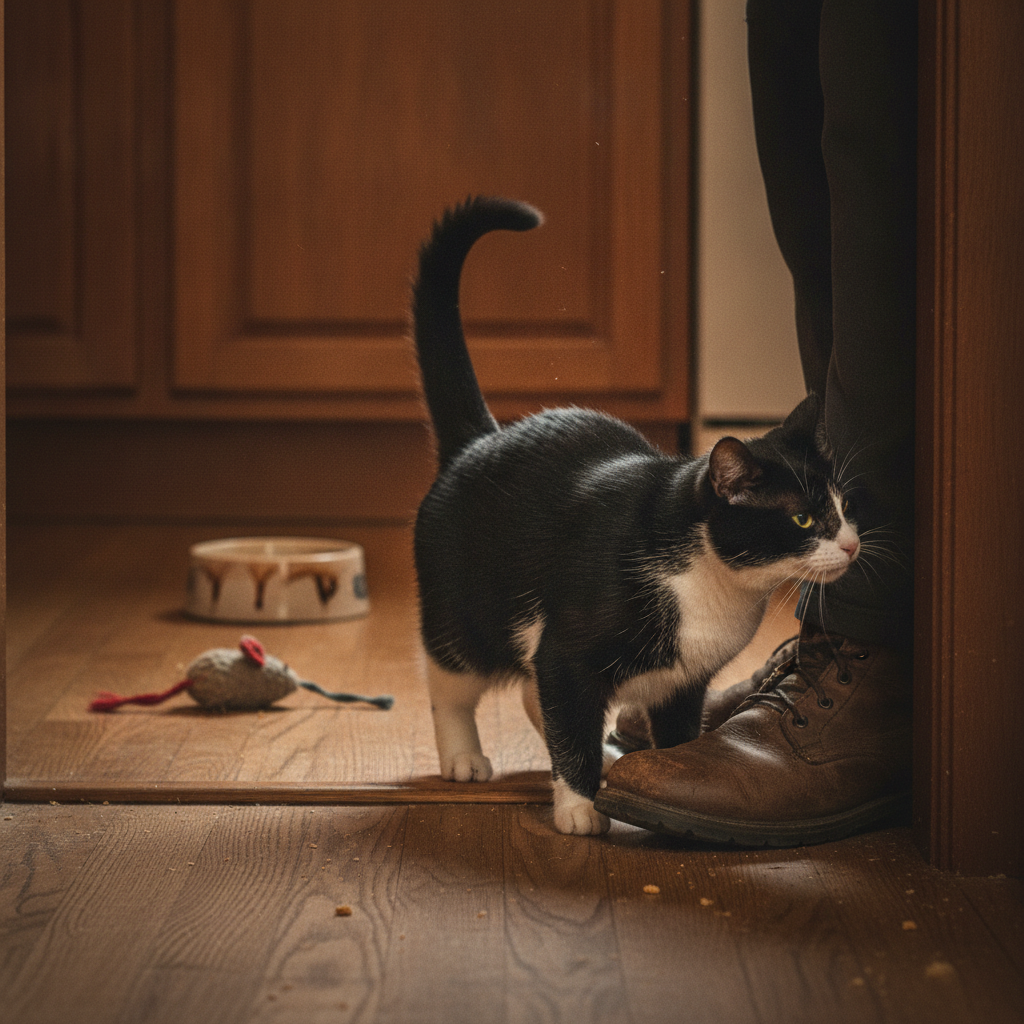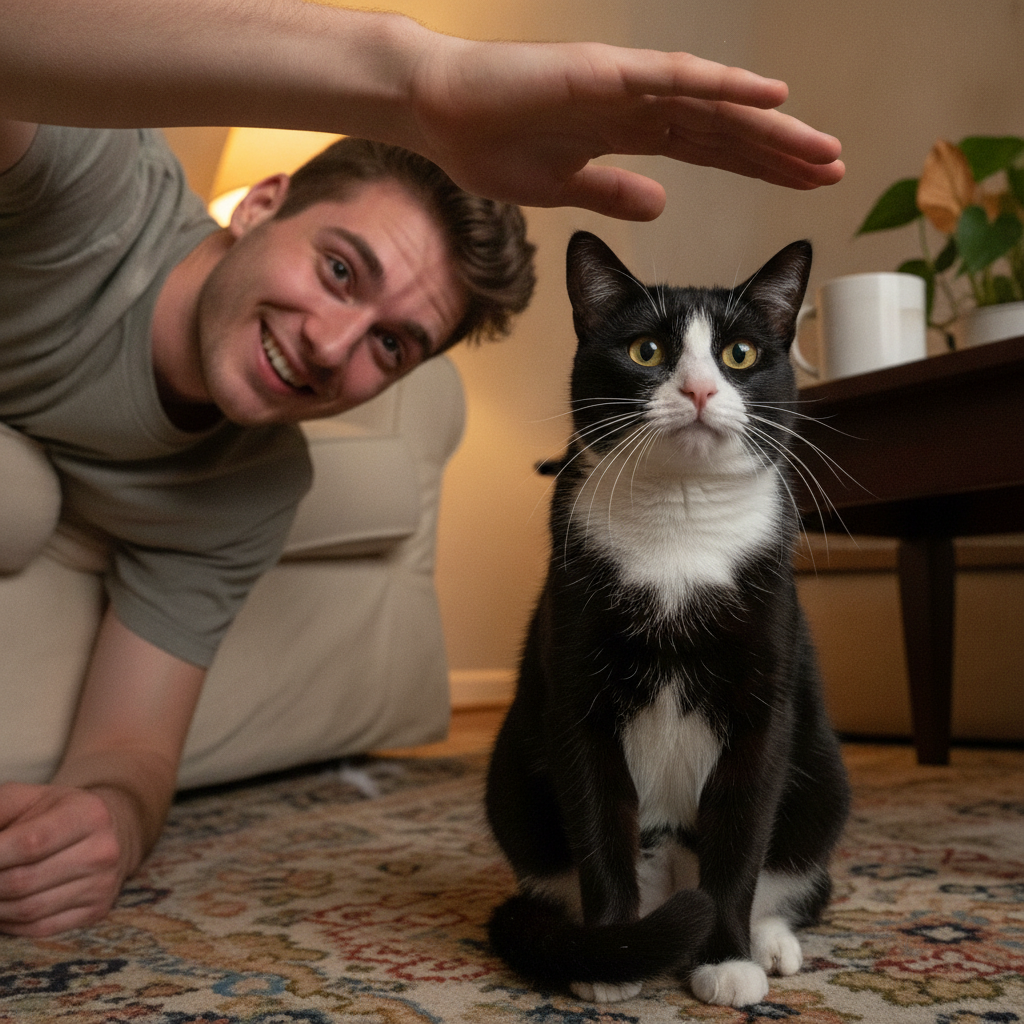
Everyone tells the same story about their cat, in different words. He paws at my leg until I pay attention. Then the second my hand lands, he drifts a foot down the couch, so now I am doing a full shoulder stretch to keep petting a cat who asked for it. Stop, and he is back, butting my wrist for more. What am I supposed to do with that?
The instinct is to call it moody, or to make a joke about how cats are toxic exes. But there is nothing random going on. What you are watching is a cat running a very consistent system, and once you can see it, the whole relationship stops feeling like a guessing game.
The system is about control. Not dominance, not manipulation. Control over the terms of contact.
The animal underneath the house cat is a solitary hunter
That is the piece most of us skip. A dog’s ancestors survived in company. A cat’s survived alone, hunting alone, and staying alert for anything that might hunt them. Nothing in that history built a strong appetite for being restrained, surrounded, or handled at length by something much larger.
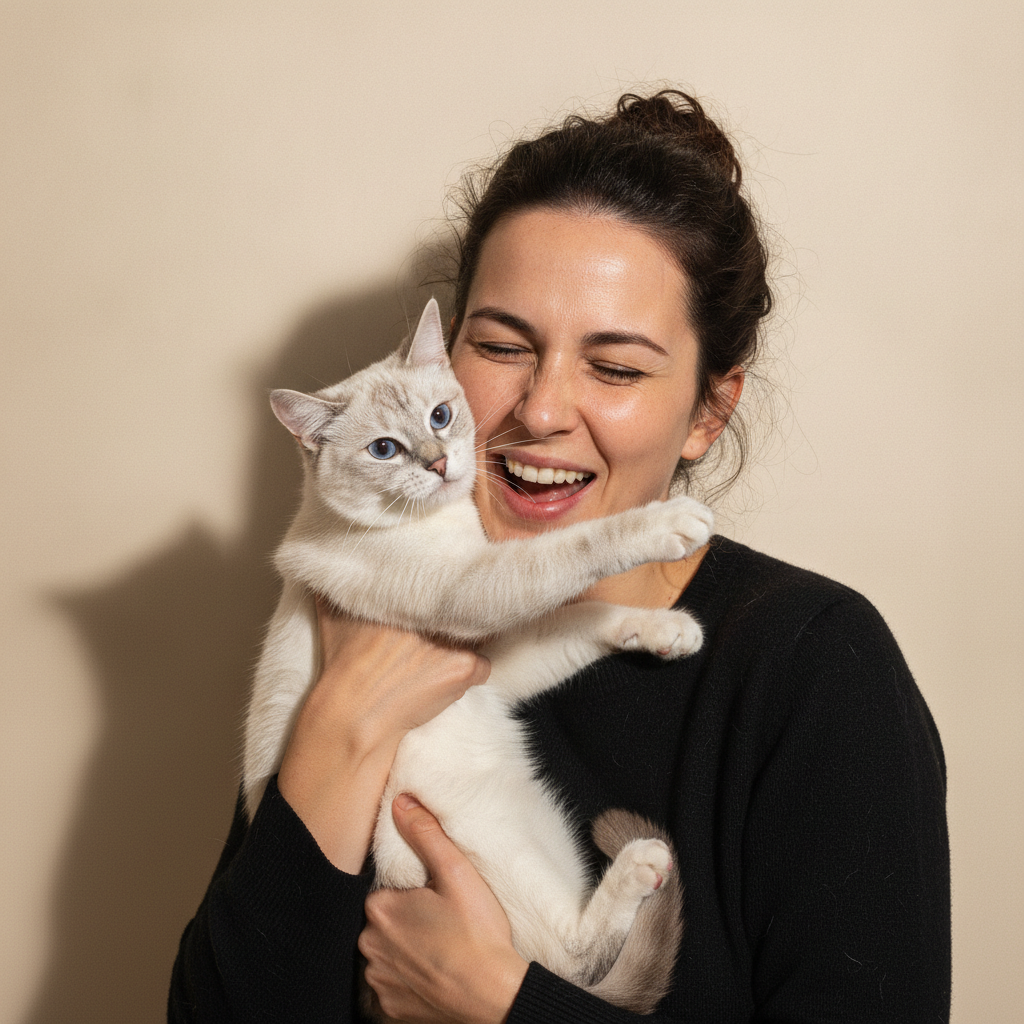
Domestic cats absolutely bond, and they seek out affection. They just do it while keeping a hand on the exit.
A cat setting the terms of a cuddle is not withholding love, they are budgeting risk. The tap on your leg is the request. The step out of arm’s reach is the cat making sure the session ends when they say it ends, not when you do.
So when your cat solicits attention and then repositions to the edge of your reach, they are not sending mixed signals. They are sending one very clear signal: yes, and on my terms. Same for the cat who turns their back to you while staying pressed against your leg. Turning away from something you do not trust is the last thing a prey-aware animal does. A cat who shows you their back is telling you they feel safe.
The bite after the cuddle is not a betrayal
The version of this that actually hurts is the one people call petting-induced aggression: five perfect minutes of purring, then teeth.
It is worth being precise about what is happening. The cat did not change their mind about you. Their nervous system hit a threshold. Repetitive touch that felt good at minute one is over-firing by minute five, and a cat’s evolved response to an unpleasant sensation is fast and physical, because in the wild the slow response gets you killed.
It is not personal, it is a limit. And critically, it is almost never unannounced. The signals come first:
- The tail starts flicking, thumping, or lashing
- The skin along the back twitches or ripples
- The ears rotate sideways or flatten
- The body goes from soft to tense under your hand
- The head turns sharply toward your hand
- Pupils widen, or the purr changes pitch
Any of those means stop. Not slow down. Stop, take your hand away, and let the cat decide what happens next.
The three rules that actually work
Here is the genuinely useful part, and it is not folk advice. When researchers wanted to know whether people could be taught to touch cats better, they built the whole intervention around three ideas, easy enough to remember as choice, attention, and touch.
Choice. Let the cat start it and let the cat end it. Offer a hand, do not reach. If they lean in, you have a yes. If they do not, you have your answer and no hard feelings. A cat who knows they can leave is a cat who stays longer.
Attention. Actually watch the body while you pet. Not the TV. The three seconds before a bite are always visible if you are looking, and they are always invisible if you are not.
Touch, but be picky about where. Stick to the head end: cheeks, the base of the ears, under the chin, around the temples. Those are the areas most likely to get a positive response. The base of the tail and lower back are the riskiest zones. The belly, flanks, and back are genuinely individual and can go either way, which means they are the ones to test carefully, not the ones to default to.
The cats in that study, handled by people following those rules, were more affectionate and showed less aggression and fewer stress signals than cats handled by people going on instinct. Not because the cats changed. Because the humans stopped overrunning the signals.
The tap-and-run may also just be a game
One more reframe, because it changes the mood of the whole thing.
A cat who taps you, moves off, waits for your hand, and darts again is doing something that looks a lot like hunting. Your hand becomes the thing that moves. The chase becomes the point. That is not a sign of an unhappy cat. That is an under-worked predator finding a way to keep the machinery sharp on your sofa.
Which is a clue about what to do with the energy. If the come-here-go-away routine is constant, your cat is probably telling you the day was too quiet. A wand toy, a few minutes of real chase-and-catch, and a small meal afterward will take a shocking amount of the friction out of your evening. Cats who get to be predators on purpose spend less time practicing on you.
What newer research adds
The handling guidelines above come from a 2021 study in Frontiers in Veterinary Science, and they hold up as one of the more useful pieces of practical cat science in years, precisely because they are so easy to do. Let the cat choose, watch the cat, keep to the head.
A newer thread is about scent. A 2025 study in PLOS One on how cats respond to human odor found that cats investigate the smell of their own person differently than they do a stranger’s, adding to the picture that the bond runs partly through a channel we cannot perceive at all. It is one more reason to stop reading your cat like a small, inconsistent dog. They are not sending mixed signals. They are speaking clearly in a language most of us were never taught.
The bottom line
Your cat wants you. They also want a say. Those are not in conflict, and the moment you start treating the second one as real, the first one gets a lot easier to enjoy.
Offer the hand. Watch the tail. Stop before they ask twice.
References
- Haywood, Camilla, et al. “Providing Humans With Practical, Best Practice Handling Guidelines During Human-Cat Interactions Increases Cats’ Affiliative Behaviour and Reduces Aggression and Signs of Conflict.” Frontiers in Veterinary Science, vol. 8, July 23, 2021. doi.org/10.3389/fvets.2021.714143
- “Behavioral Responses of Domestic Cats to Human Odor.” PLOS One, 2025. journals.plos.org
- Cornell University College of Veterinary Medicine, Cornell Feline Health Center. “Feline Behavior Problems: Aggression.” vet.cornell.edu
Common questions
Why does my cat ask for pets and then walk just out of reach?
They are managing the interaction. By moving to the edge of your reach, your cat sets the distance, the duration, and the escape route, then comes back in when they want more. It is not a rejection. It is a cat keeping one hand on the steering wheel.
Why does my cat bite me right after cuddling?
This is usually petting-induced aggression, which is a bad name for an ordinary thing: the cat has hit their limit and is saying so with the fastest tool they have. It almost always comes after quieter signals you missed, like a flicking tail, a rippling back, or ears rotating sideways.
Where is the safest place to pet a cat?
Around the head, specifically the cheeks, the base of the ears, and under the chin. Research on cat handling finds that touch to those areas tends to produce positive responses, while the base of the tail and lower back are the most likely to trigger a snap. The belly and flanks are a coin toss.
Does my cat turning their back on me mean they are annoyed?
Usually the opposite. Presenting their back or rear to you while staying nearby is a cat saying they feel safe enough not to watch you. A cat who does not trust you keeps you in view.