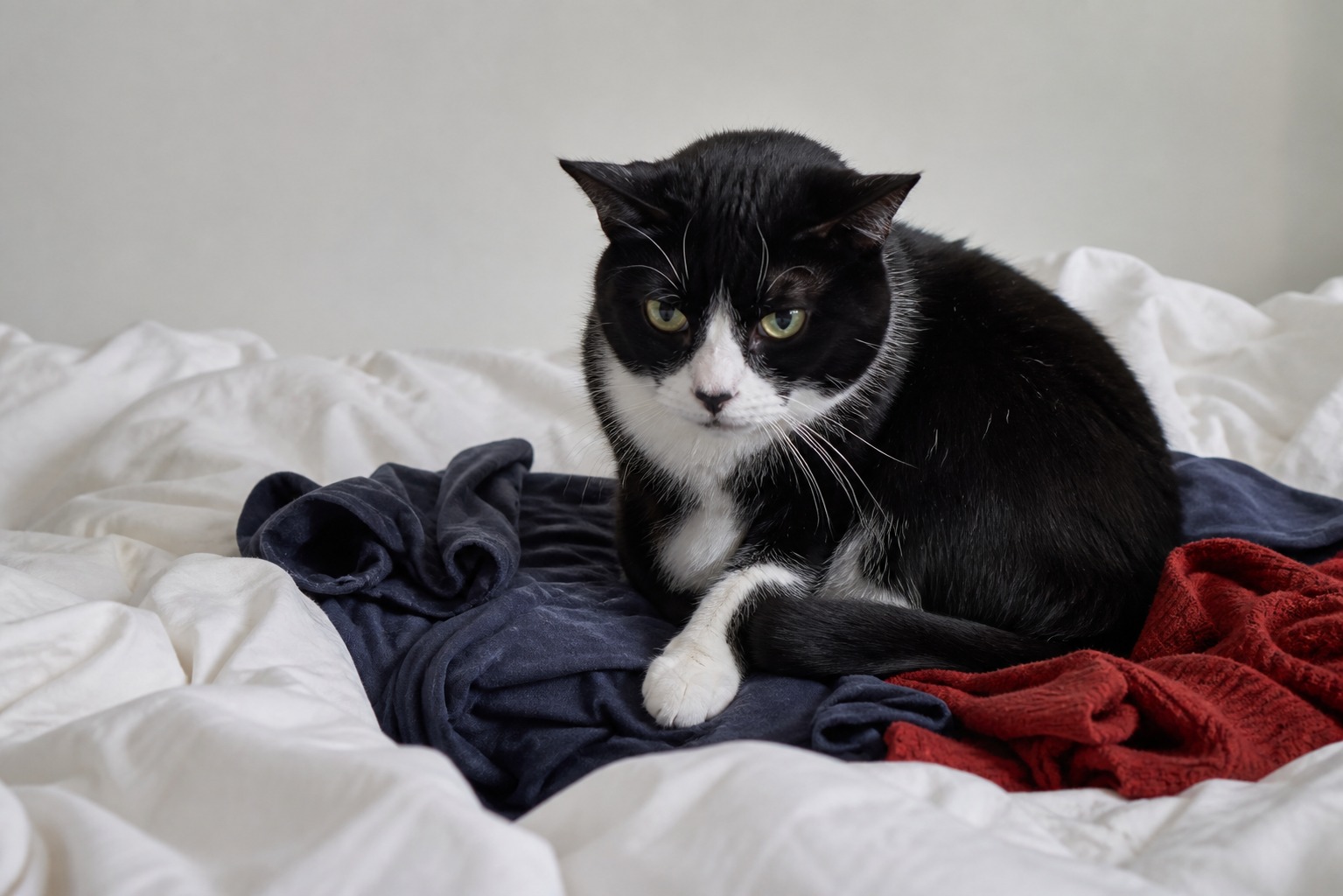
There is a specific kind of despair in pulling a jumper off the floor and realizing what has happened to it. And there is a specific, immediate, entirely wrong conclusion that arrives with it: she did that on purpose, at me.
She did not. Cats do not run revenge operations. But she also did not pick your clothes at random, and that is the part worth paying attention to. Out of every surface in your home, your cat chose one that is soft, absorbent, and thick with your smell. Those are three separate pieces of information, and read together, they narrow the problem down fast.
What the fabric is telling you
Soft and absorbent points at pain. This is the one that matters most, and the one to act on first. A cat with a painful bladder or a painful urinary tract starts associating the litter box with the pain that happens in it, and goes looking for somewhere that feels better to stand and squat. Litter is coarse and hard underfoot. A heap of laundry is not. That preference is not fussiness, it is a cat trying to hurt less.
Your scent points at anxiety. Cats self-soothe by mixing their own smell with the smells of the individuals they feel safe with. When a cat is insecure, blending their scent with yours in the most concentrated place they can find, your clothes, your bed, your side of the sofa, is a calming behavior. It looks like an insult and it is closer to a hug you did not want.
Location points at the litter box. If the soiled clothes are mostly near the box, or in the room the box is in, or on the far side of a doorway the other cat guards, the box setup is a suspect.
Most real cases sit somewhere across all three. But the order in which you investigate them is not negotiable.
Step one, always: rule out the body
Do not skip this and go straight to buying a new litter box. If your cat is peeing outside the box, they need a veterinary exam, a urinalysis, and probably bloodwork. No amount of environmental work fixes a medical problem.
Here is what your vet is looking for.
Urinary tract inflammation and infection. Painful, and often dramatic: repeated attempts to urinate, crying out, blood in the urine. Note that in cats, inflammation without infection is far more common than a true bacterial UTI, and stress is one of its known triggers.
Bladder stones and crystals. Cats form two main types of urolith, struvite and calcium oxalate. Stones can sit in the bladder, the urethra, or both, and they are exceptionally painful to pass. A urethral obstruction is a genuine emergency. In male cats, a blockage can be fatal within a short period of time. A male cat who is straining and producing nothing needs to be seen immediately, not tomorrow.
Kidney disease, thyroid disease, and diabetes. These do not necessarily hurt to pee. They make a cat drink more and pee more. A box that was adequate before is now overwhelmed, and a cat who finds it soiled every time they visit will start voting elsewhere.
Age. Older cats struggle with high-sided boxes, top-entry boxes, and boxes that require a trip up or down stairs, especially with arthritis in the picture. Cognitive decline can also mean a cat simply does not get there in time, or forgets where “there” is.
Then, and only then, the behavior
Once the vet has cleared your cat, work through this list.
The box itself. Most boxes sold are too small. A cat should be able to turn around comfortably and dig without hitting a wall. Most cats prefer a large, uncovered, standard box to a covered one, whatever the marketing says about odor control.
The litter. Unscented, fine-grained, clumping litter is the format cats choose most consistently in preference testing. Heavy fragrances and coarse textures are frequently rejected.
The number and the location. The standard is one box per cat, plus one. They should be in different places, not lined up in a row in the same corner, which functionally counts as one location to a cat. And no box should be somewhere a cat can be cornered, ambushed, or startled while they are in the most vulnerable position of their day.
The cleaning. Scoop at least once daily. Nobody wants to stand in it.
Conflict. This is the invisible one. Another cat who parks in the hallway, a dog who takes an interest, a child who follows, a resource, food, water, a perch, a nap spot, that has to be contested. Cats do not usually fight about this out loud. They just stop using the box.
Marking. Urine marking is normal cat communication and a different behavior from squatting to empty a full bladder. It is driven by territorial insecurity, and it goes up when there is another cat pressing on the boundaries, indoors or out.
“Almost every owner arrives convinced their cat is making a point,” says Dr. Lena Park. “What I usually find is a cat who is uncomfortable, or a cat who is frightened of something in the room where their box is. Neither of those is a message. Both of those are fixable.”
Cleaning up, properly
Any lingering trace of urine is an instruction to do it again there. Ordinary detergent will not remove it, because it does not break down the compounds responsible.
Use an enzymatic cleaner. For clothes, soak the garment in an enzyme solution, up to about 20 minutes, then wash as normal. Do not run soiled clothing through a hot dryer before you are certain the smell is gone, because heat sets it permanently. For mattresses and upholstery, saturate rather than dab, and let the enzyme sit for as long as the product allows.
Never clean with anything ammonia-based. Ammonia is a component of urine. You are, from your cat’s point of view, refreshing the mark.
The plan, in order
- See a vet. Exam, urinalysis, bloodwork. Emergency visit if a male cat is straining unproductively.
- Clean everything soiled with an enzymatic cleaner, or the map keeps redirecting them back.
- Fix the box. Enough of them, big, uncovered, unscented fine clumping litter, scooped daily, in calm, accessible locations.
- Lower the pressure. Daily play sessions, vertical space, more perches and hiding spots, and duplicated resources in a multi-cat home so nothing has to be contested.
- Get help if it persists. A veterinary behaviorist or a qualified cat behavior consultant can find the conflict you cannot see.
What newer research adds
Two things have sharpened here, and they change what is worth your money.
First, the medical piece is bigger than most people assume. Feline idiopathic cystitis, bladder inflammation with no infection and no stone, is diagnosed in roughly two thirds of cats who show up with lower urinary tract signs. So the mental image of “cat has a UTI, cat gets antibiotics, cat is fine” is wrong most of the time. It is more often a stress-linked inflammatory condition, which is exactly why the medical and behavioral halves of this problem are not really separable.
Second, a 2025 systematic review in the New Zealand Veterinary Journal went through the evidence for the strategies everyone recommends for recurrent cases. Two came out ahead: multimodal environmental modification, meaning genuinely reducing stress and conflict and improving the cat’s resources, and therapeutic urinary diets, particularly when combined with increasing the moisture content of the food. Those two, together, should be the backbone of the plan.
The reviewers also found little evidence supporting feline facial pheromone products, which are frequently the first thing owners buy. That is not the same as proof they do nothing. But if you are choosing where to spend, spend on the litter box setup, the play sessions, the wet food, and the vet, not on the diffuser.
Your cat is not making a point. Your cat has a problem, and it is written on the clothes.
References
- Forster, L., et al. “Understanding the Current Evidence Base for the Commonly Recommended Management Strategies for Recurrent Feline Idiopathic Cystitis: A Systematic Review.” New Zealand Veterinary Journal, 2025. https://doi.org/10.1080/00480169.2025.2477542
- “Risk Factors and Clinical Presentation of Cats with Feline Idiopathic Cystitis.” Journal of Feline Medicine and Surgery, 2024. https://pmc.ncbi.nlm.nih.gov/articles/PMC10832981/
- Merck Veterinary Manual. “Lower Urinary Tract Disease in Cats.” https://www.merckvetmanual.com/urinary-system/noninfectious-diseases-of-the-urinary-system-in-small-animals/lower-urinary-tract-disease-in-cats
- Cornell Feline Health Center. “Feline Behavior Problems: House Soiling.” https://www.vet.cornell.edu/departments-centers-and-institutes/cornell-feline-health-center/health-information/feline-health-topics/feline-behavior-problems-house-soiling
- Ellis, S. L. H., et al. “AAFP and ISFM Feline Environmental Needs Guidelines.” Journal of Feline Medicine and Surgery, vol. 15, no. 3, 2013, pp. 219–230. https://doi.org/10.1177/1098612X13477537