


Your Cat Isn't After Your Earwax. But the Q-Tip in the Trash Is a Real Problem.
The gross-out question is the wrong one. Cats lick ears because ears are where grooming goes, and the only genuinely dangerous part of this whole business is sitting in your bathroom bin.

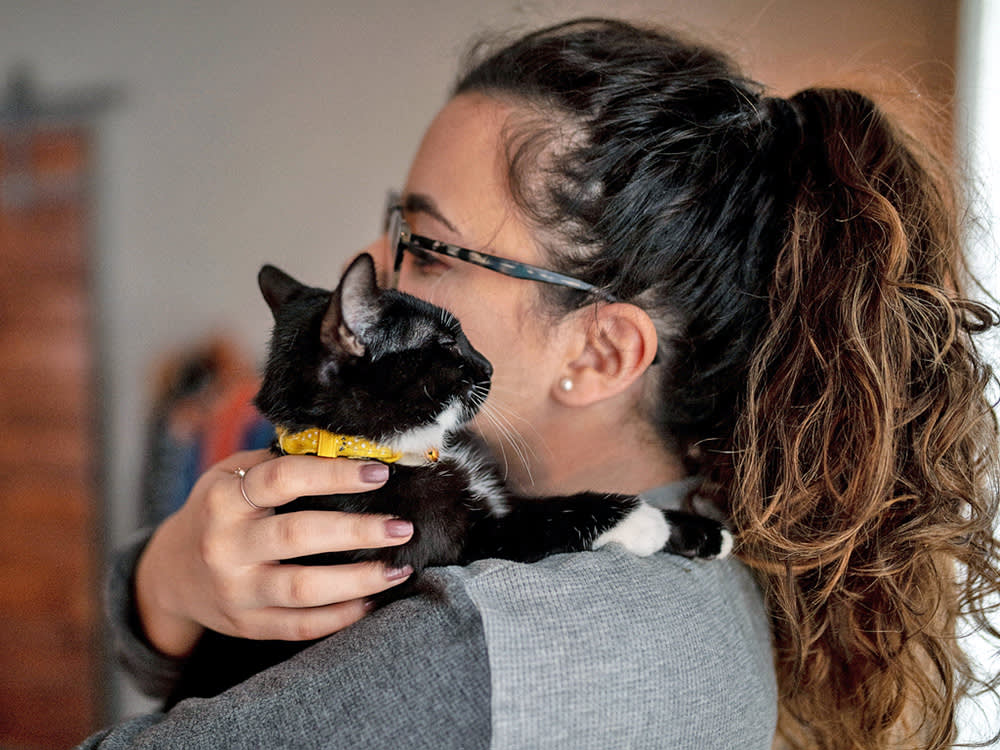
Someone in your house licks ears. Possibly yours, possibly the dog’s, possibly the other cat’s. And at some point you have thought, with a slight lurch, is she doing this for the earwax?
Probably not, in the sense you mean. But the question has an answer, and it turns out the interesting part of this topic is not the ick. It is that the entire behavior sits harmlessly in the “cats are weird” bucket except for one route, and that route is genuinely dangerous, and almost nobody is watching it.
The route is the cotton swab in the bathroom bin.
Let’s take the gross question first so we can get to the useful one.
What earwax actually is
Bodies produce a lot of goo, and the ear canal is one of the gooey parts. Glands inside it produce cerumen, mostly sebum, a substance containing cholesterol, keratin, long-chain fatty acids, and dead skin cells.
It also does real work: keeping the canal moist, protecting against infection, and trapping dirt and debris so they can be carried out. It is not waste. It is a functional secretion that happens to be sticky.
Now read that ingredient list again with a cat’s equipment. Fatty acids. Cholesterol. Skin cells. A cat is an obligate carnivore whose whole nutritional architecture runs on animal fats, and whose sense of smell is dramatically better than yours. Body chemistry, sweat from the canal, and infection can all change how it smells.
To you, that is a repulsive substance. To a cat, it is a strongly scented, fat-rich, animal-derived material.
So yes, the taste and the scent are plausible drivers. But they are almost certainly not the main one.
The real answer: ears are just where grooming ends up
Cats do not, for the most part, seek out earwax. They arrive at it.
Self-grooming. A cat’s face-washing routine is a fixed sequence: lick the paw and lower leg, sweep it over the face and ears, then lick the paw clean again. The paw is a washcloth, and everything the washcloth picks up goes into the mouth. Some earwax is going along with it. This is not a preference; it is plumbing.
Allogrooming. Cats groom each other, and the head and ears are the primary target, because the head is the one place a cat cannot reach with its own tongue. This is where the behavior gets socially meaningful: allogrooming builds a shared group scent, which is one of the main ways cats maintain a sense of who belongs to their social group. A cat grooming your ear, or the dog’s, is doing exactly what they would do with a bonded cat.
That is worth pausing on. When your cat licks your ear, they are performing a social ritual normally reserved for cats they consider family, on the one part of you they can reach that resembles the part of a cat that gets groomed. It is not about the wax. You are being enrolled.
Curiosity. Cats investigate the world with the tongue. Licking is exploration. Ears are warm, weirdly shaped, and smell interesting.
Owners come in embarrassed, like their cat has a disgusting fetish. I tell them their cat is grooming them. The wax is a byproduct. What I actually want to talk about is the cotton swabs.
The dangerous part
Here is the failure mode almost no one anticipates.
Cats are famously good at getting cotton swabs out of the trash. They will chew them, lick them, and bat them around, picking up earwax in the process, which is presumably part of the attraction.
A cotton swab is a thin plastic or paper stick with a soft head. It can bend and snap into smaller pieces. Swallowed, it can lodge in the mouth or throat, and it is a legitimate cause of gastrointestinal obstruction, which is emergency surgery. It is a foreign body with an appealing smell attached to it, sitting in an open container at cat height.
Fix the container, not the cat. A covered trash can handles most cats. A can with a locking lid handles the ones who consider a covered can a puzzle rather than a barrier. That is the whole intervention, and it removes the only significant risk in this entire article.
The second dangerous part: medicated ears
This one is subtle and it catches people.
If one of your cats has an ear infection and is being treated with a medicated ear cream or drop, and your other cat grooms their ears, that second cat is ingesting the medication. Products formulated to sit safely on the skin of an ear canal were not formulated to be eaten. Same goes for any topical product you have applied around a pet’s ears.
So during any ear treatment: keep the treated cat separated from their grooming partners for as long as your vet advises after each dose, and mention the fact that you have other cats when the prescription is written. Vets can only account for the household they know about.
And if the ear itself is infected, the wax coming off it is not healthy wax. It carries bacteria or yeast, and the smell change is likely part of why it suddenly became so interesting.
When the licking is the problem
Small amounts of earwax, encountered during ordinary grooming, are not a concern. It is not a substance available in bulk.
What is a concern is when the licking becomes compulsive. Some cats over-groom, on themselves or on a housemate, and some go further and suckle: an ear, an earlobe, a patch of a dog’s coat, a corner of a blanket. It turns up disproportionately in cats who lost their mothers or were weaned too early.
Signs it has crossed the line:
- You cannot easily interrupt it.
- It is causing physical damage: raw skin, hair loss, or irritation on the cat or on the recipient.
- It has become frequent enough to displace other behaviors.
- It arrived alongside other changes in your cat’s behavior.
Any of those, call your vet or a qualified feline behavior consultant. The point is not the earwax intake; it is that compulsive licking is often driven by stress or by pain, and the trigger needs finding. Medical causes get ruled out first, always.
For the ordinary version, where your cat just will not leave your ear alone at 6 a.m., the tool is a neutral interruption. Not a scold, which teaches nothing except that you are unpredictable. Say their name, gently toss a toy to redirect their attention, or pick them up and set them straight back down. Then give them something to actually do: a few minutes with a wand toy will burn off the energy the licking was expressing. Habits take time to shift. Be patient and be boring.
What’s new since this was written
The framing has shifted, in a way that is mildly humbling for us.
Allogrooming is no longer treated as an incidental hygiene behavior. It is understood as a core piece of feline social architecture, one of the primary mechanisms by which cats maintain group scent and manage relationships, and there is evidence in colony studies that the direction of grooming carries social information rather than being random.
Which means the correct answer to “why is my cat licking my ear” has very little to do with wax and quite a lot to do with the fact that your cat has slotted you into a social category normally reserved for other cats. That is the finding. The rest is just sebum.
And it remains true that the single most valuable thing you can take from this article is: get a bin with a lid.
References
- Cleveland Clinic. Earwax: What Is It and What Does It Do?
- van den Bos, R. (1998). The function of allogrooming in domestic cats (Felis silvestris catus): a study in a group of cats living in confinement. Journal of Ethology.
- Curtis, T. M., Knowles, R. J., & Crowell-Davis, S. L. (2003). Influence of familiarity and relatedness on proximity and allogrooming in domestic cats. American Journal of Veterinary Research.
- Hobi, S., et al. Feline otitis externa: diagnosis and management. Journal of Feline Medicine and Surgery.
- ASPCA Animal Poison Control Center. People Foods and Products to Avoid Feeding Your Pets.
Common questions
Is it safe for my cat to lick earwax?
In the small amounts a cat encounters during ordinary grooming, yes. It becomes unsafe when the wax comes off a cotton swab, when the ear is infected, or when a medicated ear product is on the skin.
Why does my cat lick and suckle my ears?
Ears are a grooming target, and for some cats a suckling target, often in cats weaned early. Occasional ear-licking is affectionate and normal. Compulsive, un-interruptible suckling is worth a conversation with your vet.
How do I stop my cat eating cotton swabs?
Change the bin, not the cat. A covered trash can solves this for most cats, and a locking lid solves it for the committed ones. Swabs are a genuine obstruction and injury risk.
Dr. Nair is a veterinarian focused on diet and feeding. She covers everyday nutrition, treats, and the many "can they eat this?" questions owners ask, grounding each answer in what is actually safe and sensible for dogs and cats.
Meet our experts ↗Keep reading
 TrainingThat 'Come Here' Cat Video Works. Your Own Voice Works Better.Dr. Lena Park · 7 min
 Health & WellnessThe Toy Brick Your Cat Swallowed Won't Show Up on an X-RayDr. Mara Chen · 7 min
 Health & WellnessYour Cat Isn't Being Weird. Plastic Bags Smell Like Food.Dr. Mara Chen · 7 min
 LivingYour Cat Isn't Watching You Cook. He's Reading the Room.Dr. Mara Chen · 7 min
 Health & WellnessYour Cat vs. the Christmas Tree: The Climbing Isn't the Real DangerDr. Ravi Mehta · 6 min
 Health & WellnessBringing an Outdoor Cat Inside Isn't Cruel. Doing It All at Once Is.Dr. Nina Kohl · 8 min