


Your Cat's Heart Murmur Isn't a Diagnosis. It's a Clue.
A vet hears a whoosh, says the word murmur, and your stomach drops. But a murmur is a sound, not a disease. Here's what it actually points to, which ones are harmless, and the tests that separate the two.

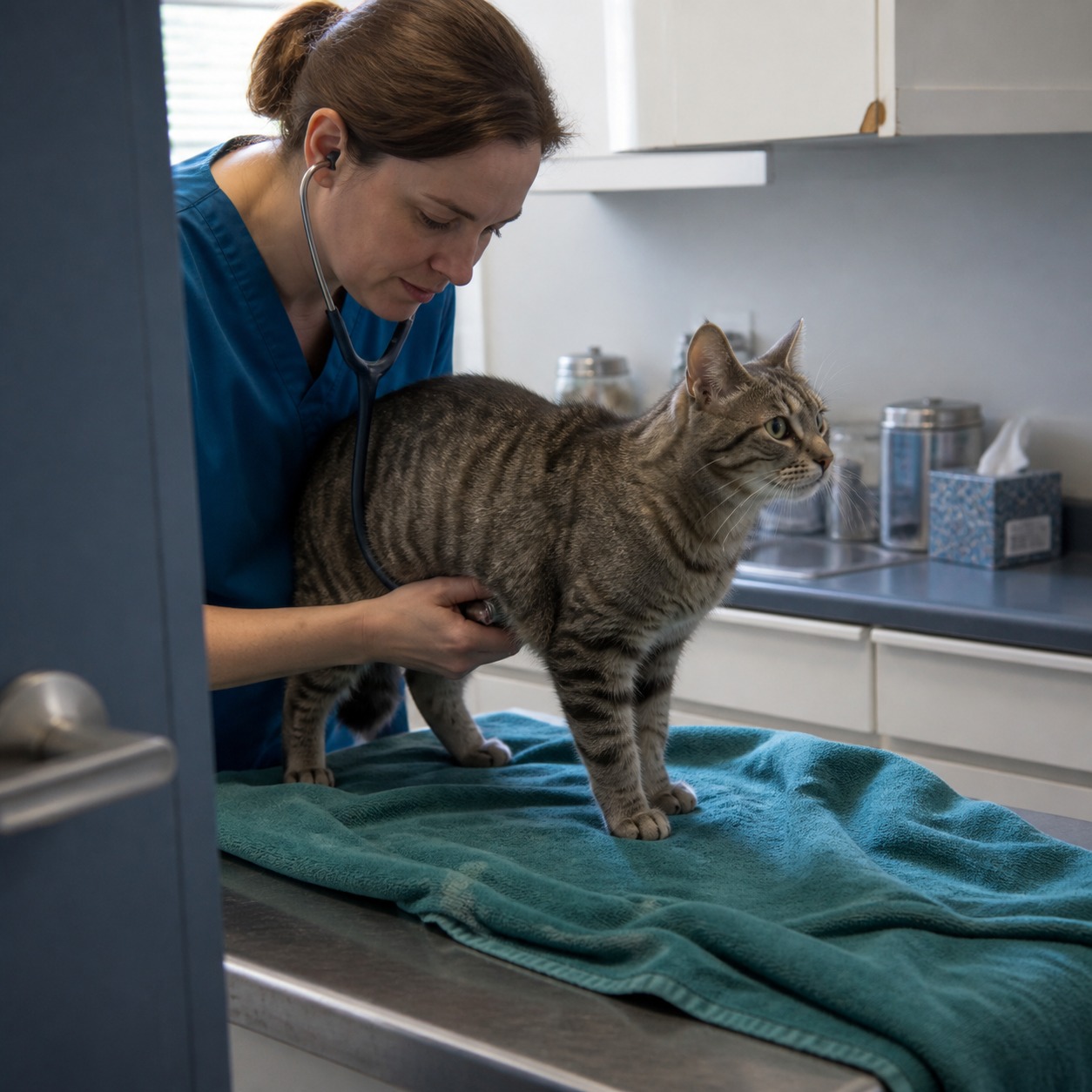
Your vet moves the stethoscope, pauses a little too long, and says the word: murmur. In that half-second, most people jump straight to the worst version of the news. Here is the reframe that actually helps. A murmur is not a diagnosis. It is a sound, and the sound is only a clue that something is worth a closer look.
That distinction is the whole point of this piece. The murmur itself is never the thing that gets treated. What gets treated, if anything, is whatever is making the extra noise, and that can range from “nothing at all” to “let’s start today.” Here is how vets sort one from the other, what your cat’s murmur might be pointing at, and when a whoosh in the chest is genuinely a reason to move fast.
What the whoosh actually is
When your vet listens to a healthy cat’s heart, they hear two clean sounds, a lub and a dub. The lub is the closing of the valves between the upper and lower chambers; the dub is the closing of the valves that send blood out to the lungs and body. Blood is moving the way it should, in the direction it should, and it makes a tidy two-beat rhythm.
A murmur is an extra sound layered on top of that rhythm, a whoosh or a swish, and it means blood is moving turbulently somewhere it should be smooth. That turbulence can come from inside the heart, from a valve or a chamber wall, or from something outside the heart entirely. You will not hear any of this yourself. Murmurs live in a frequency range that a stethoscope catches and a human ear across the room does not.
Vets also grade what they hear, on a scale from one to six. A grade I murmur is so faint it takes a quiet room and a patient vet to catch it; a grade VI is loud enough to feel through the chest wall as a vibration. Grade matters because a louder murmur is more likely to reflect real structural disease, but here is the catch that trips people up: loudness does not track neatly with danger. Some cats with serious heart disease have soft murmurs, and some with loud murmurs have hearts that are structurally fine. The grade is a clue on top of a clue, not a verdict.
The murmur is common. That is oddly reassuring.
If it helps to know you are not alone, murmurs in cats are genuinely common, and a large share of them turn out to be benign. In one study of cats passing through a rehoming center, researchers found a murmur in roughly 41 percent of them, and about 70 percent of those murmurs were functional, meaning no underlying heart disease was driving them. In the same population, the serious disease people fear most, hypertrophic cardiomyopathy, showed up in under 15 percent.
Read those numbers the right way. A murmur is a common finding, most are not sinister, but a meaningful minority do point at real disease, and you cannot tell which camp your cat is in from the stethoscope alone. That is exactly why the next step is testing, not panicking.
What a murmur can be pointing at
There are three broad reasons a cat’s heart makes an extra sound, and they carry very different weight.
Innocent and functional murmurs. These are the good-news category. An innocent murmur is just noise, often showing up when a cat’s heart rate is racing from the stress of a vet visit, or briefly in a kitten whose body is growing fast. Turn the heart rate back to normal, or let the kitten finish growing, and the sound frequently disappears. Nothing is wrong with the heart itself.
Structural murmurs. Sometimes the turbulence comes from the plumbing. A leaky valve, a valve or vessel that has thickened or narrowed, or a hole in one of the walls between chambers can all churn the blood as it passes. Young cats are more likely to have a congenital version of this, a defect they were born with. Older cats are more likely to develop it through disease. Several breeds carry a higher risk of the heart-muscle diseases behind structural murmurs, including hypertrophic cardiomyopathy and dilated cardiomyopathy, so Siamese, Persian, Ragdoll, and Maine Coon cats in particular earn regular vet checks to stay ahead of it.
Extracardiac murmurs. These are the ones that catch people off guard, because the heart is fine and the trouble is somewhere else. Anemia or low blood protein, often from blood loss, injury, or parasites, can thin the blood enough to make it turbulent. So can hyperthyroidism, heartworm, pregnancy, obesity, high blood pressure, and infection. One worth singling out: a bad dental infection can seed bacteria into the bloodstream that colonize the heart valves, causing leakiness and a new murmur. If a chronically dirty mouth was not enough motivation for dental care, protecting the heart is.
Why the vet cannot stop at listening
Listening tells your vet where the sound is loudest and how intense it is, which is useful for narrowing the possibilities. It cannot tell them the cause, and the cause is the entire game. So a workup usually means looking past the stethoscope.
Bloodwork comes first, largely to rule the extracardiac causes in or out, checking for anemia, thyroid trouble, and the like. Imaging is where the heart itself gets seen. X-rays show the heart’s size and silhouette and whether fluid is backing up into the lungs. An echocardiogram, an ultrasound of the beating heart, is the gold standard, because it lets a cardiologist watch the valves move, measure the chamber walls, and see the turbulent flow directly.
There is also a middle-ground test that has changed how vets triage murmurs: a blood marker called NT-proBNP, now available as a quick point-of-care test. It measures a substance the heart releases when its muscle is stressed. In cats with a murmur, the test does a solid job of flagging which ones likely have real heart disease and which likely do not, with a sensitivity around 71 percent and a specificity around 92 percent. It is not a replacement for an echo, but it helps a vet decide whether your cat needs one urgently, soon, or maybe not at all. For a lot of owners, that single blood draw is what turns a scary unknown into a plan.
Treating the cause, never the sound
Because the murmur is a symptom, treatment always aims at whatever is behind it. Cats with innocent murmurs usually need nothing; the sound resolves on its own. When an extracardiac cause is in play, the fix is aimed there, with medication or a diet change for hyperthyroidism, high blood pressure, or anemia, and the murmur often quiets as the underlying problem comes under control. Some cardiac causes are managed with medication and diet to ease the workload on the heart. A congenital defect may need surgery to repair. And when a murmur reflects heart failure that has already tipped over, treatment gets urgent: medication, oxygen therapy, and drawing fluid off the lungs.
When a murmur becomes an emergency
For most cats, a murmur is found quietly during a routine checkup, and there is time to investigate calmly. The situation changes the moment symptoms appear. Call your vet, and do not wait for the next scheduled visit, if your cat shows any of these:
- Increased lethargy
- Weakness or collapse
- Weight loss
- Decreased appetite
- Pale gums
- Coughing or wheezing
- Exercise intolerance
- Difficulty or labored breathing
- Stunted growth in a kitten
Labored breathing and pale gums in particular are not “watch it overnight” signs; they are “go now” signs. The temptation with an aging cat is to write off slowing down as just getting older. Resist it. The earlier a real cause behind a murmur is caught, the better the outcome tends to be.
The mistake I see most is treating the word ‘murmur’ as the diagnosis and either panicking or shrugging. It is neither. It is your cat’s heart telling us to look closer, and with today’s bloodwork and imaging, we usually can tell you exactly how worried to be, or not to be.
What newer research adds
The biggest shift in recent years is that vets no longer have to jump straight from “I hear a murmur” to “we need a full cardiac ultrasound today.” That in-house NT-proBNP blood test now lets your regular vet get a fast read on whether the murmur is likely hiding real disease, which means fewer cats get referred for expensive echocardiograms they never needed, and the cats who do need one get there faster.
Researchers are also getting better at predicting which asymptomatic cats with murmurs are worth worrying about by combining simple clues, things like being male, carrying extra weight, and having a louder murmur, with that blood marker. None of this replaces an echocardiogram when a cat truly needs one. What it does is take some of the guesswork, and a lot of the fear, out of that first appointment.
References
- Cornell Feline Health Center. “Congenital Heart Disorders.” vet.cornell.edu
- Tufts Cummings School of Veterinary Medicine. “Heart Disease in Cats.” vet.tufts.edu
- Wilkie LJ, et al. “Prevalence and Clinical Significance of Heart Murmurs Detected on Cardiac Auscultation in 856 Cats.” Veterinary Sciences, 2022. pmc.ncbi.nlm.nih.gov
- Journal of Veterinary Internal Medicine. “Accuracy of combined signalment, physical examination and cardiac biomarkers in screening cats with asymptomatic murmurs for cardiac disease,” 2026. academic.oup.com
- University of Illinois College of Veterinary Medicine. “When to Worry About Murmurs,” 2020. vetmed.illinois.edu
This article covers a health topic. It is meant to inform, not to replace an exam. If your cat has a murmur or any of the warning signs above, talk to your veterinarian.
Common questions
What does a heart murmur in a cat sound like?
A healthy heartbeat is a two-part lub-dub. A murmur adds an extra whooshing or swishing noise between those beats, made by turbulent blood flow. Your vet hears it through a stethoscope; you cannot hear it with a naked ear.
Can a cat live a normal life with a heart murmur?
Many cats do. If the murmur is innocent or the underlying cause is mild and managed, a cat can live a full life. The prognosis depends entirely on the cause, which is why diagnosing that cause matters more than the murmur itself.
Not a substitute for your vet. Our guidance is educational. For urgent symptoms, contact a vet or emergency clinic right away. Editorial standards
Dr. Chen is a small-animal veterinarian who leads health and safety coverage at The Pet Times. She writes and reviews the bulk of our illness, condition, and safety content, translating clinical guidance into clear, practical advice owners can act on at home.
Meet our experts ↗Keep reading
 Health & WellnessYour Kitten Has Fleas. The Wrong Fix Can Be Deadlier Than the Bugs.Dr. Priya Nair · 8 min
 Health & WellnessYour Senior Cat's 3 a.m. Yowling Might Be DementiaDr. Priya Nair · 8 min
 Health & WellnessYour Cat's Pink Eye Probably Isn't an Infection You Can Cure. It's a FlareDr. Mara Chen · 7 min
 Health & WellnessYour Cat Isn't Hiding That It's Sick. You Just Never Learned Its 'Normal.'Dr. Mara Chen · 6 min
 Health & WellnessTwo Myths Are Getting Cats Killed by Heartworm. Here's the TruthDr. Priya Nair · 9 min
 Health & WellnessYour Cat's Drool Is Only Cute If Your Hand Is on ThemDr. Lena Park · 8 min