


Your Cat's 'Favorite Person' Is a Job, Not a Feeling. You Can Take It.
Being the chosen one is less about chemistry than most people think. It is a role, it is assigned on evidence, and the evidence is refreshed daily. Which means it's available.

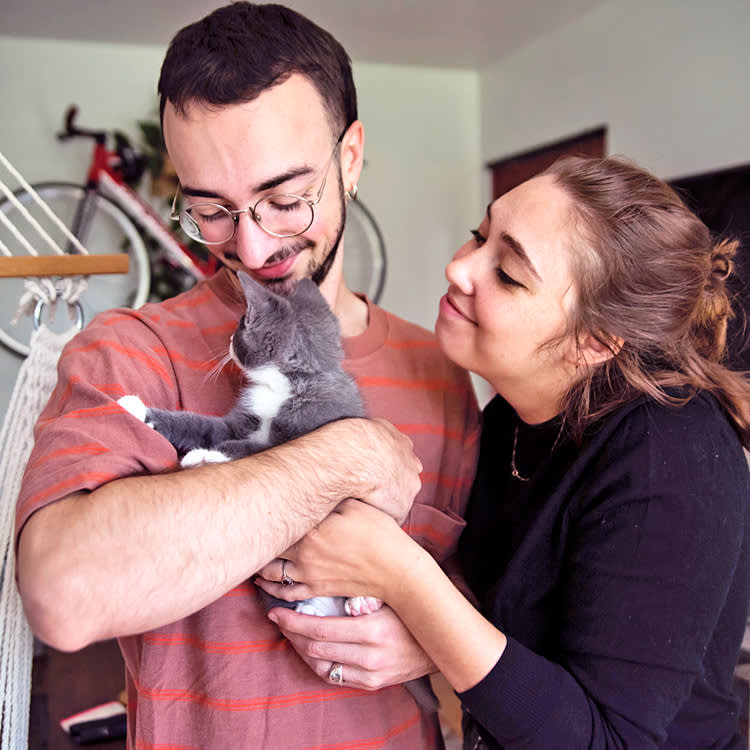
There is a particular sting to being the person who buys the food, scoops the box, pays the vet, and then watches the cat climb into someone else’s lap. It feels like a verdict. It is not one.
Here is the reframe that makes the whole thing tractable: for most cats, “favorite person” is not a soulmate designation. It is a role, filled by whoever is currently the most reliable source of safety and resources, and reassessed continuously on the evidence available. Which means two things at once. It is less personal than it feels. And it is, in most households, transferable.
First, the premise is often wrong
Not every cat has a favorite. Plenty of cats have perfectly good relationships with everyone in the house and simply distribute themselves according to who is sitting down.
Where a favorite does emerge, the single most common explanation is unglamorous: the cat’s primary caregiver, the person actually meeting their physical and emotional needs day to day, tends to get the job. That is not romance. That is a résumé.
But it is not the only explanation, and this is where people go wrong when they try to earn it.
The three things that actually decide it
Resources and predictability
Cats read the world through scent and resources. Whoever produces the food, keeps the box clean, and behaves the same way every day is, in a cat’s accounting, the load-bearing wall of the household. That person accrues trust whether or not they are trying to.
Chemistry, which is real and unhelpful
Sometimes it just is what it is. The same way you cannot fully explain why you warm to one person and not another, your cat may not have a reason either. Scent plays into it in ways we cannot access: a cat may simply prefer how someone smells.
This is the part you cannot lever, and it is worth accepting rather than fighting.
Doing less
Here is the counterintuitive one, and it is responsible for an enormous amount of household heartbreak.
The person trying hardest is frequently the person the cat is avoiding. Constant approaching, picking up, following, cooing, and reaching is, from the cat’s side of it, a barrage. Meanwhile the person on the couch scrolling their phone and ignoring the cat entirely is calm, low-demand, and, crucially, not making the cat do anything. Cats gravitate toward that.
It is common for a cat in a house of adults to pick a child, not because the child feeds them, but because the child was small and quiet and unthreatening at the moment the cat was deciding.
Almost every ‘my cat doesn’t like me’ consultation I do turns out to be a pursuit problem. The cat is not rejecting the person. The cat is declining an invitation that arrives forty times a day and never lets them say no. When the person stops asking, the cat starts arriving.
The takeover plan
If you want the job, here is how it is won. Not with grand gestures. With a schedule.
1. Take over meals. This is the highest-leverage single change available to you. Feeding is the most powerful bonding event in a cat’s day because you are delivering the ultimate resource. Make it food they actually like, and deliver it on a consistent schedule, at the same times, every day. Cats relax when they can predict the day; a reliable meal clock tells them you are dependable in a way no amount of petting does.
2. Own a routine, not a moment. Take the brushing. Take the litter box. Take the same two minutes of gentle contact when you get home and the same two before bed. Boring, repeated, small. That is the shape trust takes in a cat.
3. Play, properly, and more than you think. Two or three five-minute wand-toy sessions a day changes relationships. Five minutes is not a big ask, and most people who believe they are playing enough are not. Set a timer. Watch what happens over two weeks.
4. Clicker train them. This surprises people who assume it is a dog thing. Teaching a cat a simple trick with treats is genuine mental stimulation, it is fun, and it produces a stream of positive, cooperative interactions that all have your face attached to them.
5. Buy the love, but pay for something. Treats work and you should not be precious about it. But do not scatter them randomly. Attach them to specific things: a gentle approach, a good play session, a slow blink. Tie the reward to a behavior and you are not bribing, you are building an association, and you are the association.
6. Then stop approaching them. The hardest instruction on the list. Let the cat come to you. If you are constantly walking over to where the cat is, you are the thing that interrupts naps, and cats do not promote the thing that interrupts naps. Do less, offer more, and wait.
If you are not the favorite, and it hurts
It is worth saying plainly that this stings, and that the sting is normal. People who do the care work and do not get the affection are experiencing a real mismatch between effort and return, and it can poke at something older and rawer than a cat.
Two things help.
Stop framing the other person as competition. Your cat’s circle widening is not your loss. A cat with two people they trust is a cat with more security, not less love available. You can even use it: play as a trio, alternate who runs the treat during a training session, and let the cat’s good feeling about the household attach to both of you rather than one.
Do not sabotage. This is the mistake that does the most damage. When people feel a cat drifting toward someone else, they sometimes push the cat away, or the favored person pulls back to be kind, and the result is a cat who gets less of everyone. Nobody wins that, least of all the cat, who is now bored and lonely on top of everything else. If you are the favorite and you can see it is hurting someone in the house, do not withdraw. Pull them in.
Focus, instead, on the specific things that are yours: the way your cat sits on the arm of your chair, the way they show up when you open the laptop. Those interactions look small next to somebody else’s lap cat. Fed consistently, they grow.
What newer research adds
The research has been quietly demolishing the old story that cats are aloof opportunists who tolerate us for food.
In a 2019 study published in Current Biology, researchers ran cats through the same secure-base test used with human infants and dogs: a few minutes with their person in an unfamiliar room, a brief absence, then a reunion. About 64 percent of the cats showed a secure attachment to their person, meaning they used that human as a base to explore from and settled quickly on their return. That number is strikingly close to the figures found in human infants and in dogs.
And a formal preference study found that when cats were offered a choice between food, toys, scent, and human social interaction, social interaction with a person was the top-ranked category for the largest share of them, with food second.
Two conclusions fall out of that. Cats form real attachments, so the bond you are chasing is a real thing and not a projection. And attachment behaves like attachment: it is built from consistent, responsive, low-pressure availability over time.
Which is exactly the takeover plan above. The job is open. Show up for it on a schedule and it is yours.
References
- Vitale, K.R., Behnke, A.C., and Udell, M.A.R. “Attachment bonds between domestic cats and humans.” Current Biology, 2019. https://www.cell.com/current-biology/fulltext/S0960-9822(19)31086-3
- Vitale Shreve, K.R., Mehrkam, L.R., and Udell, M.A.R. “Social interaction, food, scent or toys? A formal assessment of domestic pet and shelter cat (Felis silvestris catus) preferences.” Behavioural Processes, 2017. https://pubmed.ncbi.nlm.nih.gov/28343989/
- Ellis, S.L.H., Rodan, I., Carney, H.C., et al. “AAFP and ISFM Feline Environmental Needs Guidelines.” Journal of Feline Medicine and Surgery, 2013. https://journals.sagepub.com/doi/10.1177/1098612X13477537
Dr. Kohl is a board-certified veterinary dentist with a particular interest in preventive oral care. She reviews all dental health content at The Pet Times and contributes practical guides on home dental routines, professional cleaning, and oral disease prevention.
Meet our experts ↗Keep reading
 TrainingYour Cat Isn't Kissing You. Watch What Happens Three Seconds Later.Dr. Mara Chen · 7 min
 LivingHating Cats Doesn't Make You a Narcissist. The Rush to Diagnose Says More.Claire Sutton · 6 min
 LivingYour Cat Didn't 'Imprint' on You Like a Duckling. What Actually Happened Is BetterDr. Nina Kohl · 7 min
 TrainingThe Cat on Your Lap Isn't the One Who Loves You MostDr. Amara Solis · 9 min
 TrainingYour Cat Doesn't Care About the Bathroom. They Care That You Finally Sat Down.Dr. Priya Nair · 8 min
 TrainingYour Cat Rubbing Your Legs Isn't a Hug. It's a Deposit.Dr. Priya Nair · 7 min