


That Bright Red Ball Is Basically Invisible to Your Dog. 12 Toys They Can Actually See
Dogs see the world in blues and yellows, not the full rainbow. Here are 12 toys, chews, and a lick mat picked in the exact colors your dog's eyes can actually pick up.

Affiliate disclosure. This article contains affiliate links. We may earn a small commission if you buy through a link, at no extra cost to you. How we handle recommendations.
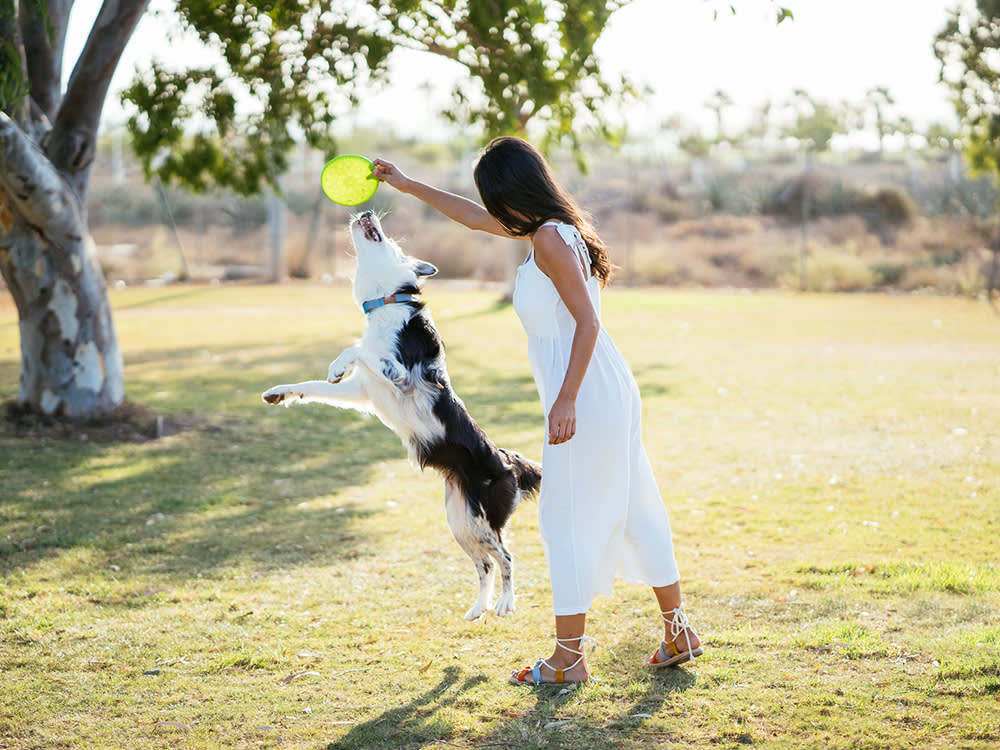
Here is a small heartbreak most of us never notice: that fire-engine-red ball you keep hurling across the grass is, to your dog, a dull grayish lump that all but disappears the second it lands. It is not that your dog is bad at fetch. It is that the toy was made for your eyes, not theirs.
The fix is almost embarrassingly simple. Buy in blue and yellow, and suddenly the toy your dog was squinting to find lights up like a beacon. Below are 12 toys, chews, and one very good lick mat chosen for the two colors your dog sees best. First, the quick science, because it changes how you shop forever.
Why your dog only sees half the rainbow
People have three types of color-detecting cones in the eye, which is why we get the full spectrum. Dogs have two. That makes them dichromats, seeing the world in a narrower band that runs from blue through gray to yellow, with reds and greens collapsing into muddy, brownish grays. The often-repeated line that dogs are “totally colorblind” is a myth; they simply see a shorter rainbow than we do.
This was worked out decades ago. In a foundational study, vision scientist Jay Neitz, PhD, then at the University of California, established that dogs discriminate colors along a blue-to-yellow axis rather than reacting only to brightness. Later research reinforced it: when given a choice, dogs will pick an object by its color, not just how light or dark it is. In other words, color is real information to your dog, not decoration.
Two things make a toy pop for a dog: color they can actually register, and movement. A yellow tug that flicks and bounces is far easier for your dog to track than a red one lying still in the lawn. Stack the deck in their favor and every game gets a little easier for them to win.
The 12, sorted by how your dog actually plays
Rather than a random pile, here they are grouped by what your dog is in the mood for: a brain workout, a chase, or something to sink their teeth into. All were picked in blues and yellows on purpose, and all were in stock when we published; popular colorways sell out, so grab the shade that matters if you see it. We may earn a small commission on purchases made through these links.
West Paw Toppl
Heads up. A tough, tip-and-wobble treat holder that comes in a clear yellow-green your dog can actually spot. Stuff it, freeze it, and it becomes a twenty-minute project. It nests with a second Toppl to raise the difficulty, and the rounded shape makes it an easy chew for dogs who give up on the tighter openings of a classic Kong.
SodaPup Honeycomb Lick Mat
Heads up. The quiet sleeper of the group. Spread wet food or plain yogurt across the yellow textured mat and the slow licking soothes anxious dogs before a bath, a car ride, or a thunderstorm. Suction-backs to the tub wall or floor.
Outward Hound Nina Ottosson Tornado Puzzle
Heads up. A spinning, layered treat puzzle in bright blue that makes your dog nudge and paw through rotating compartments to find hidden kibble. It earns its spot for rainy days: it tires out a bored brain without a single lap of the yard, and the blue reads clearly enough that dogs orient to it fast. Best for dogs who inhale their food and need a reason to slow down.
HoundGames Treat-Dispensing Puzzle
Heads up. A sliding-tile puzzle in high-contrast colors for dogs who solve the easy games in thirty seconds and look at you like, “Next.” Tougher than the Tornado, so reach for it if your dog is a puzzle veteran rather than a beginner.
Cheerble Wicked Ball
Heads up. A motorized, self-rolling ball that jitters and changes direction on its own, hitting both of a dog’s visual sweet spots at once: a trackable color and constant movement. It is the pick for the dog who wants to play when you are stuck on a call. Rechargeable, with an auto-rest mode so it does not run itself ragged.
Boots & Barkley Long Rubber Fetch Stick
Heads up. A crinkle-cored rubber stick that floats, bounces unpredictably, and stands out against grass in its brighter colorways. The safer answer to the classic backyard stick, which splinters and skewers mouths. Good for water dogs.
Ruffwear Gnawt-a-Rock
Heads up. A rugged, throw-and-float rubber toy shaped for erratic bounces, offered in a lichen green and a bright colorway that carries well outdoors. Built for trail dogs and hard chewers who destroy softer toys in an afternoon. Doubles as a light treat-stuffer.
ZippyPaws RopeTugz Blue Monkey
Heads up. A plush-and-rope combo with a built-in squeaker, all in blue, so it stays visible whether you are tossing it or tugging it. The two-in-one shape means a single toy covers fetch, tug, and squeak. Cute enough to leave on the couch.
Wild One Triangle Tug
Heads up. A soft, grippy tug in gentle blues and yellows, easy for you to hold and easy for your dog to lock onto mid-swing. Tug is one of the best two-player games there is for burning energy and practicing “drop it,” and the color makes the fast motion readable. Machine washable.
Jax & Bones Jerry the Giraffe Rope Toy
Heads up. A hand-knotted rope toy in a warm yellow that doubles as a gentle floss for teeth during a good gnaw. Best for moderate chewers; supervise dogs who try to unravel and swallow rope strands.
KONG Puppy Chew Toy
Heads up. The classic, in softer puppy rubber and a pastel blue that reads clearly to young eyes. It is on this list because it is genuinely the workhorse of stuffable toys: smear in peanut butter, freeze, and hand it to a teething puppy who needs a job. Sized down for baby teeth and gums.
Fable The Game
Heads up. A minimalist, weighty treat-dispensing toy in a clean, muted palette that leans into the blue end. It is pricier than the crowd, and it earns it with near-indestructible construction and a slow-roll wobble that keeps a persistent dog busy. For power chewers who have humbled cheaper toys.
What newer research adds
Since the early color-vision work, scientists have kept confirming the same practical takeaway with better tools: dogs really do rely on the blue-yellow difference to make choices, and they use it in the real world, not just in a lab. The upshot for shoppers has only gotten clearer. If you want a toy your dog can find fast, pick color they can see and add motion, and skip red and green, which sink into the background of a green lawn for them. None of this means a red toy is useless. It just means your dog is playing on hard mode, and you can move them to easy mode for the price of choosing a different color at checkout. Owners are often stunned to learn their dog was losing a toy in plain sight rather than ignoring it. Switch to blue or yellow, add a little bounce, and the dog who “hated fetch” often turns into a fetch machine.
References
- Neitz, J., Geist, T., & Jacobs, G.H. Color vision in the dog. Visual Neuroscience (1989). pubmed.ncbi.nlm.nih.gov/2487095
- Kasparson, A.A., Badridze, J., & Maximov, V.V. Colour cues proved to be more informative for dogs than brightness. Proceedings of the Royal Society B (2013). royalsocietypublishing.org
Sasha Ford is a certified cat behaviour consultant who has worked with shelters, catteries, and private clients across the country. They review all feline behaviour content at The Pet Times, with expertise in multi-cat households, indoor enrichment, and stress-related disorders.
Meet our experts ↗Keep reading
 Product PicksA Fashion Founder's Dog Shelf, Audited: 2 Are Real Buys, 1 Is a PropSara Lim · 7 min
 Product PicksHalf of a Dog's Birthday Haul Is for Your Camera Roll. Here Are the 12 Your Dog Actually Cares About.Nina Vasquez · 7 min
 Product Picks9 Cult-Favorite Dog Products, and the Exact Problem Each One SolvesSara Lim · 6 min
 Product PicksThe Dog Training Gear That Actually Does the Work, Grouped by the JobJordan Ellis · 12 min
 Product PicksBacon-Scented Bubbles Are Real, and My Dogs Completely Lost ItSasha Ford · 4 min
 TrainingStop Handing Your Dog a Boring Kong. Stuff It Like This.Dr. Amara Solis · 7 min