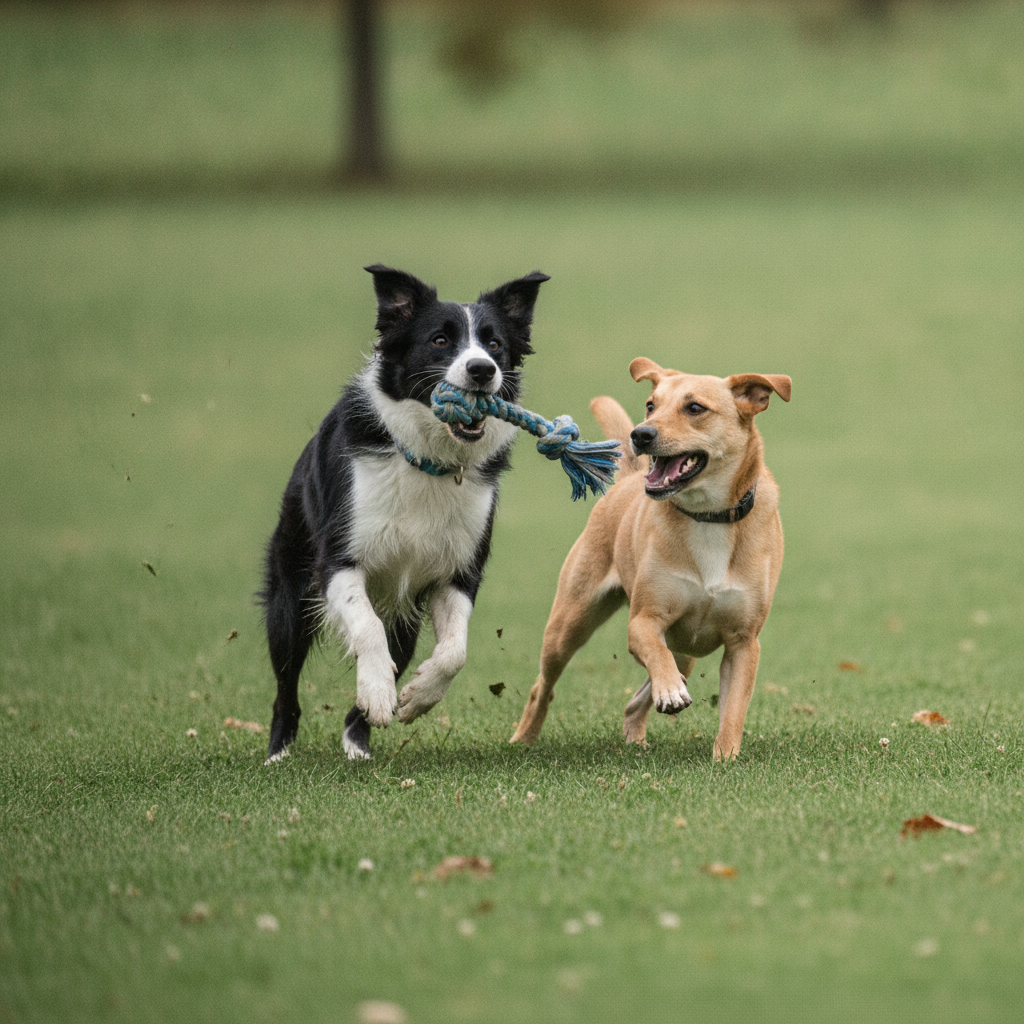
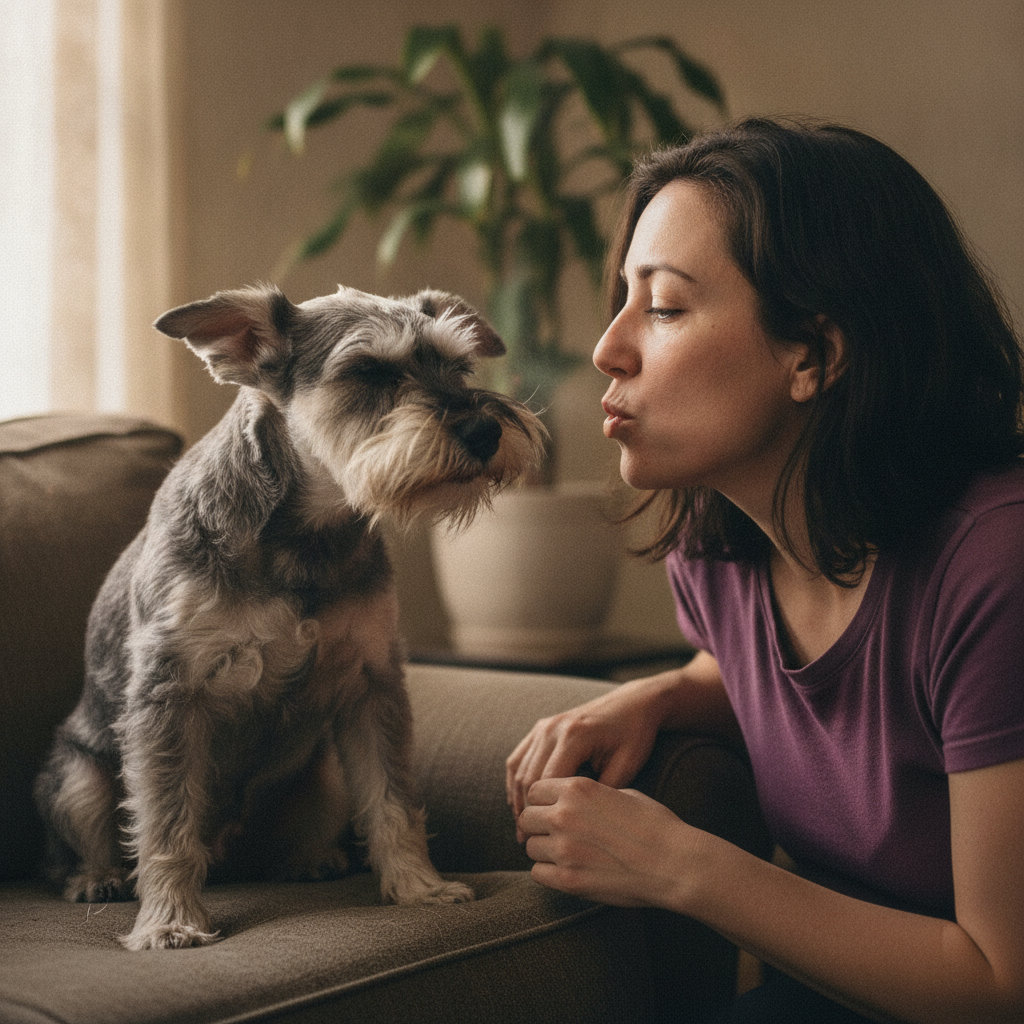
Your dog will happily hang their entire head out of a moving car window at 40 miles an hour. Blow gently on their face from six inches away and they will flinch, blink, turn away, or leave the room entirely.
That contradiction is the whole story, and it is not about the air.
The difference is consent, not wind
A dog with their head out the window chose that. They can pull back whenever they want. Nothing is leaning over them. The air is not aimed.
When you blow on your dog, four things happen at once, and none of them are in their control:
- A human face moves in close, well inside the space most dogs prefer to keep clear.
- Something is directed at their eyes and nose with no warning.
- The sensation is genuinely unpleasant, on the order of the puff-of-air test at the eye doctor.
- It arrives from the person who is supposed to be predictable.
“Dogs forgive a lot from us, but they keep a running tab on whether we are predictable,” says Dr. Nina Kohl. “Blowing in a dog’s face is a small thing that lands on the wrong side of that ledger, because it is startling, it is aimed, and it comes from a face that is already too close.”
That combination is why a mild-mannered dog can go from relaxed to stiff in half a second, and why the worst-case version of this ends with a snap. A snap is not a personality flaw. It is a dog trying to make distance after their quieter requests were ignored.
What the puff might mean in dog
We cannot ask them. But we can look at what a face full of air resembles in a dog’s world.
It looks like a challenge. Watch two dogs who do not like each other and you will see huffing, chuffing, and hard exhales at close range. Directed breath at close range is not neutral in dog conversation.
It may already be attached to a bad memory. Air on the face and body is what happens at the groomer’s dryer and, for some dogs, in the vet exam room. If your dog has filed “air blast” alongside “the place where things get done to me,” your living-room joke is pulling that file.
It messes with the sense they rely on most. A strong current of air across the nostrils dries the nose out, and a dry nose is a worse nose. For an animal that navigates the world by smell, briefly degrading their primary sense is disorienting in a way that is easy for us to underestimate.
Some dogs are simply more sensitive. Air moving over the fur registers more strongly for some dogs than others. And a dog who is relaxed, drowsy, or actively trying to sleep is going to find the whole thing more irritating than one who is up and engaged.
Learn the signals that come before the snap
The reason this is worth taking seriously is that dogs rarely go straight to teeth. They tell you first, quietly, and most people miss it because the signals are small.
Watch for:
- Turning the head aside, or backing off
- Hackles up along the spine
- A tucked tail
- Ears going flat
- A posture that suddenly goes rigid
- Vocalizing: a whine, or a bark you were not expecting
- Eyes sliding away from yours, or a hard stare over a very still body
Any one of those is a request for space. If the request gets ignored often enough, some dogs stop bothering to make it and go straight to the loud version. That is how a “he bit with no warning” story gets written, and it almost never has no warning in it.
This is also why face-level contact is the interaction to be most careful with, particularly with kids. Bite-prevention educators keep landing on the same picture: bites to children are disproportionately to the face, and they disproportionately happen during close, face-to-face interactions with a dog the child knows well. Blowing on the dog is exactly that geometry, taught as a game.
What to do instead
Give them the space back. The complete fix here is one sentence: do not blow in your dog’s face. There is no version of it you need.
Fix the dryer, if that is the real issue. If your dog dreads the groomer’s blow dryer, that is a training problem with a straightforward answer: pair the airflow with something excellent, at a distance your dog can handle, and close the gap over several short sessions. The dryer should predict chicken, not the end of the world.
Play the games your dog actually likes. Most dogs would trade every puff of air for thirty seconds of a tug toy, a scatter of treats in the grass to hunt down, a game of find-the-hand, or a decent chase. If the goal was to interact with your dog and get a reaction, those get you a much better one.
Use calm gestures, verbal praise, and food. Sudden, aimed, unpredictable actions are the category to avoid. Slow, announced, opt-in ones are the category to build on.
What newer research adds
The direction of travel in behavior science over the last decade has been away from “what can my dog tolerate” and toward choice and control as the thing that determines whether an interaction is enjoyable or merely survivable. The best-studied version of this is in cats, where researchers found that giving the animal the ability to start and end the interaction, and limiting where and how much you touch, measurably reduced aggression and stress signals. The principle transfers cleanly.
Applied to your dog, it looks like this: the interaction your dog can walk away from is the one they will come back for. The one they cannot is the one they start avoiding you for. A puff of air is a tiny thing, and that is exactly why it is worth getting right. Your dog is not keeping score on the big gestures. They are keeping score on whether you are safe to be near.
The bottom line
Blowing on your dog is not cruel, and you have not ruined anything. It is just a game where every single point goes to you and none go to them, and your dog has been telling you so with their whole body.
Put that one down. There are better games, and your dog already knows what they are.
References
- American Veterinary Medical Association. “Dog Bite Prevention.” avma.org
- Haywood, Camilla, et al. “Providing Humans With Practical, Best Practice Handling Guidelines During Human-Cat Interactions Increases Cats’ Affiliative Behaviour and Reduces Aggression and Signs of Conflict.” Frontiers in Veterinary Science, vol. 8, July 23, 2021. doi.org/10.3389/fvets.2021.714143
- American Society for the Prevention of Cruelty to Animals. “Canine Body Language.” aspca.org