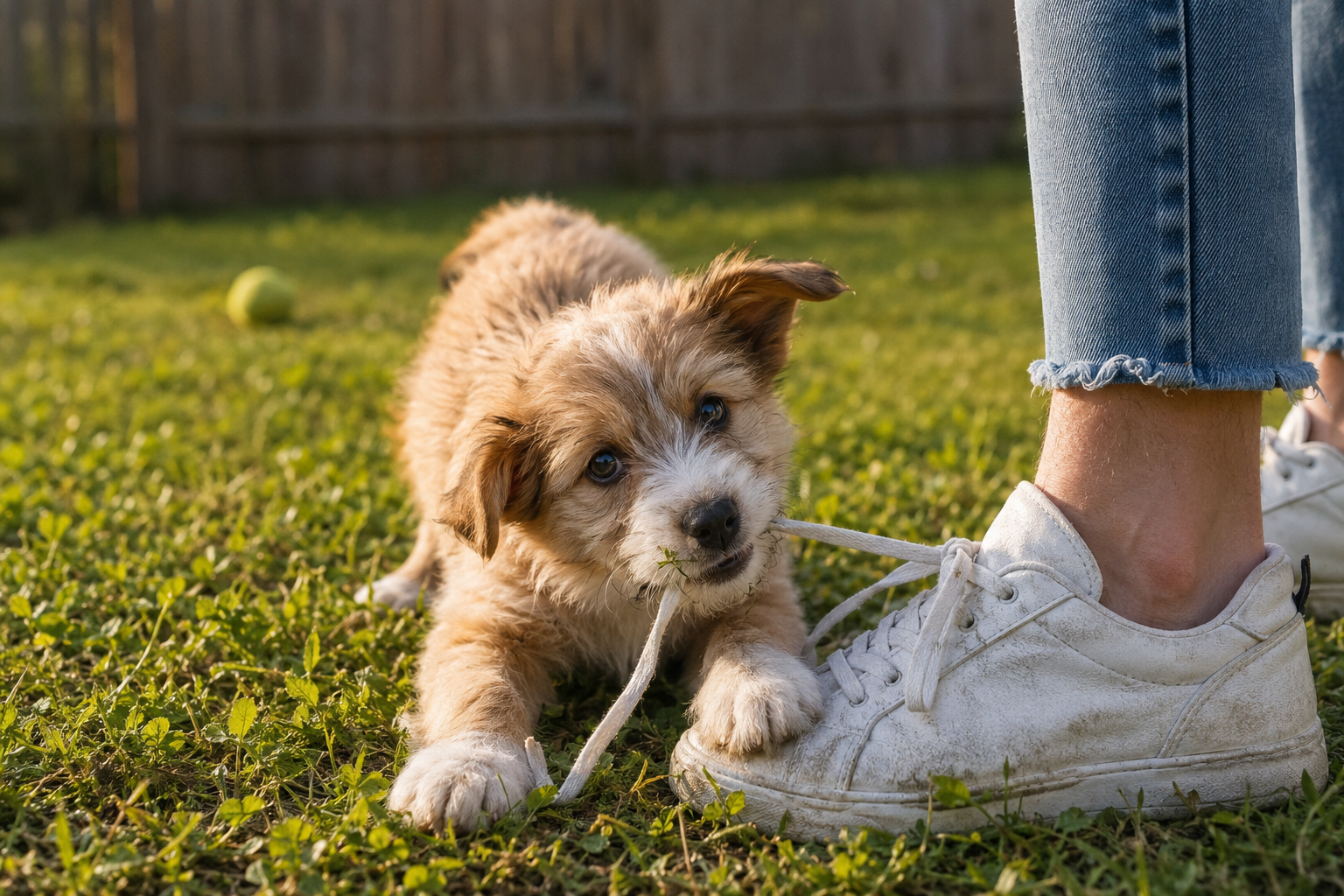
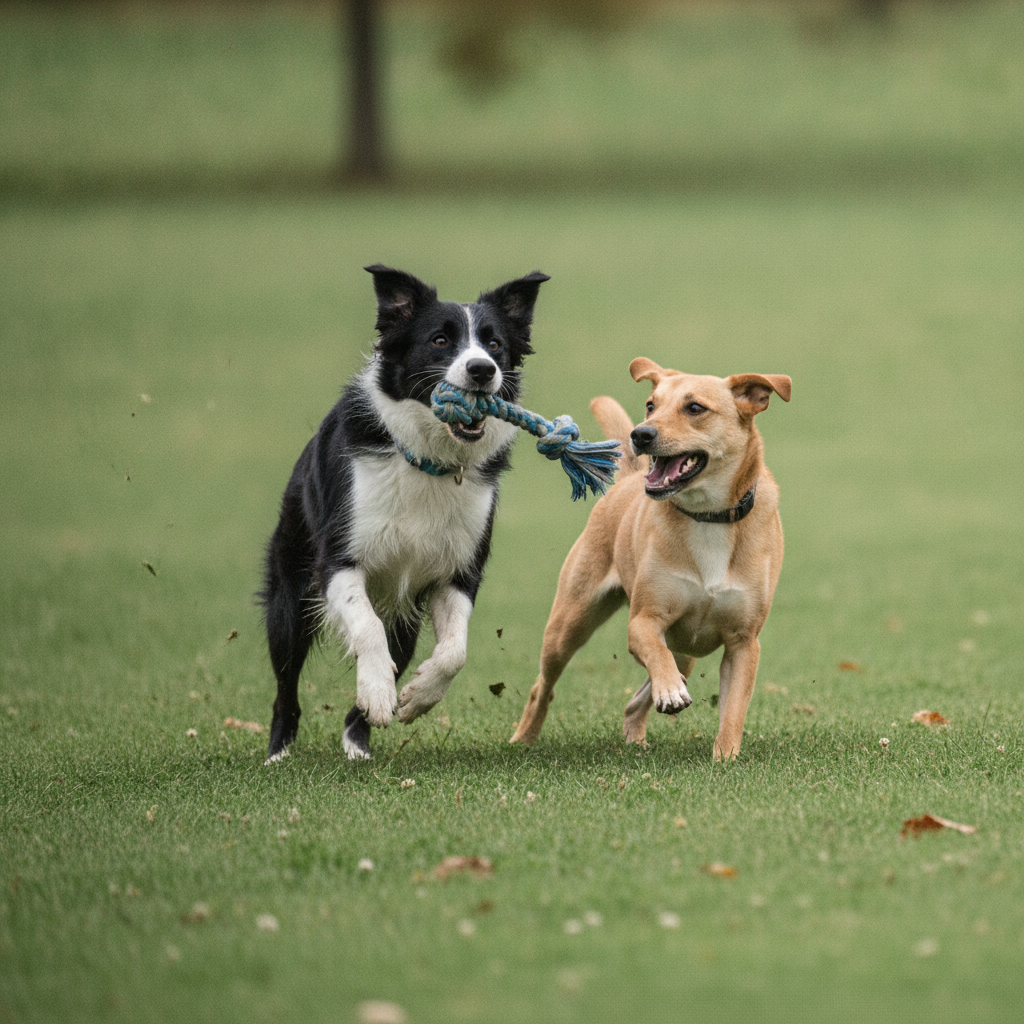
Bring a dog into a house with other dogs and, within about four minutes, one of them will be carrying something that does not belong to them. They will ignore the identical toy on the floor beside them to do it. Every dog owner has watched this and wondered what kind of moral failing they are witnessing.
Almost none. Taking another dog’s toy is ordinary dog behavior, and on its own it tells you nothing. What tells you something is the two seconds after the grab, when the dog who was robbed decides how to respond. That moment is the whole diagnostic, and it is the part people are worst at reading.
Watch the response, not the theft
Here is the sequence to train your eye on. A toy gets taken. Now:
A healthy exchange looks loose. The dog who lost the toy stays soft, maybe bows, maybe gives chase, maybe shrugs and grabs something else. Bodies stay wiggly. Nobody freezes. Nobody growls. And crucially, the dogs re-engage on their own, without you having to negotiate a peace.
A problem looks still. The freeze is the single most important thing to spot, and it is the one most people miss because it is quiet. A dog who stops moving, hardens their stare, hovers over the remaining toys, or curls a lip is not sulking. That is a warning, delivered properly, and it deserves to be respected before it escalates. Repeated one-way pressure, one dog picking on the other over and over without reciprocity, is the other red flag.
The rule of thumb behaviorists use is reciprocity. In good play, roles trade. The thief becomes the chased, the chased becomes the thief, and it keeps flipping. When it stops flipping, and one dog is always taking and never giving, the interaction has changed character even if nothing has gone visibly wrong yet.
If you see the freeze, the stare, or the lip, separate the dogs calmly and take the toy out of the equation. Not as punishment. Just remove the thing everyone is arguing about.
So why do they want the other dog’s toy at all?
There are a handful of real reasons, and they are not equally benign.
Novelty. This is the big one. A toy your dog has never seen, that smells like a strange dog, a strange house, and a strange person, is far more interesting than the third-favorite rope in your own basket. It carries information as much as it carries squeak.
It is an invitation. Plenty of thefts are social openers. It is the canine version of a kid grabbing a sibling’s toy and running: the point is not the toy, it is the reaction. Younger dogs do this more, and so do high-energy working and herding types, which is less about breed personality than about having more energy than manners.
Collecting. Some dogs simply gather. They will drag every toy, sock, and slipper into one pile in one location and lie next to it, without guarding any of it. It is hoarding without hostility, and it is harmless.
Guarding. This is where collecting turns into something else. The dog is not just accumulating, they are controlling access, and they will say so if you get close. Guarding can extend past toys to food, resting spots, doorways, and people.
Status pressure. Some grabs are a statement rather than a game. The body language is the giveaway: an invitation is loose and bouncy, a statement is stiff, deliberate, and directed at the other dog rather than at the toy.
“Owners tend to focus on the dog who took the toy, and the dog who took the toy is almost never the story,” says Dr. Amara Solis. “The dog worth watching is the one standing very still six feet away.”
People are bad at spotting guarding
This is the part that should make everyone slow down. Resource guarding is common, and owners systematically miss it.
Survey work across more than a thousand dogs puts guarding behavior toward people or other animals at roughly one in five. Shelter research found a comparable rate, around 15 percent of dogs evaluated. Toys, bones, and other high-value objects are the most commonly guarded items, ahead of food.
The uncomfortable finding is this: in a follow-up of dogs adopted out of shelters, 82 to 85 percent of adopters said their dog was not possessive about food, toys, or space, and that was true whether or not the dog had actually been classified as a resource guarder. Owners were not distinguishing between the two groups at all. People are not reading the freeze.
None of that means a dog who guards is a dangerous dog or an unadoptable one. The same research found guarding dogs did fine in homes. It means the behavior is easy to live with once you see it, and easy to walk into a fight over if you do not.
The rules that prevent most of it
Toy conflict is mostly a management problem, and management is cheap.
Leave toys at home when you go to the dog park. The whole purpose of the park is loose social play among dogs who do not know each other. Adding a possession that some dog somewhere is going to feel strongly about is asking for a scrap in the one place you have the least control.
No toys at first introductions. When two dogs meet for the first time, do it on neutral ground, a park rather than either dog’s living room, and do not hand them something to argue over. A toy at a first meeting is a test you did not need to set.
Match the supply to the crowd. More toys than dogs, spread out rather than piled, lowers the odds that any single object becomes the object.
Feed and chew separately. High-value items, bones, long-lasting chews, food puzzles, should be enjoyed behind a gate or in separate rooms. This is not a punishment. It is removing the argument.
Do not confiscate as a correction. Snatching a toy out of a dog’s mouth to teach a lesson teaches a different lesson: that human hands take things. That is how a mild guarder becomes a serious one. Trade for something better instead.
When to get help
Get a professional involved, a veterinary behaviorist or a credentialed trainer, if you see any of these: a dog freezing over objects on a regular basis, growling that escalates instead of resolving, a dog who cannot be near another dog’s chew without stiffening, one dog systematically targeting another, or any bite, however inhibited. Guarding responds well to structured work, and it responds badly to being waited out.
What newer research adds
The most useful recent finding is not about dogs at all, it is about us. The shelter follow-up work makes clear that standardized behavior tests and owner reports both do a poor job of predicting which dogs will guard in a real home, and that adopters largely did not recognize guarding when it was happening in front of them.
That is oddly reassuring. It means most toy stealing really is nothing, and most dogs sort it out. It also means the skill worth building is not a rule about toys. It is the ability to notice a dog going quiet and still, and to trust that signal, because your instinct will otherwise tell you everything is fine right up until it is not.
The dogs, for their part, are usually right on the edge of fine. Loose bodies, trading roles, a stolen octopus, and no hard feelings. As long as the teeth stay on the toy, let them have it.
References
- Jacobs, J. A., et al. “Factors Associated with Canine Resource Guarding Behaviour in the Presence of People: A Cross-Sectional Survey of Dog Owners.” Preventive Veterinary Medicine, 2018. https://pubmed.ncbi.nlm.nih.gov/29275939/
- Mohan-Gibbons, H., et al. “Abilities of Canine Shelter Behavioral Evaluations and Owner Surrender Profiles to Predict Resource Guarding in Adoptive Homes.” Animals, 2020. https://pmc.ncbi.nlm.nih.gov/articles/PMC7552731/
- Marder, A. R., et al. “Characteristics and Adoption Success of Shelter Dogs Assessed as Resource Guarders.” Animals, 2019. https://pmc.ncbi.nlm.nih.gov/articles/PMC6912206/
- American College of Veterinary Behaviorists. “Find a Board-Certified Veterinary Behaviorist.” https://www.dacvb.org/