


The Daily Walk Is Optional. Your Dog's Enrichment Isn't.
If you feel guilty every time you skip the walk, you've confused the delivery method with the need. Your dog needs stimulation and connection, and a neighborhood loop is only one way to give it, sometimes the worst one.

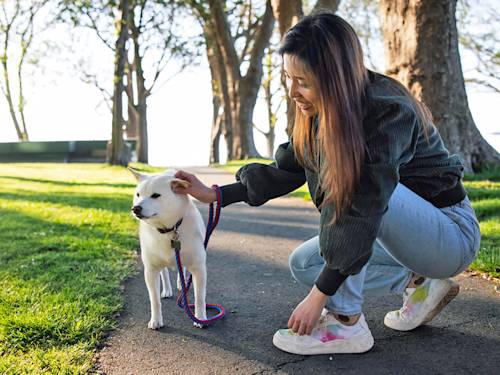
Somewhere along the way, “walk the dog” became the single measure of whether you’re a good dog parent. It’s on every dog-sitting checklist, it drives plots in movies and novels, and it sits in the back of your mind as a daily debt you’re either paying or dodging. So people confess it to their trainers like a sin: I haven’t walked him in days, I feel terrible.
Here’s the reframe that lets everyone off the hook, dog included. Your dog does not have a biological need for a neighborhood walk. Your dog has a need for physical exercise, mental stimulation, and connection with you. The walk is one way to deliver those things. It’s a common way, and for a dog without a yard it’s often the only way they get a bathroom break. But it is a method, not the goal, and for some dogs it’s a bad method that quietly makes life worse.
Why the walk gets overweighted
Two forces stack up. First, the cultural script that a “real” dog owner walks their dog every day, so skipping it feels like failing a test. Second, the modern instinct to optimize everything, to treat inputs and outputs like a machine: put in the daily walk, get out a happy dog. Relationships don’t run on that math, and a dog least of all. They aren’t dishes to be washed off a list; they’re family, and family doesn’t reduce to a checklist.
The pressure backfires. When a walk becomes an obligation you resent, both ends of the leash feel it. A dragged-out, phone-in-hand, get-it-over-with walk gives your dog very little, and it teaches you to associate your dog with a chore. That’s the opposite of the point.
Signs the walk isn’t the answer for your dog
Not every dog is served by daily strolls. Watch for these:
The walk stresses your dog out. If your dog came to you nervous around other dogs or spooked by traffic, every trip past the front door can be a gauntlet of triggers. Measuring your success in blocks covered can actively harm a fearful dog, pushing them into situations they aren’t ready for and slowing the training that would help. A stressful, trigger-packed walk is not a good walk just because it happened.
You’re both bored. Dogs, like us, are wired to engage where there’s something to learn. The same route at the same time every day stops offering much of either. Boredom is a reason to change the activity, not to grit your teeth through it.
You dread it. If the regimen has become a weight you struggle under, that’s information. Forcing joyless activity out of duty rarely produces the connection it’s supposed to.
When an owner tells me the walk has become a battle, I stop asking how to fix the walk and start asking what their dog actually needs that day, movement, a puzzle, or just twenty unhurried minutes of the two of them doing something together. Nine times out of ten the guilt lifts the moment they realize a sniff-heavy backyard scavenger hunt counts, and a tense march around the block never really did.
A better menu than the block loop
Enrichment takes many shapes. Reach for whatever fits your dog and your day:
Interactive play. Dogs are unusual in that they keep playing well into adulthood, and games strengthen the bond while working the body and brain. Tug builds impulse control and cooperation. Fetch, with a warm-up and cool-down to protect muscles, is real cardio. Hide-and-seek, where your dog waits and then finds you, satisfies both their search drive and their social pull toward you.
Passive socialization. Most pets spend their lives indoors, which is thin gruel for a curious animal. You can feed the need for novelty without a neighborhood walk: bring your dog to a patio that welcomes them, drive to a new park and just watch the world go by, or wander a pet-friendly store. New sights and smells do the mental work.
DIY nosework. For most dogs the best part of any walk is the sniffing, and you can bottle that at home. Have your dog stay or be held out of sight, hide treats or part of their meal around a room, and release them to hunt. Make it harder as they get good.
Trick training. Teaching new behaviors is serious mental exercise. Clicker (reward-marker) training is especially good for building complex tricks, and if you want a goal, organizations like the AKC offer trick titles you can earn by submitting video from your living room.
Obstacle courses and conditioning. Chairs and couch cushions make an indoor agility course; a park’s natural features make an outdoor one. Gentle stretching and strengthening, think puppy push-ups, keep an active dog sound, and you can stack them onto your own workout: hold a plank while your dog holds a down beside you, or run their loose-leash drill while you do walking lunges.
The through-line
There’s real payoff in engaged time together, and it’s not just sentiment. Time with you boosts oxytocin in both of you, and domestic dogs are the rare animal that often prefers interacting with humans over their own kind, they can even learn new things just by watching us. That preference is the whole reason the “did I walk the dog” question is the wrong one. Your dog isn’t keeping score of blocks. They’re keeping score of you.
What newer research adds
Enrichment has moved from a nice extra to a measured welfare priority. Work on canine cognition keeps showing that mental challenge and novelty aren’t luxuries; they’re what an intelligent, social species needs to stay well, and that a dog’s brain, like ours, ages better with regular use. Scent work in particular has drawn attention for shifting dogs toward a more optimistic frame of mind, which is a fancy way of saying a dog who gets to use their nose seems to feel better about the world. None of that requires a longer walk. It requires a more interesting one, or none at all, swapped for a game that lights the dog up. The obligation you can drop. The engagement you can’t.
Dr. Kohl is a board-certified veterinary dentist with a particular interest in preventive oral care. She reviews all dental health content at The Pet Times and contributes practical guides on home dental routines, professional cleaning, and oral disease prevention.
Meet our experts ↗Keep reading
 TrainingYour Dog Isn't Wrecking the Yard. They're Doing a Job. Name It.Dr. Mara Chen · 8 min
 TrainingSending Your Dog to Its Crate as Punishment Ruins the One Room That's TheirsDr. Amara Solis · 7 min
 TrainingStop Rushing the Sniffs. Your Dog's Nose Is Doing Real Work.Jordan Ellis · 6 min
 TrainingMost Dog-Park Advice Is Half True. These Are the Signals That Actually MatterDr. Nina Kohl · 10 min
 TrainingYour Dog Doesn't Know It's 5 O'Clock. It Knows You.Dr. Mara Chen · 6 min
 TrainingYour Dog Isn't Ignoring the TV. They're Seeing a Different Show.Dr. Ravi Mehta · 8 min