Most Pit Bull advocacy makes the same move. It leads with data, cites a bite-statistics rebuttal, and asks you to be reasonable about a dog you are already afraid of.
Yves Mathieu East does not bother. His case is not built on statistics, though the statistics are on his side. It is built on the observation that being sorted into a category you did not choose, and then having people decide who you are before you open your mouth, is not a canine problem. It is a human one, and he can describe it from the inside.
That is the engine of his advocacy, and it is why it lands where the pamphlets do not.
The math on the couch
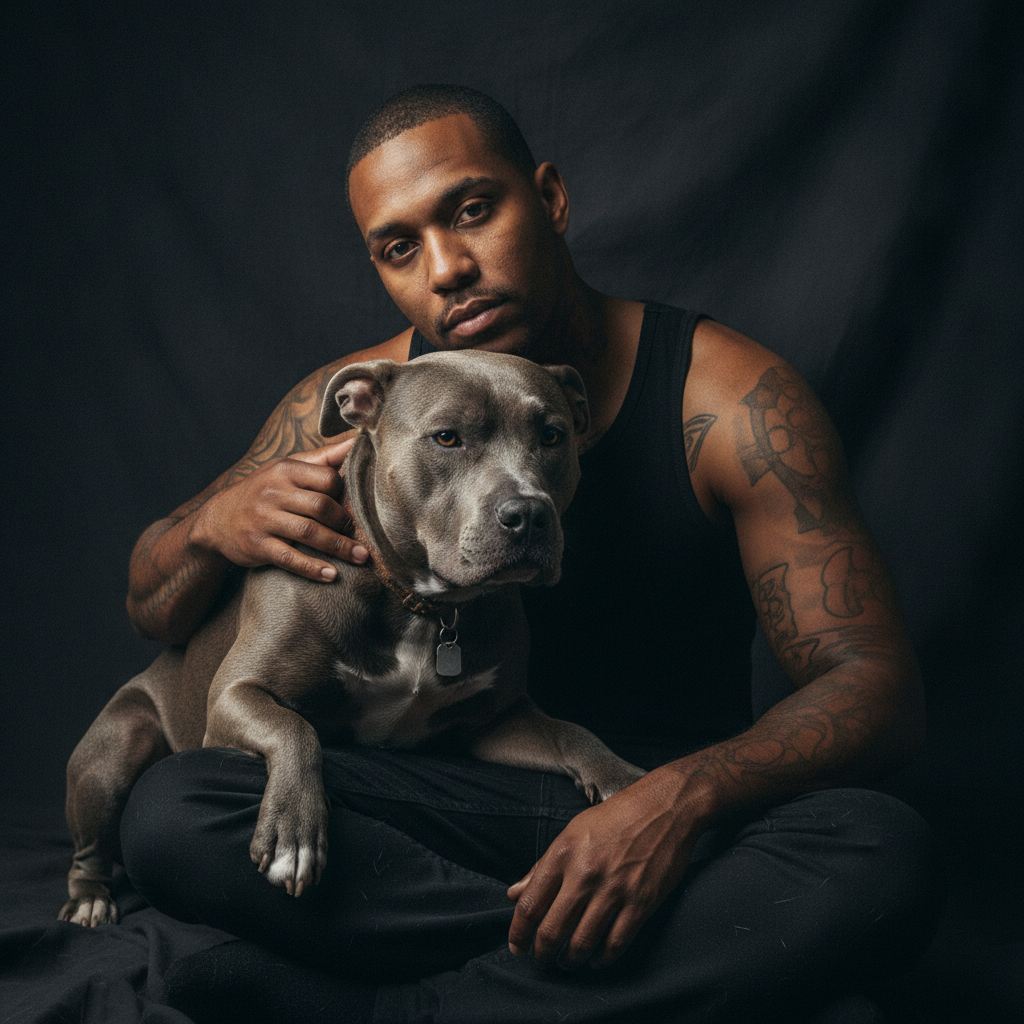
The New York artist, model, and musician has been working in animal rescue for roughly 13 years, all of it focused on the same kind of dog. He started fostering Pit Bulls in 2015, after losing his own Pittie, Princess, and began pulling dogs through the New York City Animal Care Centers. By late 2022 he was on his 38th foster.
That number deserves a beat, because fostering is not a gesture. Each of those dogs arrived from a shelter carrying whatever the shelter did to them, moved into a working artist’s apartment, ate there, slept there, learned that a person could be predictable there, and then left for someone else’s home. Thirty-eight times.
What the practice has grown into is a kind of one-man logistics operation. He travels to shelters, near and far, to work with Pit Bull-type dogs and get them adopted out, and he uses his platform as the distribution channel: “Pit Bull Carpool” on his Instagram is exactly what it sounds like, a guy in a car with a large-headed dog riding shotgun, doing the least dramatic thing imaginable, which is the entire point.
His stated reason for fostering, when he explains what makes it work, has nothing to do with training theory:
“It’s okay to be nervous, the dogs are nervous too, but you having even some degree of confidence in what the outcome is going to be will help you both,” he told The Queer Review in April 2026.
Why the dogs are in the shelter in the first place
Ask him why shelters fill up with these dogs specifically and he does not reach for a study. He reaches for an analogy about who else gets funneled into systems on the basis of how they look, and lets it sit there.
The uncomfortable part is that the shelter data does not contradict him. Pit Bull-type dogs are not a breed. The label is a bucket, and a leaky one: it gets stretched across the American Pit Bull Terrier, the Staffordshire Bull Terrier, the American Staffordshire Terrier, the American Bully, and an enormous population of mixed-breed dogs whose only qualification is a blocky head. Research on shelter breed labeling has repeatedly found that visual identification is unreliable, including among staff who do it professionally. A dog gets labeled, the label follows the dog, and the label is what a landlord, an insurer, and an adopter respond to.
And the label costs the dog time. Dogs identified as Pit Bull types sit in shelters substantially longer than lookalikes given other breed labels, which is the finding that should end the argument: the dog did not change, the word on the kennel card did.
Meanwhile, the behavioral premise underneath the fear keeps eroding. The largest genetic analysis of dog behavior to date, published in Science in 2022, found that a dog’s breed explains under a tenth of the variation in how individual dogs behave. Breed is a weak predictor of the dog in front of you. The kennel card is not a personality test.
What he actually wishes people knew
Strip out the politics and what is left is a man who finds these dogs funny.
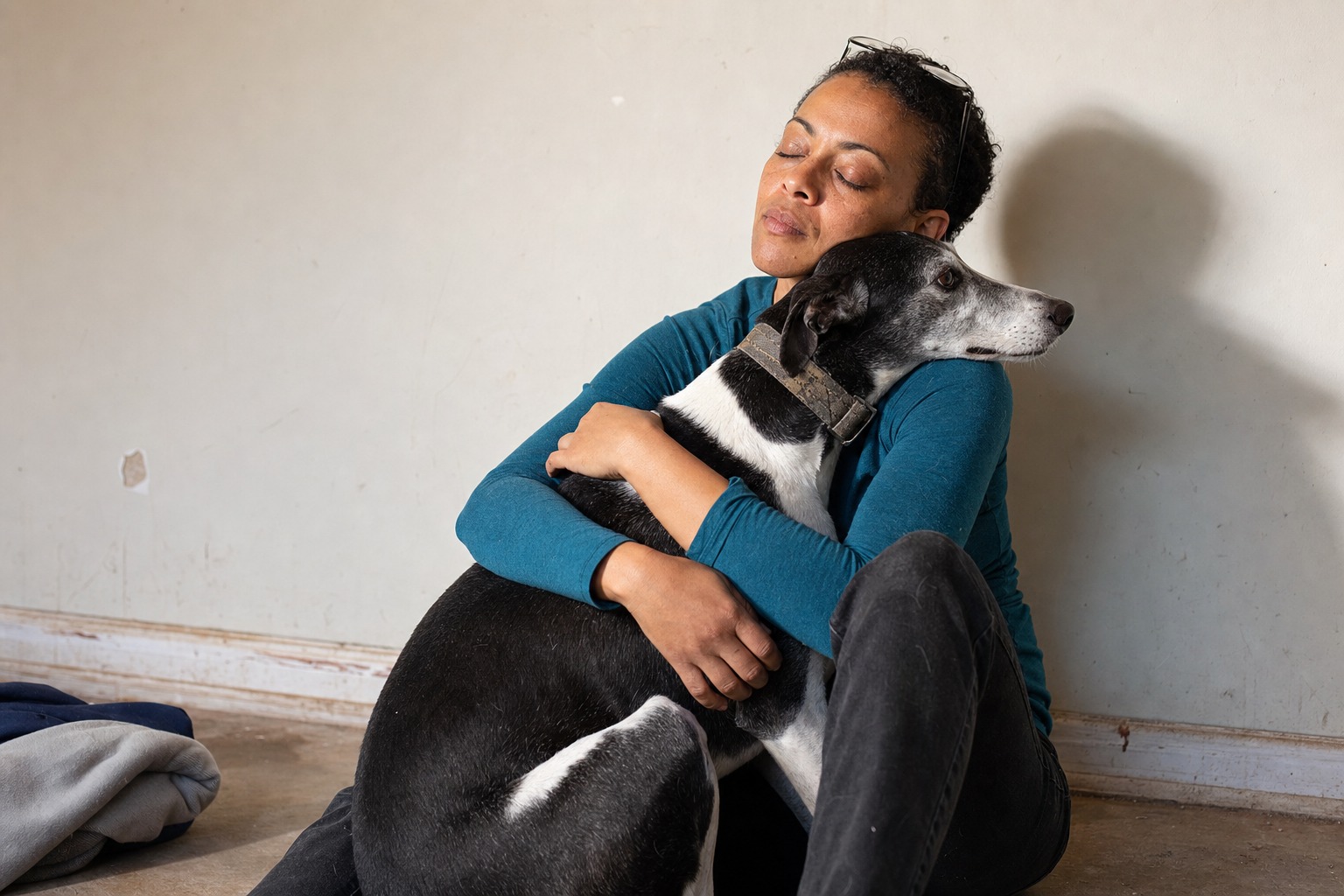
He talks about Pit Bulls as silent comedians, a breed whose entire interior life plays across their face in real time, so that you always know precisely what they think of you and your decisions. He talks about the loyalty as a kind of permanence, the sense that once you are in, you are in forever. And he talks about napping with a foster on day one as the moment he knows the dog is going to be okay, because sleep is the most defenseless thing an animal can do near you, and a dog who has been failed by people does not do it lightly.
That is the observation that survives all the discourse. Trust, in a dog with a history, does not look like obedience. It looks like a nap.
What fostering a Pit Bull actually asks of you
If the profile is doing its job, this is the section that matters, because the shortage is not admiration. It is couches. Here is what the work actually requires, from people who do it constantly:
Two weeks of nothing. The consensus among rescue groups is to expect roughly three days of shutdown, three weeks of settling, and three months before you meet the actual dog. Most foster failures happen in week one, when the dog is still a stranger to themselves.
A door you can close. A single room, a crate, and a baby gate solve most of the first month. Decompression is a physical arrangement, not a mood.
A realistic read on your building. Breed-restricted leases and insurance policies are the reason many of these dogs are surrendered in the first place. Check yours before the dog is in your car, not after.
A willingness to be looked at. This is the part nobody warns you about. You will be the person on the sidewalk with the dog people cross the street to avoid, and how you carry that changes how your dog reads the street. Confidence is a training tool.
A finish line, and a plan to hand it over. The organization covers medical care and adoption logistics. Your job is to keep a dog alive, socialized, and sleeping in a home instead of a run, and then to let them go, which is the hardest and most useful thing about the entire arrangement.
What he’s doing now
The advocacy runs alongside a career that has gotten conspicuously loud. He has modeled for Calvin Klein, Burberry, Kenneth Cole, Thom Browne, and Willy Chavarria; he officiated a wedding on the second season of Michelle Buteau’s Netflix series Survival of the Thickest; he appeared on the cover of The New Yorker’s 100th anniversary edition alongside a group of New York artists and designers. His singles “Trap Disco” and “Born in the 90’s” arrived with music videos, one of them shot at a refugee housing center in Italy, and an album is slated for later in 2026.
He remains, at protests and online, an unrelenting presence on trans rights and on the deaths that never make the news, memorializing people he mostly never met on the grounds that being forgotten twice is the real injury.
Asked how he describes his job when someone asks casually, he has a ready answer: an artist and a glorified volunteer.
Which brings the whole thing back around. The fashion campaigns and the album are the platform. What the platform is for is a dog in a car, going nowhere in particular, looking utterly unremarkable, which is the most persuasive argument anyone has ever made on this subject.
References
- The Queer Review. Exclusive interview: artist and activist Yves Mathieu East (April 2026).
- Morrill, K., et al. (2022). Ancestry-inclusive dog genomics challenges popular breed stereotypes. Science, 376(6592).
- Gunter, L. M., Barber, R. T., & Wynne, C. D. L. (2016). What’s in a name? Effect of breed perceptions and labeling on attractiveness, adoptions and length of stay for pit-bull-type dogs. PLOS One, 11(3), e0146857.
- Olson, K. R., et al. (2015). Inconsistent identification of pit bull-type dogs by shelter staff. The Veterinary Journal, 206(2), 197-202.
- ASPCA. Position statement on breed-specific legislation.
- NYC Animal Care Centers. Foster program.