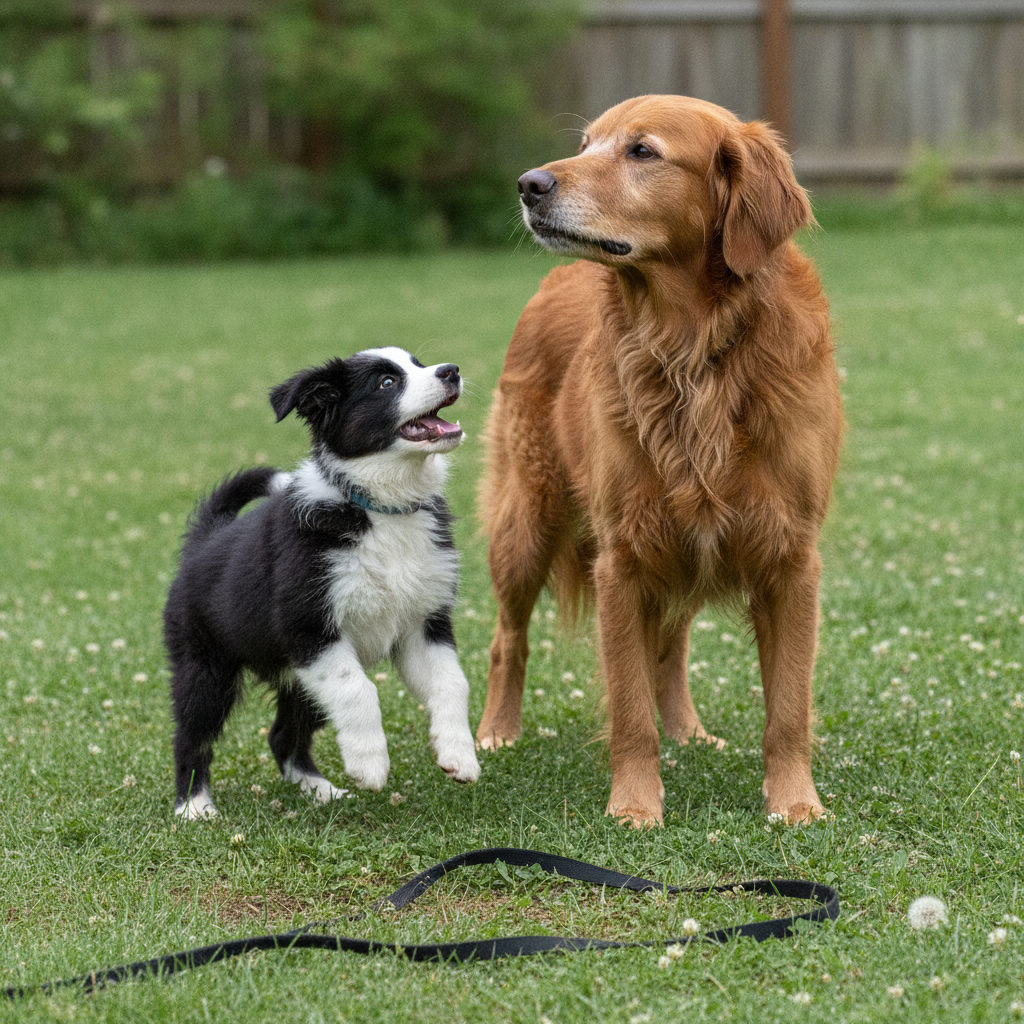
The internet has convinced you that the danger in this situation is the big dog. That there is a hierarchy to be respected, an alpha to be appeased, and that your job is to introduce a puppy carefully so your dominant dog accepts them into the pack.
Almost none of that is real, and it points you at the wrong animal.
Dominance theory, as applied to pet dogs, has been discarded by behavior science for decades. Dogs do not run a linear hierarchy in your living room, they do not think they are superior to you, and the dog you are calling “dominant” is usually just older, more established, and clearer about what they want. That is not a rank. That is seniority.
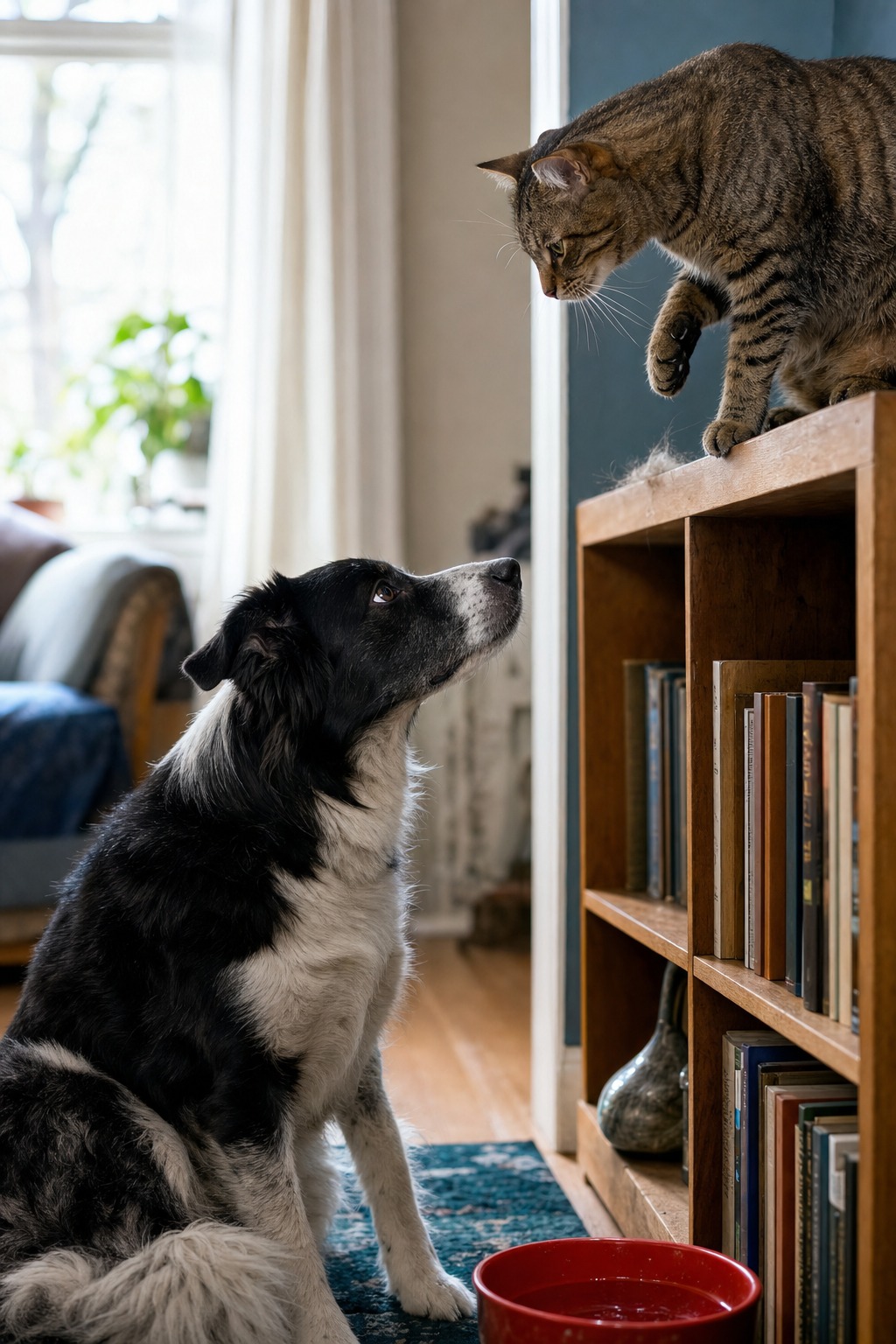
Here is what is actually true, and what changes everything about how you run this: the older dog will tell the puppy to back off, and the puppy will not understand. Adult dogs communicate with an entire vocabulary of subtle refusals: a head turn, a freeze, a lip lift, a hard stare, a walk-away. A puppy has not learned to read any of it. So they keep coming. And keep coming. And the adult dog escalates, gets punished by you for escalating, learns that warnings do not work, and eventually skips the warnings.
That is the actual failure mode. Not a dominant dog attacking a puppy. A patient dog running out of ways to say no.
Everything below is built to prevent that.
Before the puppy arrives: strip the house
Do this in the week before, not the day of.
Remove everything contestable. Every bone, every chew, every high-value toy, every food bowl. All of it goes into a cupboard. You can reintroduce items later, one at a time, under supervision. Guarding fights are the most common serious conflicts in multi-dog homes, and the easiest to simply prevent by removing the object.
Build the adult dog an escape. A room, a crate, or a gated corner the puppy can never get into. This is the single most important piece of furniture in the entire project. Your adult dog needs a place where the answer to the puppy is a physical door, not their own teeth.
Build the puppy their own area too, with their own bed, their own bowl, and their own toys, so there is nothing to argue about.
Water bowls can stay out. Water is almost never the fight.
The meeting: neutral ground, moving bodies, loose leashes
Location decides this. Do not introduce a puppy to your resident dog in your living room, and do not do it in your backyard. Your yard is your dog’s yard, and they know it. Find somewhere neither dog owns: a friend’s fenced yard, a quiet enclosed space, anywhere new to the adult dog.
Bring a second person. One handler per dog. Nobody should be managing two leashes and a phone camera.
Walk before you meet. This is the step most people skip and the one that does most of the work. Take both dogs on a walk together, at whatever distance keeps both of them relaxed, moving in the same direction. Do not let them approach each other. Just walk, side by side, until each dog is bored of the other’s existence.
Parallel movement gives dogs a shared activity with no confrontation in it. Face-to-face greetings are the most socially loaded thing two strange dogs can do, and doing it cold, on tight leashes, in a small space, is how bad first impressions get made.
Then let them greet, on dragging leashes. In the enclosed neutral space, leave the leashes on but drop them. A taut leash telegraphs your anxiety straight down the line and physically prevents the polite curving approach dogs naturally use. Let them close the distance themselves.
No high-value items in the space. No bones, no toys, no food bowls.
“The tight leash is the thing that turns a fine greeting into a bad one,” says Dr. Lena Park. “You are worried, so you shorten the lead, and now your dog cannot move away, cannot curve, cannot do any of the things that say I am not a threat. You have taken away their manners and then blamed them for not having any.”
Reading it in real time
Going well: play bows, loose bodies, tails wagging low and sweepy, open relaxed mouths, the puppy rolling onto their back, and, most importantly, give and take. Healthy play is two dogs swapping roles. Chaser becomes chased. On top becomes underneath. If one dog is doing all of one thing, that is not play, that is pressure.
Going wrong: teeth showing, raised hackles (the “mohawk” ridge along the back), a hard motionless stare, a stiff body, sustained loud barking. From the puppy: a tucked tail, trying to get between your legs, freezing, or clinging.
Watch the adult dog’s face specifically, not the puppy’s noise. The puppy will be loud. That is not the signal.
End it before it degrades. Several short outdoor sessions over several days are far better than one marathon. Keep visits outside and neutral until they are consistently uneventful, then move indoors.
If it goes badly
Separate immediately and without drama.
If you need to interrupt a scuffle, the safe tools are a physical barrier (a board, a chair, a large piece of cardboard), a loud sudden noise, or water. Never reach between two dogs with your hands. Never grab a collar in a fight, which is where most owner bites happen. If two adults are available and the fight is serious, the safest method is to grab each dog by the back legs, high up where the leg meets the body, lift, and walk backward. Then leash them and put them out of sight of each other before you do anything else.
Any puncture, even a small one, needs a vet.
And then be honest about what happened. One tense moment on day one is not a verdict. A pattern of stiffness, guarding, and escalation is, and it means you call a professional now rather than in three months.
The six weeks after the meeting (this is the actual work)
The introduction gets all the attention. It is the easy part. The relationship is built, or broken, in the weeks that follow, and it is built by management.
Gates everywhere. The puppy should not have unrestricted access to the adult dog. Not because the adult is dangerous, but because a puppy with unlimited access will pester an adult into resentment. Access is a privilege that expands slowly.
Feed in separate rooms, always. Not on opposite sides of the kitchen. Separate rooms, or opposite sides of a closed gate. Many professional trainers never feed two dogs in the same space, permanently, and they are right. It costs you nothing and it removes the single most likely flashpoint.
Enforce the puppy’s “no.” When the adult dog disengages, walks away, or gives a warning, your job is to physically stop the puppy from following up. Do not wait for the adult to enforce it themselves. That is the whole ballgame. If you consistently back the adult dog’s boundaries, they never have to escalate, and they never learn that this puppy ignores them.
Do not punish the growl. Ever. A growl is information, and it is a gift. Punish it and you get a dog who has learned that warnings bring trouble, so they stop warning.
Separate, uninterrupted one-on-one time for each dog. A walk alone. A training session alone. Ten minutes of undivided attention. Your resident dog’s life just got substantially worse without their consent, and this is the compensation.
Supervise every play session, and interrupt. Break up play every few minutes with a brief pause, even when it is going well. It teaches both dogs that arousal comes back down, and it keeps play from tipping over the edge, which it does gradually and then suddenly.
Never leave them alone together, for weeks. Crate, gate, or separate rooms when you are out. Even a pair who seem delighted with each other.
Teach “leave it” to both dogs. It is the most useful cue in a multi-dog home.
The other clock you are running
While all this is happening, remember what else your puppy is doing.
The primary socialization window closes at around 12 to 14 weeks of age. In that period, your puppy is forming their lifelong template of what is normal and safe. A resident adult dog is an enormous part of that education, and a good one is worth a fortune: puppies learn bite inhibition, play rules, and how to read another dog’s signals from adult dogs who tell them off appropriately.
Which is the final argument for protecting the adult dog rather than the puppy. A well-adjusted adult who is allowed to give clear, fair, unpunished corrections is not a threat to your puppy’s development. They are the single best teacher your puppy will ever have.
Your job is to make it easy for them to teach, and impossible for the puppy to make it not worth their while.
When to call someone
Call a certified trainer or a veterinary behaviorist at the first sign of real trouble, not the fifth. Meaning: any stiffness that keeps recurring, any guarding of food or space, any snap, any bite, or an adult dog who has started avoiding rooms.
Introductions that are going wrong tend not to right themselves. They just get more practiced.
References
- American Veterinary Society of Animal Behavior. Position Statement on the Use of Dominance Theory in Behavior Modification of Animals.
- American Veterinary Society of Animal Behavior. Position Statement on Puppy Socialization.
- Preventive Vet. How to Break Up a Dog Fight.
- Bradshaw, J.W.S., Blackwell, E.J., and Casey, R.A. Dominance in Domestic Dogs: Useful Construct or Bad Habit? Journal of Veterinary Behavior.