


Your Dog Puts Up With Your Kisses. That's Not the Same as Loving Them
Kissing is a human language your dog didn't grow up speaking. Most dogs tolerate it for our sake, and a face pressed to theirs can read as a threat. Here's how to tell affection your dog enjoys from affection your dog endures.

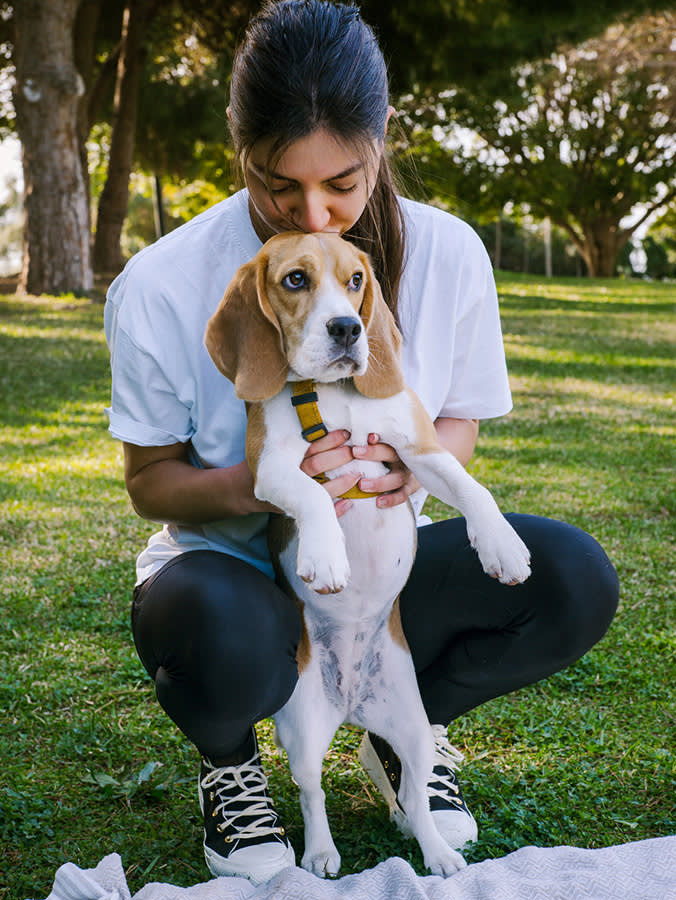
We kiss the things we love. Faces, foreheads, the tops of small heads, it’s one of the most instinctive gestures people have. So it feels natural to plant one on the dog. The catch is that your dog did not grow up speaking this language, and from where they sit, a human face looming in for a kiss can read less like devotion and more like an intrusion. Most dogs tolerate it, some for years, out of pure patience with us. Tolerating is not the same as loving, and learning to tell the two apart is one of the kindest skills an owner can build.
None of this means your dog doesn’t adore you. It means affection has an accent. We express love by closing distance and pressing our faces to theirs. Dogs express it in an almost opposite grammar, and when we don’t translate, we can end up stressing the very animal we’re trying to shower with love.
The question isn’t whether your dog loves you, it’s whether your dog enjoys the specific thing you’re doing. A kiss on the muzzle is a human sentence. Plenty of dogs sit through it politely, the same way you’d smile through a hug from someone whose hugs you don’t love. The dog’s job isn’t to enjoy our gestures. Ours is to notice when they don’t.
How dogs actually show love
Hugging and kissing are human affection, not canine. A dog who adores you shows it with a loose, wiggly body, by rubbing against you, by nuzzling your hand to ask for a scratch, by choosing to be near you. That’s the native vocabulary. When we swap in our own gestures, hugs, kisses, face-to-face contact, we’re asking the dog to accept a form of affection that runs against their instincts, and many will, for our sake, without ever really liking it.
Dogs do have their own version of a kiss: the lick. But it doesn’t map neatly onto ours. Licking is instinctive from birth, starting with the way a mother communicates with and cares for her puppies. It can also serve social functions, including appeasement, with a more deferential dog licking a more confident one to keep the peace. So when your dog licks you, it’s genuine communication, affection, attention-seeking, or a little of both, just not the human gesture you’re returning.
The stress signals that mean “please stop”
Here’s the part worth memorizing, because it protects both of you. From the dog’s angle, a human head dropping down toward their face is closer to a looming gesture than a loving one, and a full-body hug pins them in place in a way their instincts never asked for. Even the gestures we think of as gentle, a pat on top of the head or a hand wrapped around a paw, can land as an imposition rather than a kindness.
The tells that a dog is uncomfortable are consistent and readable once you know them. If you kiss or hug your dog and they go rigid or freeze, flick their tongue, lick their lips, pull their ears back, yawn, turn their head away, or lean their body back, those are signs they’d like you to ease off. A dog can’t say “not right now” in words, so they say it in posture. Missing it is how well-meaning affection quietly becomes something a dog dreads.
The deeper issue is projection. We tend to treat dogs as furry people and assume they should relate to touch the way we do, when they’re animals with their own instincts, most closely related to wild canids. Respecting their signals isn’t cold; it’s what lets you love them without accidentally causing them stress.
Let your dog vote
The most useful tool here is simple, and it hands the choice to the dog. It’s often called a consent test, and it works for kisses, cuddles, and petting alike.
Offer a few seconds of touch on a spot your dog generally likes, then stop, draw your hands back, and watch what happens next. A dog who shifts toward you, bumps your hand, or leans back in is voting “yes, keep going.” One who holds still, glances away, or gets up and drifts off is telling you “not right now,” and the right move is to take the no. Repeated over time, this little check trains you to read your specific dog, and trains your dog to trust that their answers are heard, which tends to make them more relaxed about affection overall.
So where does that leave the face-kissers?
A few dogs genuinely don’t mind, and a handful may even seek it out. The point isn’t to swear off kissing your dog forever; it’s to trade the assumption that they love it for the habit of actually watching. Let each dog’s reaction set the terms, dial the affection up or down to fit what that particular dog signals back, and put your energy into the gestures they clearly welcome: the chest scratches, the calm together-time, the greeting when you walk in. If you’re a helpless face-kisser by nature, you’re in good company; just pair the impulse with a glance at your dog’s ears and body, and follow their lead.
What newer research adds
Two recent threads sharpen the picture. On the warm side, work led by researcher Linda Handlin and colleagues found that affectionate interaction between people and dogs raises oxytocin, the bonding hormone, in both the human and the dog, which suggests the closeness itself is genuinely rewarding even when a specific gesture isn’t the dog’s favorite. On the reality-check side, a widely cited VetStreet poll found that while about 55 percent of American dog owners regularly kiss their dogs, only around 10 percent say their dog “loves it” every time. Put together, the message is encouraging and humbling at once: the affection is doing real good for your bond, and it’s still worth reading your particular dog before you assume the kiss is landing.
References
- Handlin, Linda, et al. “Short-Term Interaction Between Dogs and Their Owners: Effects on Oxytocin, Cortisol, Insulin and Heart Rate.” Anthrozoös, vol. 24, no. 3, 2011, pp. 301–315, https://doi.org/10.2752/175303711X13045914865385.
- Mariti, Chiara, et al. “Analysis of the Intraspecific Visual Communication in the Domestic Dog: Body Language and Stress Signals.” Journal of Veterinary Behavior, vol. 12, 2017, pp. 41–46, https://doi.org/10.1016/j.jveb.2016.11.001.
- Kujala, Miiamaaria V. “Canine Emotions as Seen Through Human Social Cognition.” Animal Sentience, vol. 14, 2017, https://doi.org/10.51291/2377-7478.1114.
Common questions
Do dogs actually like being kissed?
Some do, sometimes, but most dogs tolerate kisses rather than enjoy them. Hugging and kissing are human ways of showing love, not canine ones, and having a human face loom in that close can register as pressure rather than affection. Watch your individual dog's body language to know which camp yours falls into.
How can I tell if my dog dislikes kisses?
Look for stress signals: a stiff or frozen body, tongue flicks or lip licks, ears pulled back, yawning, turning the head away, or leaning back. Any of these means back off. A dog who leans in, softens, or nudges you for more is telling you the opposite.
If my dog licks me, does that mean they're kissing me?
Not in the human sense. Licking is an instinctive canine behavior, starting with how a mother communicates with her puppies, and it can signal affection, appeasement, or attention-seeking. It's real communication, just not the same gesture as a human kiss.
Dr. Kohl is a board-certified veterinary dentist with a particular interest in preventive oral care. She reviews all dental health content at The Pet Times and contributes practical guides on home dental routines, professional cleaning, and oral disease prevention.
Meet our experts ↗Keep reading
 TrainingYour Dog Doesn't Know What 'Family' Means. They Know Exactly Who's in Their Group.Dr. Nina Kohl · 5 min
 TrainingYour Dog's Love Language Isn't About Their Breed. Not Really.Sasha Ford · 8 min
 TrainingThat 'Guilty Look' Isn't Guilt. It's a Read on You.Dr. Nina Kohl · 7 min
 LivingYour 'Dog Type' Is a Mirror, Not a PreferenceDr. Nina Kohl · 6 min
 LivingYou're Not Soft for Loving Your Dog This Much. You're Wired for It.Dr. Mara Chen · 6 min
 TrainingYour Dog Picked the Person Who Ignores It. Here's Why.Dr. Priya Nair · 7 min