


Your Dog Isn't Pranking Anyone. Here's What That 'Gotcha' Really Is.
The internet is full of dogs supposedly playing elaborate practical jokes. The truth is stranger and more useful: what looks like mischief is your dog running a simple, brilliant experiment on you.

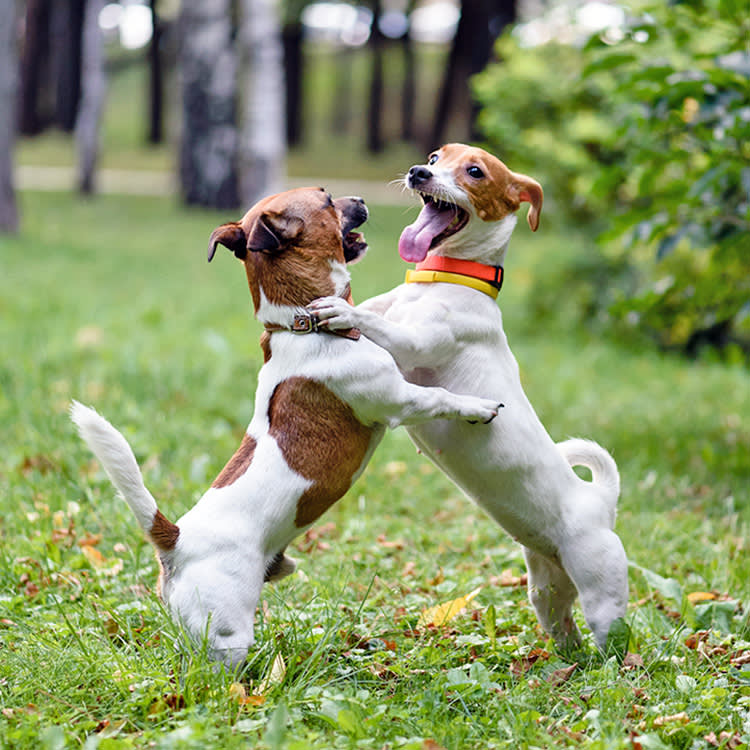
Search “dog plays prank” and you will fall into a rabbit hole of clips that seem to show genuine canine comedy: a dog who ding-dong-ditches its owner, a dog who “gets revenge” on a sibling with an elaborate setup. It is delightful content. It is also, almost without exception, staged by the human holding the camera.
That does not mean the impulse behind the videos is wrong. Dogs really do seem to mess with each other, and with us. But the mechanism is nothing like a prank, and once you understand what is actually happening, a lot of your dog’s more baffling behavior suddenly makes sense.
A prank needs a mind your dog doesn’t have
Pulling off a real practical joke requires a specific and fairly sophisticated set of mental moves. You have to grasp cause and effect, picture how another mind will react, and act now to produce a surprise later. That is a lot of forward-modeling, and it is not how a dog’s mind is built.
Dogs are associative thinkers, not plotters. They live in a world of “this tends to be followed by that,” learned through repetition, rather than “if I hide here and jump out, my sibling will be startled.” Your dog is not sitting on the stairs scripting April Fools’ Day. What they are doing is something arguably more impressive in its own way: running fast, constant, low-effort experiments on their environment to find out what pays off.
Owners love the idea that their dog is a little trickster, but what I see is a very good empiricist. The dog does a thing, something interesting happens, and the dog files that away and tries it again. There is no plot and no malice. There is just a smart, social animal noticing which of its moves reliably makes the world do something fun.
What looks like mischief is really an attention economy
Think of your dog’s behavior as a marketplace, where the currency is your reaction. Behaviors that “sell,” that earn a laugh, a chase, a raised voice, a game, get produced more often. Behaviors that get nothing quietly fade. This is why the same dog will do the same weird thing over and over: it worked once, and your dog is a creature of results.
It is exactly like a baby who makes a face, gets a laugh, and immediately makes the face again. The baby is not being clever about your emotions. The baby has discovered a lever and is pulling it. When your dog drops a toy just out of a housemate’s reach and waits, or jukes left and bolts right during play, that is a lever, too. The dog has learned that the move triggers a chase, and the chase is the whole point. It can genuinely look like your dog enjoys “creating a reaction,” because they do. They just enjoy the reaction itself, not the trickery we imagine behind it.
Sibling pestering is real, and it’s usually fine
Here is the one place the “dogs mess with each other” idea holds up. Anyone with two dogs has watched one of them, bored and full of energy, saunter over to a peacefully resting housemate and poke, paw, or nose at them until they get a response. That is deliberate in the sense that the dog wants a reaction. It is not deliberate in the sense of wanting to annoy for annoyance’s sake. There is no canine version of the kid in the back seat chanting “I’m not touching you.” The pestering is almost always a bid, for play, for attention, for something to happen, that has been rewarded before.
Most of the time this is healthy, normal social behavior and a good sign of a dog with problem-solving drive and social awareness. Let it run. The exception is the moment the fun stops being mutual. Watch the dog on the receiving end. If they stay loose, bouncy, and keep re-engaging, everyone is having a good time. If they go stiff, keep turning or moving away, freeze, or start throwing hard stares, the “game” has become one-sided, and that is your cue to calmly interrupt and redirect. Not every dog enjoys a ribbing, no matter how good-natured the instigator.
The takeaway for a smarter dog
None of this makes your dog less impressive. It makes them impressive in a truer way. You are not living with a comedian plotting bits. You are living with a relentless little scientist who is always testing what earns a response, and who will happily keep any behavior you accidentally reward, charming or not. That is worth remembering the next time your dog does something maddening and you laugh: to your dog, the laugh was the payoff, and you just funded the sequel. If a behavior delights you, react. If it drives you up the wall, the fastest way to end it is often to make sure it stops paying.
Common questions
Can dogs actually plan a prank?
No. A true prank requires understanding cause and effect and anticipating another's surprise, and dogs are associative rather than plotting thinkers. What looks like a setup is usually a behavior that earned a fun reaction before.
Why does my dog fake one way and then dart the other during play?
That is real, and it is a play tactic, not deceit. Dogs learn that a juke or a dropped toy reliably triggers a chase, and they repeat what works because the reaction is the reward.
Is it okay when one of my dogs keeps pestering the other?
Usually yes, as long as both dogs stay loose and take turns. Step in if the dog on the receiving end looks stiff, keeps trying to leave, or the pestering tips into obsessive or aggressive behavior.
Dr. Kohl is a board-certified veterinary dentist with a particular interest in preventive oral care. She reviews all dental health content at The Pet Times and contributes practical guides on home dental routines, professional cleaning, and oral disease prevention.
Meet our experts ↗Keep reading
 TrainingThe Wagging Tail Lie: Why Reading One Dog Signal Gets People BittenTom Hadley · 8 min
 TrainingYour Dog Isn't Just Making Noise. Every Bark Is Aimed at Someone.Jordan Ellis · 8 min
 TrainingNo, Your Cat Didn't Secretly Raise Your Dog. But Something Real Is Going On.Dr. Nina Kohl · 5 min
 TrainingWhen Your Dog Turns to Stone on a Walk, Don't Pull. Read It.Dr. Amara Solis · 6 min
 TrainingYour Dog Understands About 165 Words. How You Say Them Matters MoreDr. Mara Chen · 7 min
 TrainingThe Dog Park Sells Socialization. It Often Delivers the Opposite.Dr. Nina Kohl · 7 min