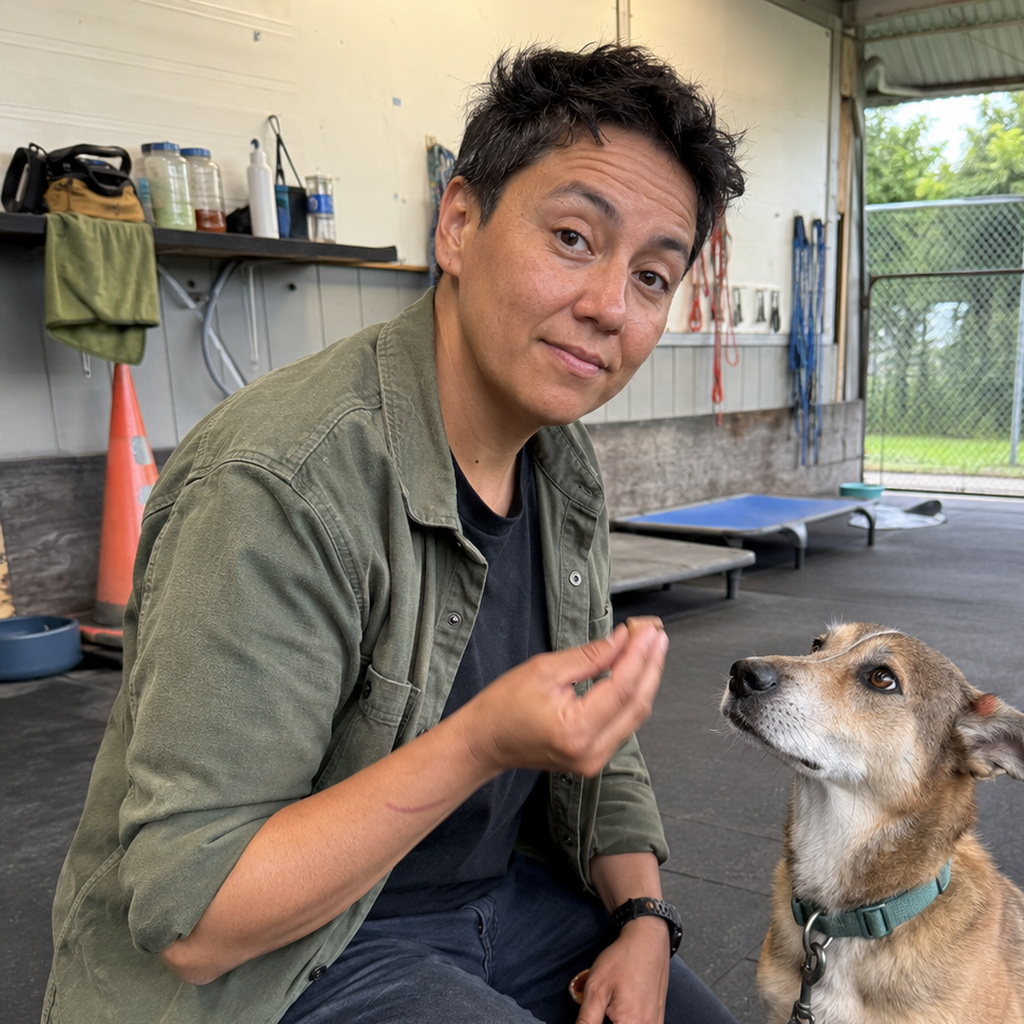
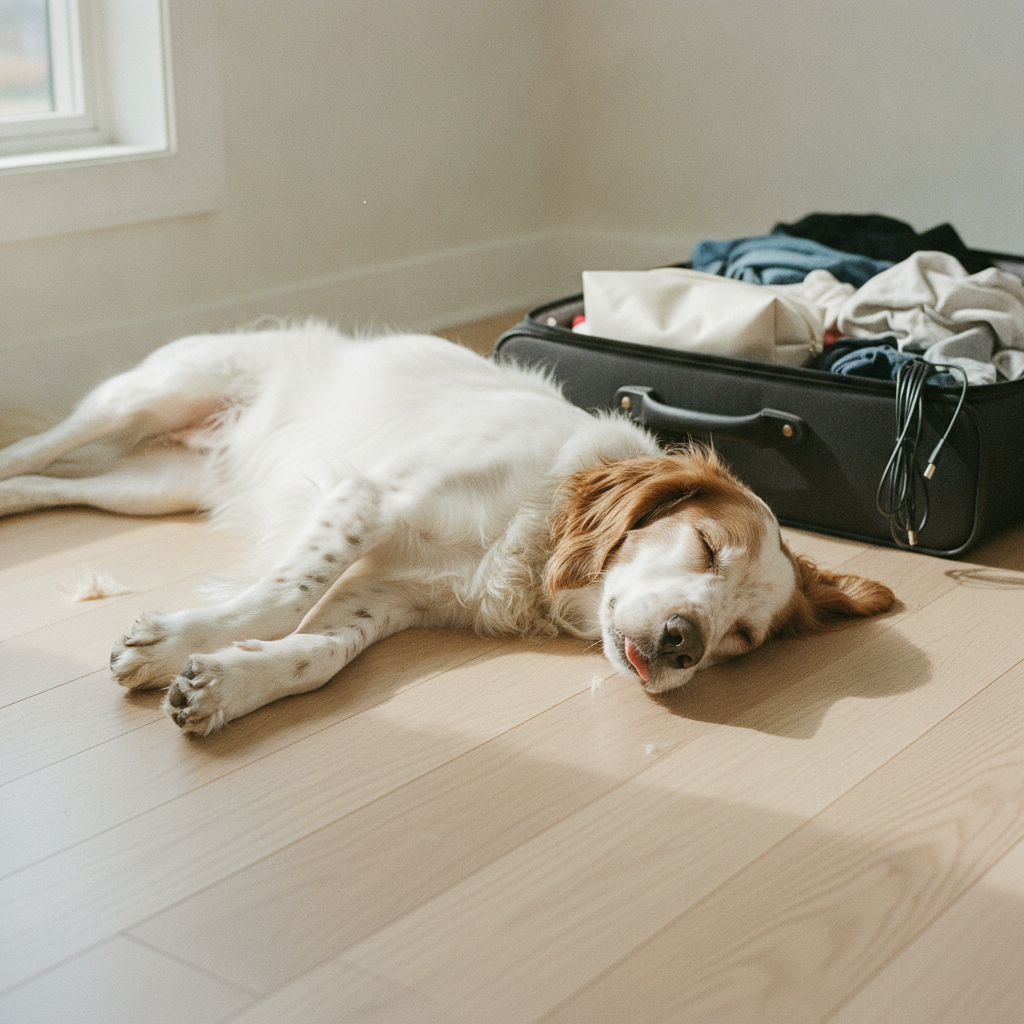
There is a particular feeling that arrives about ten minutes after you book the flight. You look at the dog. The dog looks back. And the whole trip suddenly seems like an act of abandonment dressed up as a holiday.
That feeling is real, it is nearly universal, and, as far as anyone can tell, it is based on a mistake about what is happening inside your dog’s head.
You are imagining him counting. He isn’t counting.
What the evidence actually suggests
The behavior consultants who deal with this for a living are fairly relaxed about it, and so is most of the research. As long as a dog’s needs are being met and he is comfortable, there is little sign that he is doing the thing you are picturing, which is sitting in the hallway maintaining a mental countdown to your return.
Dogs appear to be poor at that kind of forward projection. They do not seem to hold the question when is she coming back, and they do not seem to hold the question where did she go. Their needs run on a much shorter loop than ours, and that loop is dominated by what is happening now.
Which means that while you are running a low-grade guilt spiral over dinner in Italy, your dog is not contemplating your absence in the abstract. He is thinking about the person currently holding his lunch.
“The joy at the door is completely real, and people take it as proof of the suffering they imagine came before it,” says Dr. Ravi Mehta. “It isn’t. A dog can be delighted to see you without having spent nine days grieving you. Those are two different animals, and only one of them is yours.”
The reunion is real. The longing you have imagined preceding it is mostly yours.
Why this is good news, and what it changes
It would be easy to read that as bleak, as if your dog does not care about you. That is exactly backwards.
What it means is that the variable you have been agonizing over, how much he misses me, is not the variable that determines whether he has a decent week. The variables that do are entirely practical, and they are all inside your control:
Does he eat at the time he expects to eat? Does he get walked? Is he comfortable? Is somebody kind and attentive with him? Is his routine roughly the shape it usually is?
That is the whole list. And unlike “does he miss me,” every item on it can be solved with planning and a competent human.
“People spend the entire trip feeling awful and almost none of the week before it setting the sitter up properly,” says Jordan Ellis. “That is precisely the wrong ratio. Your dog does not need your guilt. He needs his dinner at six.”
Where should he stay?
There is no universal answer, and the honest one depends on the dog you actually have.
Some dogs are homebodies. They do best in their own house, with the smells and the sounds and the sleeping spot all exactly where they left them. Others are perfectly happy to decamp somewhere else and treat it as their own small holiday.
The rule of thumb is to count the variables. If your dog is anxious, have the sitter come to him, because that changes the fewest things at once. One new human is one new thing. A new human plus a new house plus new smells plus a new bed is four new things, stacked on top of each other, for an animal who was already struggling with one.
A confident, sociable dog can do well staying elsewhere, and sometimes better, particularly if the alternative is long stretches home alone between drop-in visits.
Protect the routine above everything
Here is the piece most people underweight, and it is the one that maps directly onto what dogs are genuinely sensitive to.
Dogs cope with a change of place far more easily than a change of schedule. So the single most valuable thing you can hand a sitter is not a list of your dog’s charming quirks. It is the shape of his day, written down as clock times rather than vibes.
Breakfast at seven. Walk after. Lunch. Long walk at five. Dinner. Out one last time at ten.
A dog whose day arrives in the right order at roughly the right times has very little to be unsettled by, more or less regardless of who is delivering it.
Make the sitter worth having around
The meet-and-greet before you go is not a formality, and it is not only about you vetting them. It is your dog’s first training session with this person, and you can load the dice.
Do not stand there reassuring him. Reassurance tells a dog that a situation requires reassurance. Instead, hand over the goods. Whatever your dog is most obsessed with, the bully stick, the good treats, the ball, the sitter is the one who produces it, not you. If he knows sit, shake, down, and stay, have the sitter run a quick training session and pay him generously for it.
What you want by the time you leave is not a dog who has been introduced to somebody. It is a dog who has learned that this particular person’s arrival reliably predicts good things.
Give the sitter what they actually need
Write down the food and the portions. The medications and exactly when they are given. The exercise routine. The idiosyncrasies: the neighbor’s dog he hates, the doorbell, the fact that he will absolutely eat a sock if you leave one on the floor.
Then the emergency information, which people leave vague and shouldn’t. Your vet. A neighbor or friend nearby who can physically get to the house. You, with an honest note on when you will be unreachable. And, if you are going to be genuinely out of contact, an agreed answer to the question of who is allowed to make a decision at three in the morning if nobody can raise you.
Last, the small stuff, which is less small than it sounds. If he is staying at the sitter’s place, send a blanket that smells of your house, and send his own toys. It costs nothing and it does real work.
And if the guilt won’t go
It probably won’t, entirely, and that is fine.
The solution is not to reason yourself out of a feeling. It is to route around it: ask for evidence. A sitter who sends a photo at lunchtime is worth paying for, and there is no shame at all in asking for one.
The photos are not for the dog.
The larger point is one worth making plainly, because the guilt tends to become a reason never to travel at all, or worse, a reason not to adopt a dog in the first place. There is no perfect moment when your budget, your schedule, and your certainty all line up. There never will be. Sometimes you plan it properly, hand the leash to someone competent, and go.
What newer research adds
Two threads are worth knowing, and they complicate the “he’s fine” message in a way that is useful rather than guilt-inducing.
The first is that separation-related problem behavior is genuinely common in dogs, and it is not the same thing as missing you in the wistful, human sense. It is closer to panic: a dog who cannot cope with being alone at all. That dog is not sad about your holiday, he is distressed within twenty minutes of any departure, including your trip to the shops, and a two-week absence is not his real problem. If your dog destroys things, howls, or soils the house when left, the trip is a symptom and the underlying separation distress is the thing to treat, ideally with a behaviorist and possibly with your vet.
The second is that dogs are far more sensitive to the predictability of their environment than to its glamour. Work on canine stress consistently finds that routine, control, and predictable access to resources matter more to welfare than novelty or enrichment for its own sake. Which is the scientific version of the advice above: hold the schedule, and the rest matters less than you think.
So book the trip. Then spend the week before it on the sitter rather than on the guilt.
References
- Ogata, N. “Separation anxiety in dogs: What progress has been made in our understanding of the most common behavioral problems in dogs?” Journal of Veterinary Behavior, vol. 16, 2016, pp. 28–35.
- de Assis, L.S., Matos, R., Pike, T.W., Burman, O.H.P., Mills, D.S. “Developing Diagnostic Frameworks in Veterinary Behavioral Medicine: Disambiguating Separation Related Problems in Dogs.” Frontiers in Veterinary Science, vol. 6, 2020, 499.
- Bray, E.E., Otto, C.M., Udell, M.A.R., et al. “Enhancing the Selection and Performance of Working Dogs.” Frontiers in Veterinary Science, vol. 8, 2021.
- Beerda, B., Schilder, M.B.H., van Hooff, J.A.R.A.M., de Vries, H.W. “Manifestations of chronic and acute stress in dogs.” Applied Animal Behaviour Science, vol. 52, 1997, pp. 307–319.
- American Veterinary Society of Animal Behavior. “Position Statement on Separation Anxiety.” AVSAB.