


Your Dog Is Chasing Your Laugh. Science Says It's No Accident.
Does your dog do bits? Research can't prove dogs tell jokes on purpose, but it shows they're powerfully drawn to the sound of human happiness, and that they double down when you laugh.

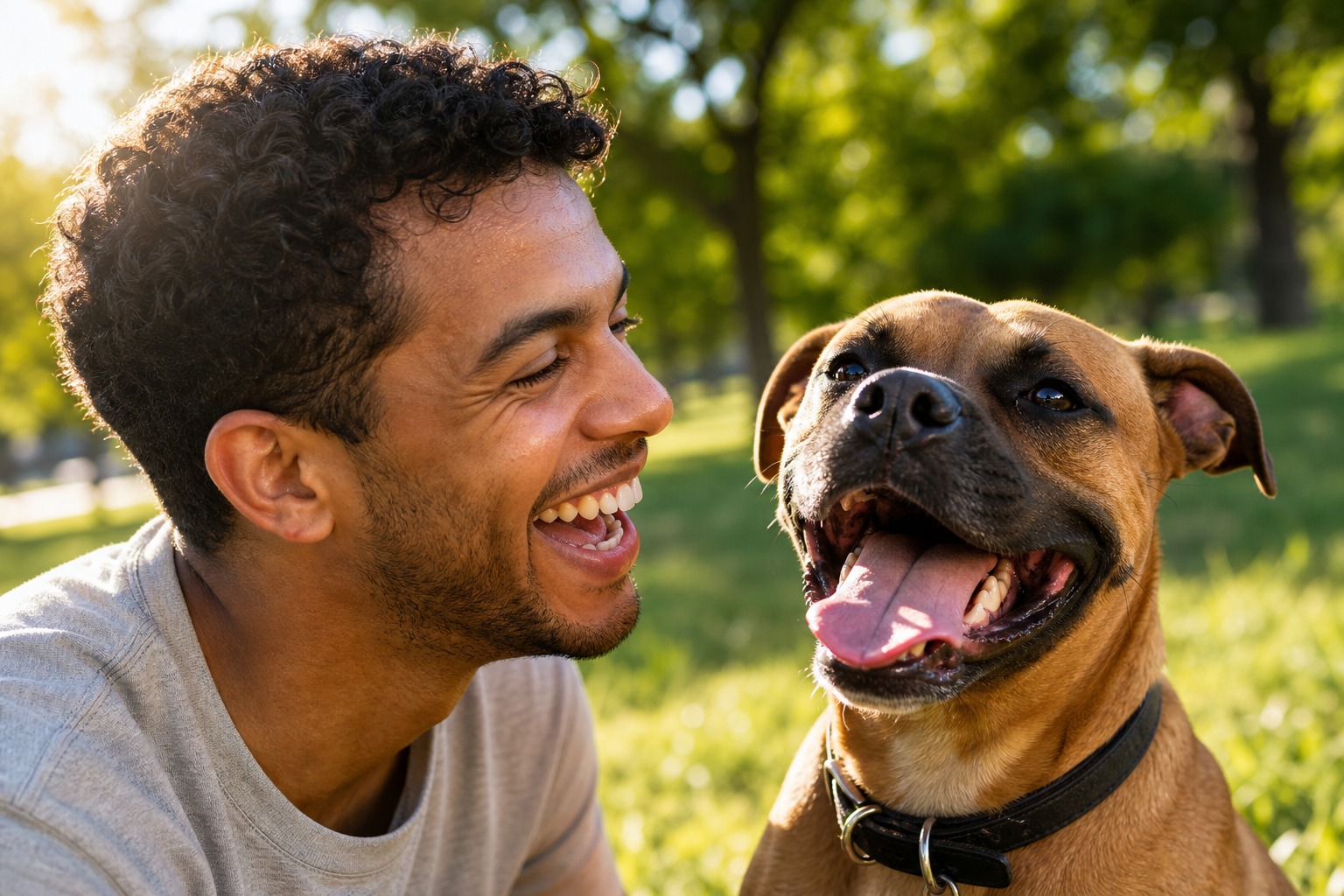
Every so often a clip makes the rounds claiming your dog is a secret stand-up comedian, deliberately doing bits for the laughs. It’s a lovely idea, and it’s not quite what the science says. What the research actually supports is gentler and, honestly, more charming: your dog is finely tuned to the sound of your happiness, and there’s a good chance it leans into whatever earned your laugh in the first place.
Dogs are built to read the room
Start with the thing no dog owner doubts. Dogs are remarkably good at picking up on human emotion. A 2014 review by researcher Veronika Konok at Eötvös Loránd University in Budapest pulled together study after study showing dogs read our states and adjust accordingly. In one, dogs were slower to grab a forbidden piece of food when they were told off in a stern tone than in a cheerful one. In others, dogs preferred toys and food that a person had greeted with obvious delight over items a person had reacted to with disgust.
The signal isn’t just visual, either. A comparative fMRI study led by Attila Andics scanned dogs’ brains and found a region that lit up more for positive human sounds, like laughter, than for negative ones, like crying. Your dog’s brain treats your laugh as its own category of good news.
What the research does and doesn’t prove
Here’s the honest line the feel-good clips skip. None of this shows a dog intends to be funny. You can’t ask a dog whether the zoomies were a planned routine. What the evidence shows is a strong emotional response to positive human sounds, and that response is enough to explain the behavior we love to over-interpret.
Picture the loop. Your dog does something goofy. You laugh. Your dog, wired to find that laughter rewarding, does the goofy thing again, harder. From the outside it looks like a comedian working a crowd. Underneath, it’s a feedback loop between a happy noise and an animal that finds your happiness magnetic. That’s not less special. It’s arguably more, because it means the bit is really about you.
Dogs don’t need to understand comedy to chase your laughter. They just need to find that sound rewarding, and they clearly do. So the ‘joke’ is really a conversation, and you’re the one who started it.
How to build the loop on purpose
If you want more of the funny dog, you already hold the reinforcement in your own throat:
- Laugh at the good stuff, not the risky stuff. Dogs will repeat whatever earns the happy sound. Laughing at a play-bow and a silly toss is great. Laughing at counter-surfing or shredding a shoe teaches the same lesson, just in the wrong direction.
- Pair the laugh with attention. A laugh plus a “yes!” and a scratch tells your dog clearly that this was a win, which makes the behavior more likely to come back.
- Don’t force the encore. If your dog offers a bit and you crack up, you’ve done your part. Nagging them to “do it again” usually kills the mood; the spontaneity is the whole point.
What newer research adds
The picture has only gotten richer since 2014. Work on the dog brain keeps confirming that dogs process human vocal emotion in dedicated ways, and separate research shows they track our feelings through scent and behavior too, not just tone of voice. Konok also flagged a detail that lands nicely here: emotionally charged moments are easier to remember than neutral ones. If that holds for dogs the way it does for people, then some of your dog’s strongest memories of you may be the ones where you were laughing. That’s a good reason to hand out the laughs freely.
References
- Emotional communication between dogs and humans — V. Konok, 2014 review
- Voice-sensitive regions in the dog and human brain are revealed by comparative fMRI — Andics et al., Current Biology
Dr. Kohl is a board-certified veterinary dentist with a particular interest in preventive oral care. She reviews all dental health content at The Pet Times and contributes practical guides on home dental routines, professional cleaning, and oral disease prevention.
Meet our experts ↗Keep reading
 TrainingYour Dog Isn't Catching Your Sadness. They're Catching Something TrickierDr. Priya Nair · 7 min
 TrainingYour Dog Isn't Reading Your Face. They're Reading Your Hand on the Leash.Dr. Lena Park · 8 min
 LivingA 160-Pound Ranch Dog Found a Lost Toddler. His Breed Was Built for Exactly This.Dr. Nina Kohl · 6 min
 TrainingYour Dog Picked the Person Who Ignores It. Here's Why.Dr. Priya Nair · 7 min
 LivingYour Dog Isn't Upset When You Argue. They're Trying to Stop You.Jordan Ellis · 6 min
 TrainingYour Dog Doesn't Just Smell Your Stress. They Catch ItDr. Mara Chen · 6 min