


Yes, Your Dog Has a Belly Button. Here's Where to Find It (and When to Worry).
Dogs have belly buttons, they're just easy to miss. Here's exactly where it sits, why it looks nothing like yours, and the one belly-button problem worth a vet's attention.

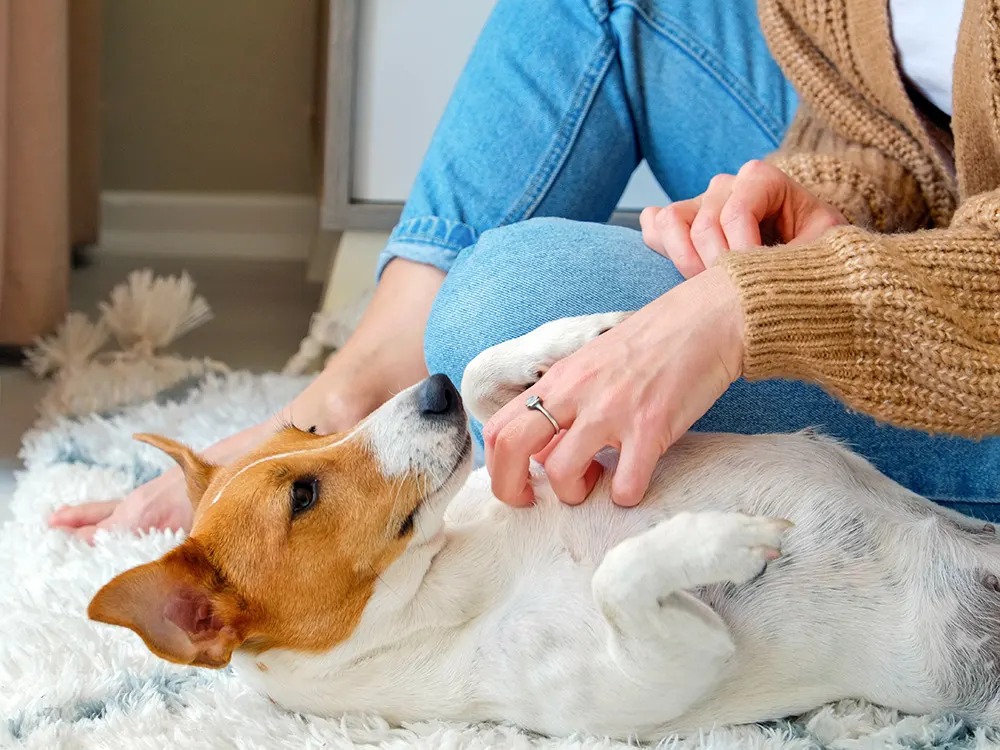
Your dog flops over, all four legs in the air, silently demanding a belly rub. Somewhere in that expanse of warm fur is a body part almost nobody thinks about: your dog has a belly button. It is really there. It just does such a good job of hiding that most pet parents have petted right over it for years without noticing.
The reason you have never spotted it is not that it is small. It is that you are looking for the wrong thing. You are looking for a human navel, and a dog’s belly button is a completely different shape in a slightly surprising place. Once you know what you are actually hunting for, you can find it in about ten seconds.
Same origin story, different scar
A belly button, in any mammal, is a scar. Before birth, a puppy is connected to its mother’s placenta by an umbilical cord that ferries oxygen and nutrients in and waste out. Every puppy in a litter has its own cord and its own placenta.
After birth, the cord’s job is done. An attentive mother usually chews through it while cleaning her newborn, and the stub dries up and drops off within a few days. What is left where the cord entered the abdomen heals into a small scar. That scar is the belly button. It is the exact same event that gives you yours, which is why the anatomy rhymes even though the result looks so different.
Where it actually is
Here is the part that trips people up. A dog’s belly button sits higher than you would guess. Run your hand down the centre seam of the underside and stop level with the final rib; that’s the spot. That works out to roughly one third of the way up from the pelvis toward the bottom of the ribcage, not down near the groin where instinct sends your hand.
The easiest way to locate the midline is to read the fur. Belly hair grows in a pattern, and along the centerline it changes direction, curving toward the head or tail. Follow that seam up to the level of the last rib and you are in the right neighborhood.
Why it doesn’t look like yours
About nine in ten people have an “innie,” a clear little dimple. Dogs almost never do. Because of how their bodies are shaped and where fat sits under the skin, a dog’s belly button is usually flat and understated: a ragged little seam of skin, running lengthwise rather than wide, often tucked beneath a small swirl of hair and sometimes a touch lighter in color than the skin around it.
On short-coated dogs you may just make it out as a faint seam. On thick-coated dogs, feeling beats looking. Run a finger gently along the midline and you may notice a semi-firm, slightly roughened ridge, usually a centimeter or two long depending on the size of the dog. Some dogs have a small palpable knot, others just a subtle irregularity. On a dog who has packed on real extra weight, you might occasionally feel something closer to a human-style innie, but that is the exception, not the rule.
What it’s for now: essentially nothing
The moment a puppy draws its first breath, the belly button is out of a job. Until then it was the port for the umbilical cord: fresh blood from the mother in one direction, spent blood carrying waste back out the other. After birth, with lungs and a gut doing those jobs, the belly button has no ongoing function. It is a keepsake, a small physical record of the connection between a puppy and its mother, and nothing more.
The one thing genuinely worth watching
Serious belly-button trouble in dogs is uncommon, but two conditions are worth knowing, and one of them you can actually spot at home.
An umbilical hernia is the big one. It happens when the muscle of the body wall doesn’t fully close over the spot where the cord entered. The skin heals fine, but underneath, a small gap remains, and a bit of fat, or in larger cases abdominal contents, can push through it. You would notice it as a soft bulge at the belly button. It is thought to be hereditary. Small hernias often carry little risk and are commonly repaired during a routine spay or neuter, so they get handled without a separate surgery.
A small umbilical hernia is usually a minor footnote we take care of during the spay or neuter. What I don’t want a family to shrug off is a bulge that’s growing, firm, or tender, because a larger hernia can let a loop of intestine slip through and get trapped, and that turns into an emergency fast.
The second condition, umbilical infection, called omphalitis, shows up only in the first days of life. Newborn puppies with it may be sluggish, have a swollen or painful belly, and an inflamed, sore umbilical area. It can become serious quickly and needs a vet, but it is not something that develops in an adult dog. Good hygiene at birth, including a swipe of dilute iodine on the stump, is what prevents it.
What newer research adds
There is no dramatic new science on dog navels, and that is fine, because the anatomy hasn’t changed since the last vet manual was printed. The useful modern takeaway is a shift in emphasis: veterinary guidance increasingly folds the belly-button check into routine at-home body scans rather than treating it as a curiosity. When you are running your hands over your dog anyway, feeling for lumps, mats, ticks, or sore spots, the midline near the last rib is worth including. Ninety-nine times out of a hundred you will feel the same harmless little ridge. The one time something has changed, you will have caught it early, which is the entire point of knowing your dog’s normal.
References
- Davidson, Autumn P. “Management of the Neonate in Dogs and Cats.” MSD Veterinary Manual, msdvetmanual.com.
- Roberts, Jennifer N. “Hernias in Animals.” MSD Veterinary Manual, msdvetmanual.com.
- Shaw, Scott P. “Pediatric Emergencies.” dvm360, dvm360.com.
Common questions
What does a dog's belly button look like?
Not like a human's. Look for a small ragged seam of skin running lengthwise rather than round, usually tucked beneath a swirl of hair, and often a shade paler than everything around it. On fluffy dogs it's easier to feel than to see, like a small firm ridge on the midline.
Should I worry about my dog's belly button?
Rarely. The one thing to watch for is an umbilical hernia, a soft bulge at the site that means the muscle didn't fully close. Small ones are often fixed during a spay or neuter. A larger or firm, painful bulge needs prompt veterinary attention.
Not a substitute for your vet. Our guidance is educational. For urgent symptoms, contact a vet or emergency clinic right away. Editorial standards
Dr. Chen is a small-animal veterinarian who leads health and safety coverage at The Pet Times. She writes and reviews the bulk of our illness, condition, and safety content, translating clinical guidance into clear, practical advice owners can act on at home.
Meet our experts ↗Keep reading
 Health & WellnessYour Straining Dog Might Not Be Constipated at AllDr. Lena Park · 6 min
 TrainingYour Dog Doesn't Need a Longer Walk. It Needs These 6 Running Games.Dr. Amara Solis · 6 min
 Health & WellnessWhy Your Puppy's Rabies Shot Can't Come Too Early or Too LateDr. Lena Park · 8 min
 Health & WellnessHeartworm Treatment Is a Brutal, $3,000 Ordeal. Prevention Is a Chewable.Dr. Lena Park · 6 min
 Health & WellnessAn AI Can Now Grade Your Dog's Teeth From a Phone Photo. The Catch Is What It Can't DoDr. Amara Solis · 5 min
 Health & WellnessThe Real Threat to an Old Dog Isn't Age. It's a World That Keeps Getting Smaller.Dr. Ravi Mehta · 8 min