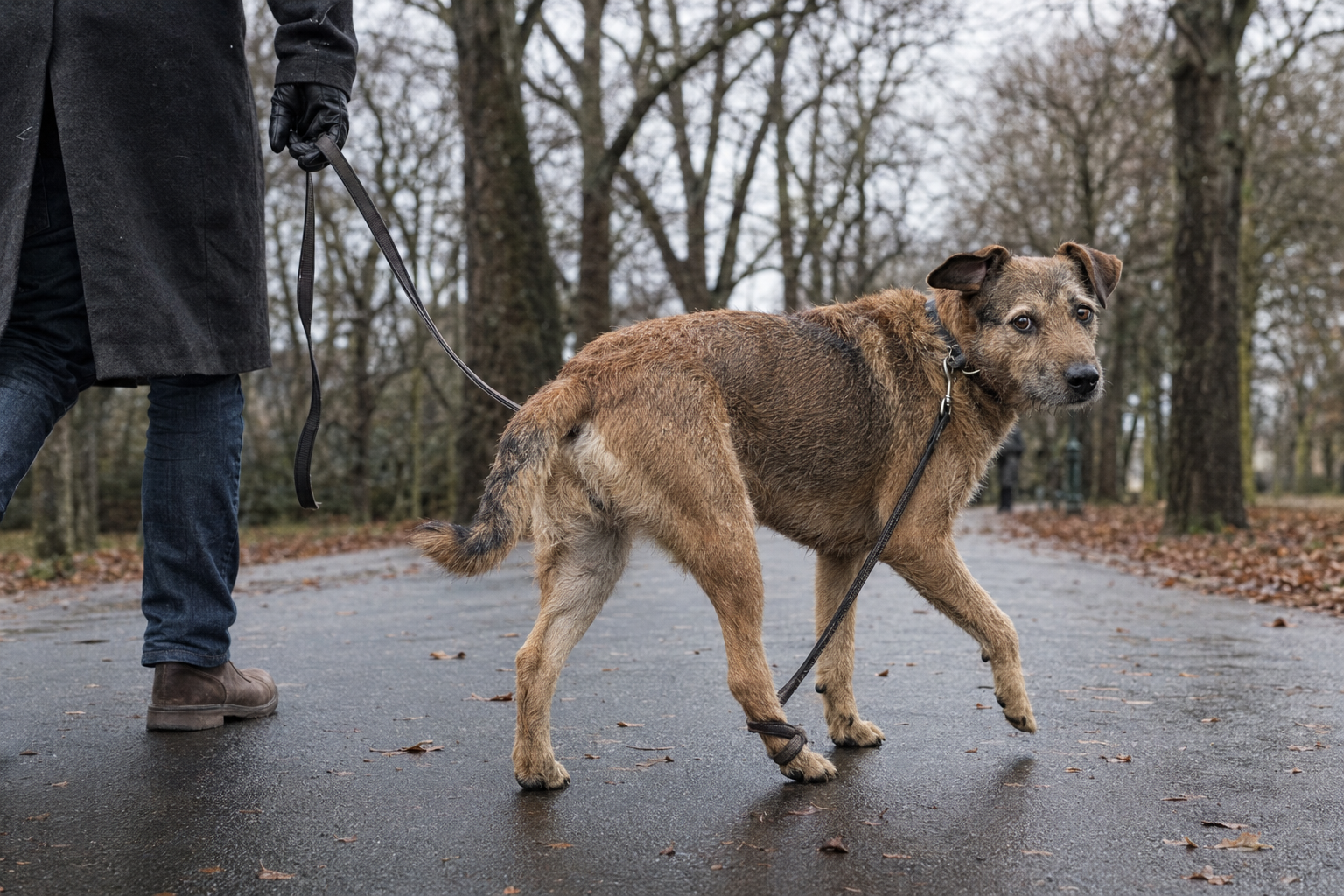
Watch enough dogs on walks and you’ll spot two clear camps. One dog feels the leash slide under a back leg, lifts the paw, steps over, and carries on without breaking stride. The other dog feels the same thing and simply freezes, waiting for a human to sort it out. It’s tempting to read the first dog as the clever one. That’s not really what’s going on.
Whether a dog untangles itself comes down less to brainpower and more to whether the tangle bothers them in the first place. That single fact changes how you should think about the whole problem, and it’s why the fix is easier than most people assume.
First, why it’s worth caring about
A tangled leash looks like a minor nuisance, and usually it is. But it’s worth keeping an eye on for one real reason: safety. A leash that wraps fully around a leg can trip a dog or throw off their balance, and a line that’s out of position can pull them off course at exactly the wrong moment near a curb or another dog. So this isn’t about tidiness. It’s about keeping your dog steady on their feet.
Why some dogs never bother to fix it
There isn’t one cause. A few different things stack up to decide whether a given dog learns to extricate itself, and they don’t all point the same direction.
Problem-solving ability plays a part, but a smaller one than you’d guess. A dog does have to notice the leash and work out a path around it, so there’s a puzzle-solving element. It’s just rarely the deciding factor.
The bigger predictor is comfort. Some dogs genuinely do not mind the leash resting against a belly or looped loosely around a leg. If the sensation doesn’t register as a problem, there’s nothing for the dog to solve. From their point of view, the leash is fine exactly where it is, so they leave it there.
Then there’s simple attention. A dog deep in the smells and sights of a good walk has bigger priorities than a line under one leg. This is why the same dog will sometimes step neatly over the leash and sometimes plow right through it. On a dull walk they notice and adjust. On an exciting one, the leash doesn’t make the list. Some dogs are so absorbed in the sensory buffet of every outing that they never fuss over the leash at all.
Put those together and the “tangled” dog often isn’t failing a test. They’ve just decided, correctly for them, that a twisted leash isn’t worth the trouble.
How to teach the untangle
If the tangling is frequent enough to be a genuine hazard, you can shape better leash habits without much fuss. A handful of practical moves:
Choose a shorter leash, which gives the line less slack to loop around legs in the first place. Skip retractable leashes entirely, since the long, thin cord tangles readily and offers little control when it does. Teach your dog to walk closer to your side, so the leash stays out to the outside rather than swinging between their legs. If you use a front-clip harness, clip to the collar as well, which helps keep the line from dropping low across the body.
And you can teach the untangle itself. When your dog happens to step over or shake off a tangle on their own, mark that moment with a treat and warm praise. Catch it a few times and you’re rewarding the exact behavior you want, which nudges an indifferent dog toward doing it on purpose. You’re not overriding their personality so much as giving them a small reason to care.
“People assume the dog who ignores a tangled leash is being dense. Usually the dog just doesn’t find it uncomfortable, so there’s no problem to solve in their mind. Once you make untangling worth a treat, even the laid-back ones start doing it,” says Marcus Webb.
The goal isn’t a dog who obsesses over a perfectly straight leash. It’s a dog who can free a leg when it counts, so a stray loop never turns a nice walk into a stumble.