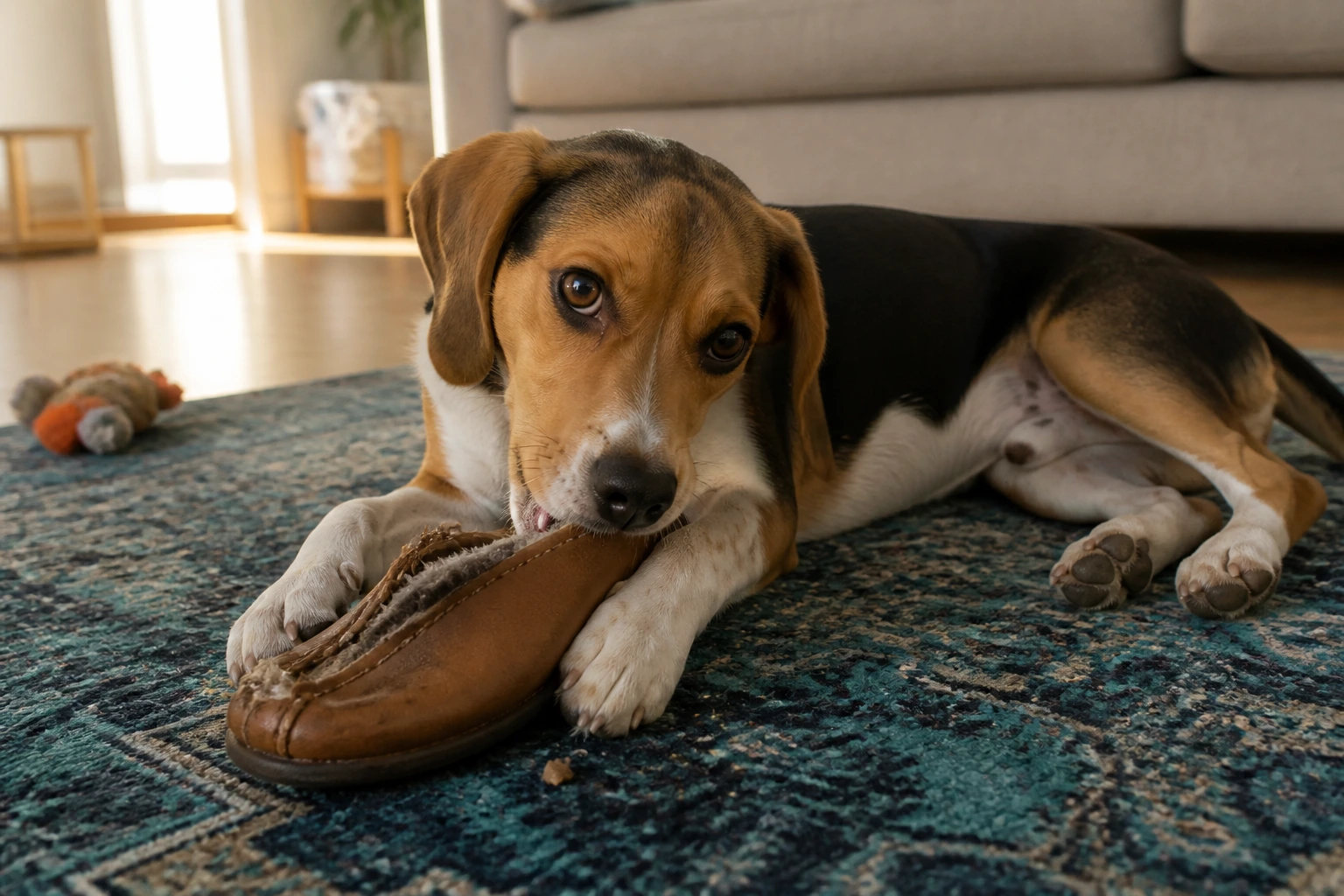
There are few worse feelings than coming home to a new pair of shoes turned into confetti on the living room floor. Then it is a phone cord, a pen, the corner of a bag. Somewhere in the cleanup you ask the question every dog owner eventually asks: does this ever stop?
Here is the honest answer, and it is not the one most people want. Dogs do not outgrow chewing the way they outgrow a chewed-up puppy crate. Chewing is a normal, healthy, hardwired behavior, and for most dogs it never fully switches off. What changes, if you set them up well, is where that chewing goes. The dogs who “grow out of it” are really the dogs whose people gave the instinct a job. So instead of waiting for the phase to end, the more useful project is understanding the drive and aiming it somewhere that does not cost you a wardrobe.
Why dogs chew in the first place
Chewing is not misbehavior. It is a core dog activity, right alongside sniffing. Puppies explore the world with their mouths, but adult dogs need to chew too, and the reasons are physical and emotional at once. The act of chewing releases feel-good, stress-lowering endorphins. It is, in a real sense, how a dog self-soothes.
That means chewing often shows up as a displacement behavior, a way to cope with boredom, uncertainty, or stress. Think of it as the canine version of a person jiggling a knee or fidgeting with a pen when they are restless. It is not a flaw to stamp out. It is a need looking for an outlet.
So do dogs ever “grow out” of it?
They ease off, but they do not quit. Most dogs chew noticeably less once they finish teething, around six to seven months of age. The adolescent stretch from six to 18 months can still bring bursts of it, especially in high-energy or highly intelligent dogs. By 18 to 24 months, as dogs mature mentally and physically, the intensity usually settles down. Consistent training, regular exercise, and appropriate chew toys all help move that timeline along.
Some dogs, though, are lifelong chewers by design.
“Breeds developed for mouth-based work, fetching, holding, gripping, tend to keep that drive their whole lives,” says Dr. Ravi Mehta. “Labs, German Shepherds, Malinois, and many terriers do not lose the urge to chew. It just has to be pointed at the right target instead of your baseboards.”
And a handful of dogs stay what you might call perpetual puppies, curious and mouthy well into adulthood no matter how they were raised. There is no fixing that out of them, and there is no need to. For those dogs, and for their belongings, the smart move is management: control access to the things they should not have, and keep the things they should chew within easy reach.
When chewing is telling you something is wrong
Most chewing is ordinary. But when it escalates past normal exploration or boredom, it can signal an underlying problem. It is worth knowing the red flags:
- Oral pain. Dogs with dental disease, a cracked tooth, or a retained baby tooth may chew more to relieve discomfort.
- Nausea or GI trouble. Some dogs chew or lick excessively when their stomach is upset.
- Nutritional gaps. Uncommon, but certain mineral deficiencies can drive unusual chewing patterns.
- Skin allergies. What looks like chewing on the body is often self-directed licking or biting at itchy, irritated skin, especially around the paws.
- Anxiety. Stress chewing looks different from developmental chewing. Dogs with separation anxiety often target door frames, windowsills, or objects that carry your scent, like shoes and clothing, as a way to manage the panic of being alone.
“Any sudden change in chewing deserves a look,” says Dr. Ravi Mehta. “A dog who was never destructive and suddenly starts, a dog chewing through exercise and enrichment, a dog who only chews when left alone: those patterns point at pain, nausea, allergies, or anxiety, not stubbornness.”
Call your vet if a previously well-behaved dog abruptly starts chewing, if there are signs of mouth pain like drooling or bad breath, if the chewing continues no matter how much you exercise and engage them, if it comes alongside vomiting or appetite loss, if it only happens during alone time, or if it involves gnawing and licking at their own body.
How to redirect it, before it becomes a habit
The best time to solve destructive chewing is before it happens. You can redirect in the moment by swapping the forbidden object for an appropriate chew, but prevention beats interruption. Keep good chew items available and easy to grab, and step in with play or a chew before boredom sets in, not after your dog has already found the couch cushion.
There is a training reason this matters beyond saving your stuff. Every time a dog rehearses an unwanted behavior, it gets stronger, and if chewing the wrong thing reliably summons your attention, you may be teaching a lesson you did not mean to: chew the shoe, and mom comes running. Give the drive a legitimate target instead. Appropriate chew items are not a luxury; they are basic enrichment that meets a real species need.
A few reliable outlets:
- Sturdy chew toys sized so your dog cannot break off and swallow large chunks. Retire any toy that has been gnawed down to a choking or obstruction hazard.
- Food-stuffable toys like a Kong, especially frozen, which turn chewing into a longer, calming project.
- Enough exercise and mental work that your dog is not chewing out of sheer under-stimulation.
What newer research adds
Veterinary behavior guidance has shifted in recent years away from “stop the chewing” and toward “meet the need.” The current framing treats appropriate chewing as enrichment, part of a dog’s daily requirement for outlets, on par with walks and sniffing time, rather than a nuisance to suppress. Studies on canine enrichment increasingly link unmet needs for chewing, foraging, and sniffing to stress-related and destructive behavior, which is why so many trainers now start with “what is this dog missing?” before they reach for any correction. The practical upshot for you is encouraging: a dog with the right outlets and enough stimulation is a dog who rarely eats your things.
Chewing, at its core, is normal and necessary. For many dogs it fades with maturity, especially when their needs for exercise, enrichment, and appropriate chew outlets are consistently met. For others it stays a lifelong habit that simply needs better direction. Either way, the fix is rarely punishment. It is paying attention to the pattern, and when the pattern looks off, checking in with your vet or a qualified positive-reinforcement trainer.
References
- Watson, Katrina, et al. “Canine Enrichment and Behavioral Welfare: A Review of Chewing, Foraging, and Sensory Outlets.” Animals, MDPI, www.mdpi.com/journal/animals.
- American Veterinary Medical Association. “Dog Behavior Problems: Destructive Chewing.” AVMA, www.avma.org.