Ask most people why dogs like squeaky toys and you’ll get some version of “they think it’s fun.” Which is true, and also completely uninformative, and also doesn’t explain the thing that drives everyone crazy: the toy usually dies within a week, and the dog seems perfectly satisfied when it does.
Here’s the framing that actually explains all of it. The squeak is not a fun noise. It’s a prey distress call, a high, thin, repeating sound in exactly the register a small struggling animal makes. Your dog is not enjoying the sound the way you enjoy a song. They are responding to it the way you would respond to a smoke alarm, with a single-minded urge to find the source and shut it off.
And that reframe pays off, because once you know the goal is silence, everything else falls into place.
Why the squeak works so well
The sound sits right at the top of what dogs are built to notice. Dogs hear well above the human range, and their auditory system is tuned toward the frequencies that small mammals produce. A squeaker hits that band on purpose.
But frequency alone isn’t the trick. The trick is contingency. The toy squeaks because the dog bit it, and it stops squeaking when the dog stops. That’s a closed feedback loop, and closed feedback loops are the most reinforcing thing in behavioral science. Bite, feedback. Bite harder, more feedback. The toy is responding, so the toy is alive, so the sequence continues.
You can watch a dog run this loop consciously. Many dogs will adjust bite pressure to modulate the squeak, mouthing gently for a slow chirp and clamping for a full shriek. That’s not random chewing. That’s a dog experimenting with an instrument.
“A squeaky toy is the only toy in the bin that talks back,” says Dr. Ravi Mehta. “That’s why it wins, and that’s also why it doesn’t last. A dog isn’t trying to make it squeak forever. They’re trying to make it stop, and the fastest way to do that is to take it apart.”
The moment the squeaker dies is not a failure. It’s the finish line.
This is where owners get frustrated and dogs get satisfied. When your dog rips the squeaker out and drops the deflated husk on the floor, they have not broken the toy. They have completed the task.
Which is worth understanding, because it changes what you buy and how you supervise. A squeaky toy is a consumable, not an heirloom. If you want it to last, you have to interrupt the loop before the loop finishes.
What the squeak is actually good for
Beyond the obsession, squeakers earn their place for four real reasons.
They’re a training currency. Some dogs are food-motivated. Others are barely food-motivated but will sell you their soul for a squeak. A squeaker is a portable, high-arousal reward you can use to build a recall on a dog who yawns at chicken. It’s also useful for the reverse: teaching a dog to disengage from something exciting on cue is much easier when you have something exciting to practice on.
They fight boredom, which fights destruction. Dogs with a real outlet for chewing and shredding are less likely to invent one out of your baseboards. That’s not a slogan; it’s the whole mechanism.
They create a shared game. A squeaker is an invitation. Tug, fetch, and chase built around a noisy toy are some of the fastest relationship-builders available, and they cost nothing.
They give the mouth a job. Depending on material, a squeaky toy can double as a chew. Textured rubber does light work on gum tissue and surface plaque. It is not a substitute for brushing, and no toy is, but a dog who chews appropriate objects is doing their mouth a small favor.
The safety rule almost nobody follows
Here is the part of this article that is not optional.
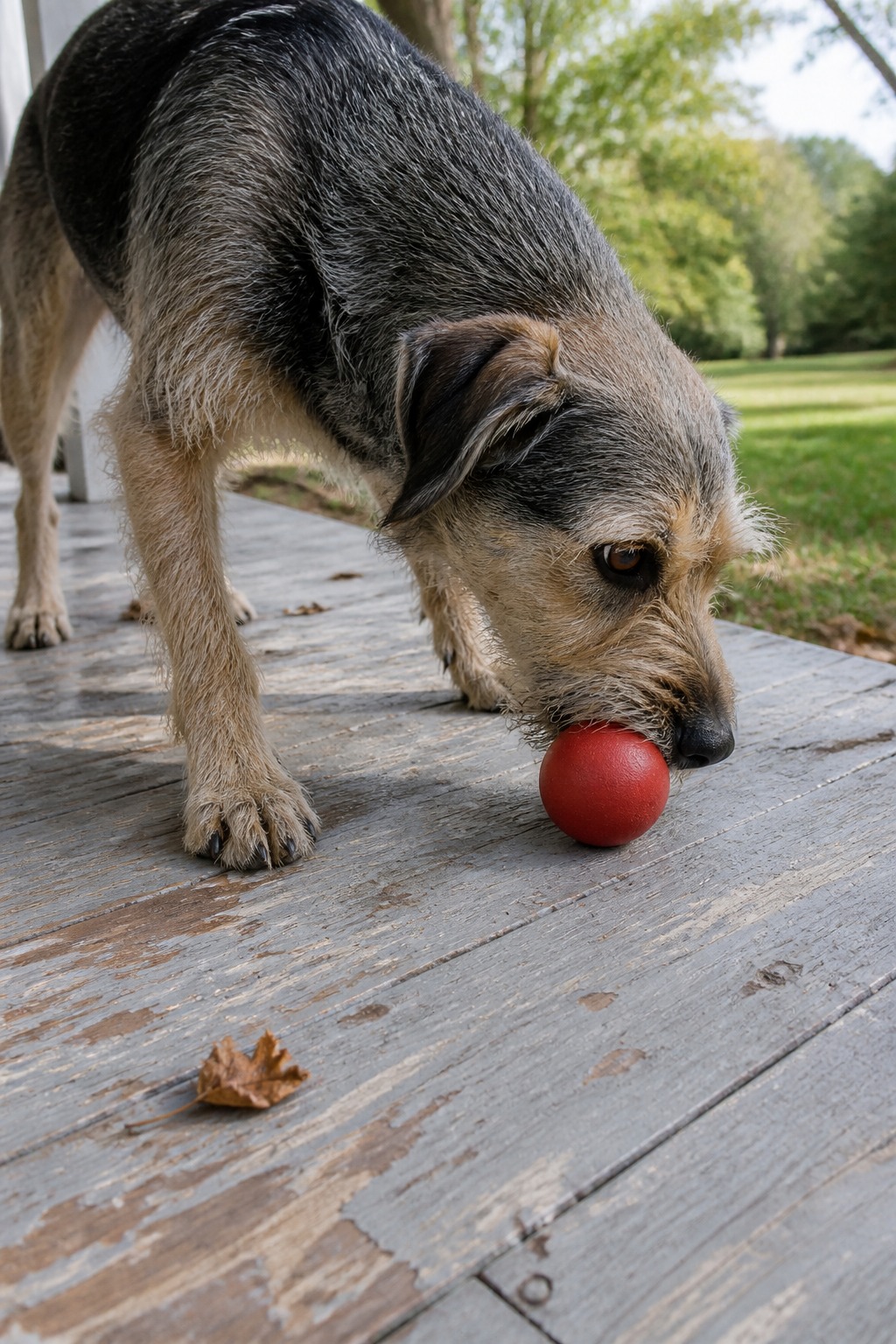
The squeaker is the hazard, not the toy. A plastic squeaker is roughly the size and shape of something that lodges. It does not digest. It does not soften. If it goes down, it can obstruct, and obstruction is surgery.
So the rule is: you play with a squeaky toy, you don’t hand one over and leave.
Concretely:
- Supervise every session with a squeaker, every time. Not “with new toys.” Every time.
- When the toy is breached, the toy is done. The second there’s a hole, take it. Do not let your dog fish the squeaker out. That’s the exact moment ingestion happens.
- Put it away between sessions. This does two jobs at once: it removes the unsupervised risk, and it keeps the toy novel, which makes it more valuable as a training reward.
- Size it honestly. A toy your dog can fit fully behind their molars is a choking hazard. Err large.
- Buy for the chewer you have, not the chewer you want. If your dog is a determined destroyer, look for toys built for power chewers, or accept that a plush squeaker is a fifteen-minute toy and price it accordingly.
- Modify anything with removable parts. Plastic eyes, ribbons, and sewn-on noses come off before the toy goes down.
Watch for the aftermath, too. Decreased appetite, repeated vomiting or retching, lethargy, and straining are the signs of an obstruction, and they can show up a day or more after the fact. If you know the squeaker is missing and you can’t find it on the floor, call your vet rather than waiting to see.
Not every dog is a squeaker dog
Worth saying plainly, because owners of quiet dogs sometimes worry. Preference varies enormously. Breeds with a strong grab-and-shake heritage tend to go hardest at squeakers; plenty of other dogs find them mildly interesting and move on; some dogs find the noise genuinely aversive and will leave the room.
None of that is a defect. If your dog ignores squeakers, they’re telling you their reinforcement lives somewhere else. Try a scent game, a flirt pole, a food puzzle, or a tug rope, and use what actually lights them up.
What newer research adds
A 2025 study in Frontiers in Behavioral Neuroscience handed rubber chew toys to 29 puppies, half of them scented, to see whether smell drove chewing. The result that matters for shoppers is a side note in the paper: the researchers had a hard time isolating scent because the squeaker in the center of the toy was influencing behavior in its own right, and most of the puppies ended up working the toy’s edges rather than the middle.
Two practical takeaways sit in that. First, the squeaker is a strong enough variable that it can drown out other features a manufacturer is charging you for. Second, dogs attack the geometry they can get a tooth behind, which means the seam and the edge are where a toy fails, not the middle where the squeaker sits.
Older kennel work backs the same idea from the other direction: dogs given a choice reliably prefer toys that can be chewed and toys that make noise, and they habituate fast once the toy stops producing new information. Which is the honest case for a toy rotation. A squeaker in a bin for two weeks comes back new.
Bottom line
The squeak is a distress call. Your dog hears prey, and the goal is to end it. That’s why the obsession is so intense, why the toy has a short life expectancy, and why the loose squeaker is the single most dangerous object in your toy bin.
Play the game with them. Then take the toy away and put it on a shelf.
FAQs
Why are dogs so obsessed with squeaky toys? The high, repeating squeak resembles the distress call of small prey, and the toy makes the sound only when the dog bites it. That closed loop of action and feedback is intensely reinforcing.
Are squeaky toys safe for dogs? The toy is generally fine; the squeaker inside it is the risk. It can be swallowed and cause an obstruction. Supervise every session, and throw the toy out the moment it’s torn open.
Why does my dog destroy squeaky toys so fast? Because destroying it is the goal. Getting the squeaker out ends the “prey” sound, which is what the dog was working toward from the first bite.
Can squeaky toys be used for training? Yes, and they’re especially useful for dogs who aren’t strongly food-motivated. A squeaker makes a high-value reward for recall, and practicing disengagement from one builds real impulse control.
My dog is scared of squeaky toys. Is that a problem? No. Some dogs find the sound startling or unpleasant. Use a quiet toy, a scent game, or a food puzzle instead. Nothing is lost.
References
- Bradshaw, John W. S., et al. “Why Do Adult Dogs ‘Play’?” Behavioural Processes, vol. 110, Jan. 2015, pp. 82–87. https://doi.org/10.1016/j.beproc.2014.09.023
- Pullen, Anne J., et al. “Preferences for Toy Types and Presentations in Kennel Housed Dogs.” Applied Animal Behaviour Science, vol. 125, no. 3–4, July 2010, pp. 151–156. https://doi.org/10.1016/j.applanim.2010.04.004
- Mehrkam, Lindsay R., et al. “The Influence of Breed and Environmental Factors on Social and Solitary Play in Dogs (Canis lupus familiaris).” Learning & Behavior, vol. 45, no. 4, Dec. 2017, pp. 367–377. https://doi.org/10.3758/s13420-017-0283-0
- “To Chew or Not to Chew? Exploring the Influence of Scented Chew Toys on Puppy Chewing.” Frontiers in Behavioral Neuroscience, 20 June 2025. https://doi.org/10.3389/fnbeh.2025.1602063
- “Gastrointestinal Foreign Bodies in Small Animals.” MSD Veterinary Manual. https://www.msdvetmanual.com/digestive-system/diseases-of-the-stomach-and-intestines-in-small-animals/gastrointestinal-foreign-bodies-in-small-animals