


Your Dog Jumps Because It Works. Here's How to Make It Stop.
A dog who bowls people over at the door isn't being dominant or bad. Jumping is an over-rewarded greeting, and the fix is teaching calm and an incompatible behavior, not punishment.

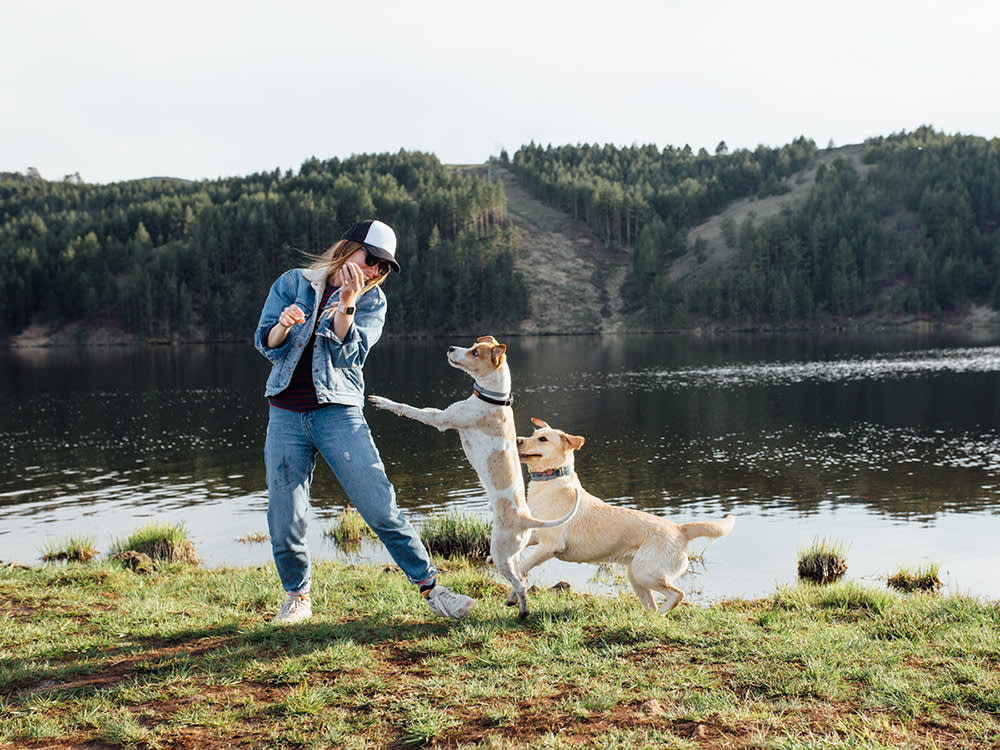
An overexcited dog can turn a simple hello into a hazard. A hard jump can knock over a child or an older relative, scratch an arm, or catch someone in the face as they bend down. And it tends to feel personal, like the dog is defying you or trying to run the show.
They’re not. Jumping is one of the most misread behaviors in dogs, and once you understand what’s actually driving it, the fix stops being a battle and starts being a plan.
Why dogs jump in the first place
Dogs greet by jumping because they’re excited and social, and because getting up near your face is how they’d like to say hi. That part is instinct. The reason it sticks around, though, is on us: jumping usually gets rewarded. The dog leaps, and they get attention, scratches, eye contact, a reaction. To the dog, that’s a paycheck. Even pushing them off or saying “no” can register as a reward, because it’s still attention aimed their way.
So the real goal isn’t to suppress a greeting. It’s to change what earns the payoff, and to give your dog a different, calmer way to say hello.
First, drain the tank, and not just with walks
A dog running on too much unspent energy will struggle to control any of this, so start there, but don’t stop at the leash.
Physical exercise matters, but it’s the tip of the iceberg. On its own, more walks can even build a fitter, more tireless dog. What actually takes the edge off is pairing exercise with mental work. Mental stimulation, problem-solving that engages your dog’s brain, burns energy and anxiety and can be folded right into daily life. Run through basic cues before meals. Practice new skills in short bursts. Keep it varied and fun so your dog stays engaged.
Environmental enrichment does the same job in a different way. Interactive feeding toys turn dinner into foraging and dissecting work. Tucking a few treats around the house for your dog to sniff out taps into their scenting instincts. A good chew gives a dog a legitimate outlet for pent-up energy. A dog whose brain gets a real workout has far less fuel left to launch at the mailman.
The centerpiece: teach a calmer job
Enrichment lowers the baseline, but the dog who loses their mind when guests arrive needs an actual skill to replace the jumping. This is where most of your effort should go, because teaching your dog what to do beats endlessly telling them what not to do.
Build it in layers. First, confirm the foundations, sit, come, stay, and especially “go to your mat.” If those are shaky, a group manners class or a few private sessions with a certified, reward-based trainer is a worthwhile investment. Then teach your dog to go to a specific bed or mat on cue and settle there. Once they’re eagerly parking themselves on the mat, add a “stay,” and slowly stretch both the distance you can move away and the time they hold it, rewarding with high-value treats and genuine praise.
Now make it hard on purpose. When your dog can hold a 20-to-30-second stay, start piling on distractions: clap your hands, jump up and down, plop on the floor, sing badly. Over a few weeks, work up to the real triggers, knocking on the door, ringing the bell, running back and forth. You’re teaching your dog to perform a behavior that’s physically incompatible with jumping (they can’t launch at a guest while parked on a mat), and desensitizing them to the exciting cues that used to set them off.
When they backslide, respond without a scene
Progress isn’t a straight line. Even a well-trained dog will occasionally go nuclear at the door, and how you respond teaches the next lesson. Dogs repeat what works, so the aim is to make sure jumping quietly stops working.
One effective tool is the calm time-out. When your dog cranks up the jumping, matter-of-factly remove them from the excitement. In situations you can see coming, keep a lightweight house leash on your dog indoors so you can calmly guide them to a bathroom or bedroom the moment they jump. Keep time-outs short, fifteen to thirty seconds away from the fun is plenty. If they come back out and immediately relaunch, simply repeat. They don’t get back into the party until they’ve noticeably settled. Skip the yelling and the physical wrangling; force just adds excitement and frustration and usually makes the behavior worse.
Out on a walk, use the same logic. If your dog gets overzealous about someone you meet, move them back a few feet, redirect their attention, and re-approach only when they’re calm, repeating as needed. And crucially, catch them being good, praise and reward the calm greeting, because your dog needs to know what right looks like, not just what wrong feels like.
Keep the training front and center
Time-outs help, but they can’t carry the whole project. The training exercises are the real fix; a dog who’s learned to manage their excitement in a controlled setting will hold it together far better than one relying on time-outs alone, especially when the stakes are high and everyone’s amped up.
Above all, keep in mind that your job here is to coach, not to quiz. Move slowly and let your dog set the tempo. Jumping is a habit they’ve practiced with success for a long time, and switching gears is genuinely hard for them. With patience and consistency, steady progress is the realistic goal, not overnight perfection.
People get discouraged because they expect the jumping to vanish in a week. But you’re competing with a behavior that’s been paying off for years. Every calm greeting you reward is a deposit. Stack up enough of them and the calm version quietly becomes the dog’s first instinct.
What newer research adds
Behavior scientists have started studying jumping-up specifically rather than lumping it in with general “misbehavior,” and the findings back up the reward-based approach. Work applying the principles of applied behavior analysis to jumping has shown that identifying exactly what reinforces the leap for a given dog, usually attention, and then systematically rewarding an alternative, calm behavior instead resolves it more durably than punishment. Broader reviews of dog-training methods continue to find that reward-based, force-free techniques produce better long-term behavior and a stronger relationship, while aversive methods raise the risk of fear and aggression. In short, the gentlest approach is also the one that works best, which is a rare and welcome overlap.
References
- VCA Animal Hospitals. “Dog Behavior Problems: Greeting Behavior — Jumping Up.” https://vcahospitals.com/know-your-pet/dog-behavior-problems-greeting-behavior-jumping-up
- Feuerbacher, Erica N., and Clive D. L. Wynne, et al. “Using Principles from Applied Behaviour Analysis to Address an Undesired Behaviour: Functional Analysis and Treatment of Jumping Up in Companion Dogs.” Animals, vol. 10, no. 6, 2020. https://doi.org/10.3390/ani10061037
- Ziv, Gal. “The Effects of Using Aversive Training Methods in Dogs — A Review.” Journal of Veterinary Behavior, vol. 19, 2017, pp. 50–60. https://doi.org/10.1016/j.jveb.2017.02.004
Common questions
How do I stop my dog from jumping on guests?
Manage the greeting so jumping never gets rewarded: use a leash or gate at the door, and have guests ignore the dog until all four paws are on the floor. Pair that with training an incompatible behavior, like going to a mat and staying, so your dog has a calm job to do when people arrive.
What should I train my dog to do instead of jumping?
Teach a behavior that can't happen at the same time as jumping, most commonly a solid 'go to your mat' and 'stay,' or a sit for greetings. Reward that heavily, and it becomes your dog's new default when they're excited.
My dog has endless energy. How do I calm them down?
Physical exercise is only part of it. Add mental stimulation and enrichment, like food puzzles, scent games, and short training sessions, which tire a dog out and build self-control far better than walks alone.
Dr. Chen is a small-animal veterinarian who leads health and safety coverage at The Pet Times. She writes and reviews the bulk of our illness, condition, and safety content, translating clinical guidance into clear, practical advice owners can act on at home.
Meet our experts ↗Keep reading
 TrainingYour 'Dominant' Puppy Is Just a TeenagerDr. Nina Kohl · 5 min
 TrainingYour Dog Isn't Being Stubborn. You're Paying Them to PullDr. Mara Chen · 8 min
 TrainingAnti-Bark Devices Don't Stop Barking. They Punish a Sentence You Can't ReadSasha Ford · 7 min
 TrainingThe Viral 'Run Away From Your Dog' Trick Works. You Get to Use It Once.Dr. Mara Chen · 7 min
 TrainingNo Dog Is "Untrainable." Some People Just Quit.Dr. Nina Kohl · 8 min
 TrainingYes, You Can Potty Train a Senior Dog. Start Here.Dr. Ravi Mehta · 6 min