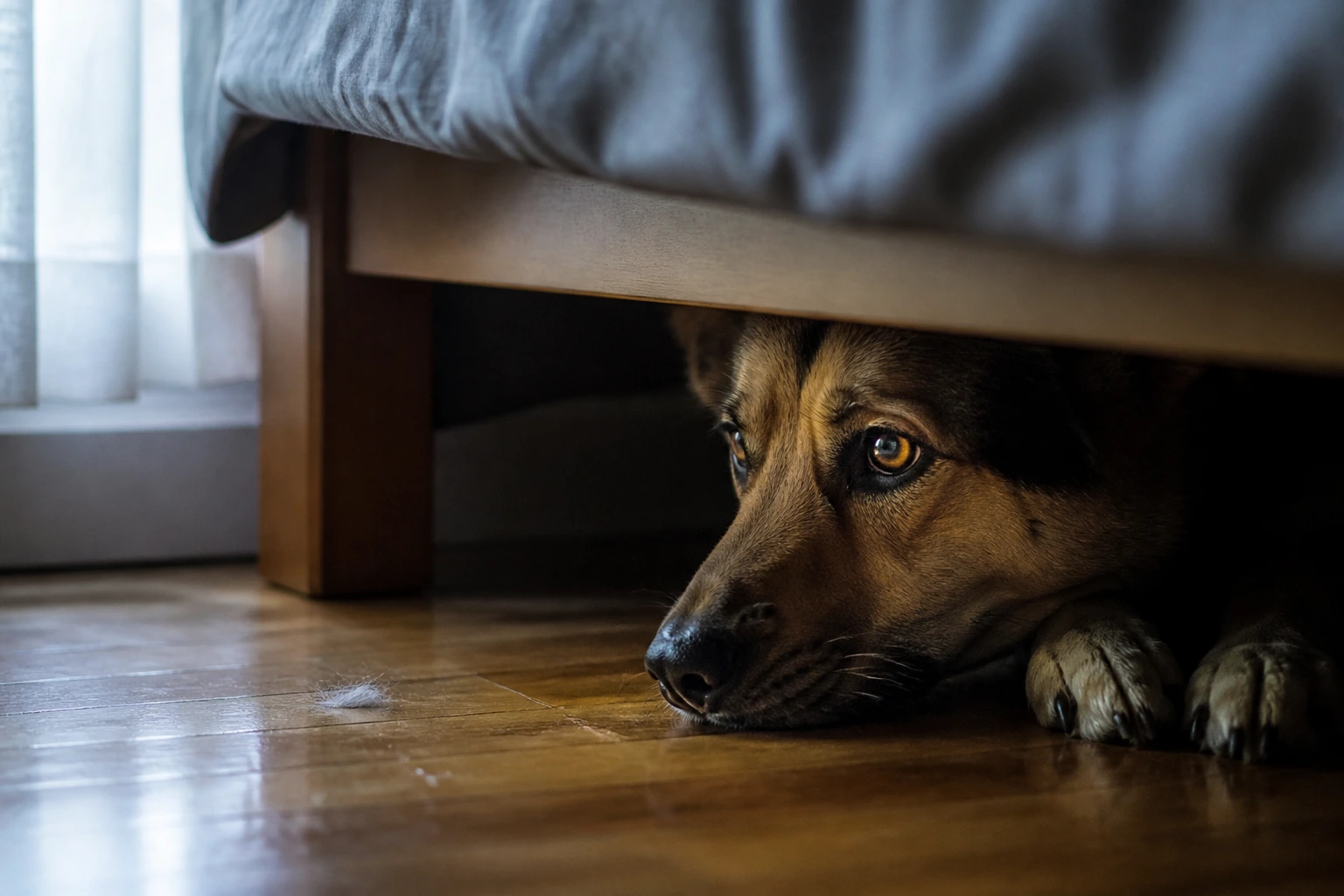
If my dog Willy could squeeze under the bed during a thunderstorm, he would. The bed sits too low, so instead he wedges himself under the bathroom sink, into my son’s closet, or into any tight space he can find. Willy is a Collie mix I rescued as a puppy eleven years ago, and he is like a lot of dogs: when he feels anxious, overwhelmed, or unwell, he instinctively seeks out a den-like space. The enclosed spot gives him a sense of protection, dials down the sensory overload, and helps him feel secure. Plenty of people can relate to wanting exactly that.
So a dog hiding under the bed is not a mystery to be alarmed by. It is communication. The behavior itself is normal and often healthy. The real skill for an owner is learning to read it, because the same posture, a dog tucked into a small dark space, can mean “I am coping just fine” or “something is genuinely wrong.” This piece is about telling those apart.
“Hiding is one of the ways dogs self-soothe, the same way other dogs lick or chew when they are stressed,” says Dr. Amara Solis. “Usually it comes from feeling overwhelmed, overstimulated, or unsure about what is happening. The behavior is not the problem. The question is always what is driving it.”
Why the den instinct runs so deep
To understand the under-the-bed retreat, it helps to look back at how dogs evolved: in close-knit groups that slept curled together in dens. Seeking safety in a cave-like space when danger threatens, real or merely perceived, is written into that history. What you want to watch alongside the hiding is the intensity of the distress. Occasional retreating is ordinary. Trembling, shaking, heavy panting, or persistent whining tells you the fear has tipped into something worth addressing.
Below are the common triggers, and what to do about each.
Loud noises and environmental triggers
Dogs are exquisitely sensitive to loud sounds, especially fireworks, thunder, and gunfire. Hiding driven by these can be intense. Helpful tools include calming chews and sprays, canine ear protection like specialized earplugs or soft ear-covering bands to dampen sound, a quiet room without windows, and calming music for dogs who respond to it. For severe noise phobia, a vet can prescribe medication such as trazodone or gabapentin to give before a predictable event like the Fourth of July.
Thunderstorms
Storms rank near the top of the list. It is not only the thunderclaps; dogs can sense the drop in air pressure ahead of a storm and start to worry before the first rumble. Fireworks-heavy nights like the Fourth of July and New Year’s Eve are especially hard, and for storms and fireworks alike, smoke and ash carry scents that can push a sensitive dog into panic.
Construction and everyday racket
If you have ever endured a jackhammer, you understand. The ordinary noise of modern life, construction, car alarms, smoke detectors, vacuums, blaring music, is stressful to dogs precisely because they have no context for it. A big change, like moving from a quiet suburb to a busy city, can flood a dog with unfamiliar sound they have no framework to process.
Tension in the house
Conflict affects pets as much as people. It is not only the raised voices; humans emit different scents when we are angry, stressed, or sad, and dogs are perceptive enough to catch those shifts even when we think we are hiding them. A dog who disappears during arguments is reacting to more than volume.
Baseline anxiety
Some dogs are simply wired to be more anxious, whether from limited socialization as a puppy, poor breeding, a lack of training, or the home environment. If your dog hides for no obvious reason, a qualified trainer or behaviorist can help build their confidence by giving them a job, structured exercise, and proper outlets for mental stimulation, all of which lower baseline anxiety over time.
A new pet
Triggers arrive when you least expect them. Bring home a bird, a cat, or another dog, and the unfamiliar smell, sound, and sight can send your resident dog under the bed. Introduce any new animal slowly, and for a new dog, arrange a neutral meet-and-greet before moving them in.
Strange visitors
Certain breeds, Shiba Inus, Chow Chows, Basenjis, and Akitas among them, carry more natural “stranger danger” than others and may hide when they feel threatened. Let your dog approach guests on their own terms, allow sniffing, and have the visitor offer a treat rather than reaching for the dog. Read the body language and do not push. It is completely fine, and far safer, if your dog chooses not to interact, since bites often happen when a stressed dog’s warning signals get ignored.
A changed environment
Dogs thrive on routine and notice disruptions: a family member moving in or out, furniture rearranged, and above all a move to a new home. Familiar scents help enormously, so bring along an unwashed blanket or bed from the old place, and stay calm and matter-of-fact yourself. Dogs feed off our energy, and a confident owner helps a nervous dog settle.
When hiding is about the body, not the mind
Here is the part that turns a behavior article into a health one. Dogs communicate through body language, vocalization, and behavior, and a sudden urge to hide can be your first clue that something physical is wrong. If your dog is tucked under the bed and also trembling, whining, panting, or drooling, call your veterinarian.
“In the wild, showing pain marks an animal as an easy target, so many animals learn to hide it,” says Dr. Amara Solis. “Dogs carry that instinct. Sometimes a pet hides simply because they do not feel well or they hurt. Ruling out pain is the first step to helping them, so any sudden, out-of-character hiding is worth a vet’s eyes.”
Learning your dog’s normal body language, ear and tail position, posture, the look of their eyes, lets you catch trouble early and often intervene before it escalates. A few specific health-adjacent reasons a dog may hide:
- Pain or vulnerability. Feeling hurt triggers the instinct to seek a protected spot.
- Rest and recovery. Some dogs retreat to a quiet den after a long walk or burst of activity, which is perfectly normal.
- Age. Older dogs are more prone to arthritis, joint pain, and illness, and that discomfort can revive the urge to hide.
Personality and breeding play a part
Just as some people are more anxious than others, so are some dogs. Reputable breeders test not only for health but for temperament, aiming to produce confident, stable-minded dogs, while puppy mills and backyard breeders often test for nothing and can pass anxious traits to their pups. Genetics shape the burrowing habit too: Siberian Huskies carry a strong burrowing instinct rooted in staying warm in cold climates, and Dachshunds, terriers, and some toy breeds were bred to go to ground, so you are as likely to find them tunneling under the covers as hiding under the bed.
Two groups deserve extra patience. Dogs with an anxious temperament, the pacers, whiners, lip-lickers, and ear-pinners, often benefit most from more exercise, more mental stimulation, and a professional’s help building confidence, since for them action genuinely relieves anxiety. And rescue dogs, whose histories are usually unknown, may find hiding a natural response to triggers no one can predict. Introduce new experiences slowly so you do not overwhelm them and trip the fight-or-flight response that hard beginnings can leave behind.
What newer research adds
How common is the fear behind a lot of this hiding? More common than most owners assume. A study of nearly 14,000 dogs published in Scientific Reports found that noise sensitivity was the single most prevalent anxiety-related trait, affecting about 32 percent of dogs, with fear of fireworks the most common subtype at roughly 26 percent. The same research found noise sensitivity tends to increase with age, which helps explain why a dog who once shrugged off thunder may start hiding from it in their senior years. The reassuring part is that fear this widespread is also well studied, and the tools, from desensitization and counter-conditioning to vet-prescribed anti-anxiety medication, are more effective than they have ever been. If your dog’s hiding is frequent or intense, that is a conversation worth having with your vet or a behaviorist, not something to simply wait out.
Above all, be gentle. A dog under the bed is asking for safety. Give it to them, figure out what they are telling you, and call the vet when the message points at the body.
References
- Salonen, Milla, et al. “Prevalence, Comorbidity, and Breed Differences in Canine Anxiety in 13,700 Finnish Pet Dogs.” Scientific Reports, vol. 10, 2020, www.nature.com/articles/s41598-020-59837-z.
- Okamoto, Kazuya, et al. “Factors Influencing the Development of Canine Fear of Thunder.” Applied Animal Behaviour Science, vol. 270, 2024, www.sciencedirect.com/science/article/pii/S0168159123003118.
- Carbone, Larry. “Do ‘Prey Species’ Hide Their Pain? Implications for Ethical Care and Use of Laboratory Animals.” Journal of Applied Animal Ethics Research, vol. 2, no. 2, 2020, pp. 216–236, brill.com/view/journals/jaae/2/2/article-p216_6.xml.