Wet food has a lot going for it. Vets often recommend it, it helps with hydration, and introducing it early tends to head off the picky-eater problem down the road. It has exactly one real drawback: unlike a bowl of kibble, it can’t sit out indefinitely. And the key to handling that drawback is understanding a single moment, the instant you peel back the lid.
A sealed can is essentially a sterile little vault. The food inside was cooked and then sealed away from the outside world, which is why an unopened can stays safe on a shelf for a very long time. Opening it ends that protection. The second air and household microbes reach the food, a clock starts, and the rule of thumb for that clock is four hours. Here’s how to read it, when it runs faster, and what to do with what’s left.
The four-hour rule, and what bends it
As a general guideline, canned or wet cat food shouldn’t stay at room temperature beyond about four hours. In plenty of situations, a shorter window is smarter. The reasoning is straightforward: as soon as the seal is broken, microbes from the environment land on the food, and the longer it sits at room temperature, the more they multiply and the higher the chance of spoilage or of introducing something that could make your cat sick.
A few things move that four-hour ceiling:
- Heat shrinks it. If the food is somewhere warm, sitting outside in the heat, or in a room without climate control, the safe window gets shorter, because many germs flourish faster in warmth.
- Cold extends it, a little. Feeding outdoors on a genuinely cold day buys some extra time, since many microbes don’t do well in the cold. It’s not a license to leave food out all day, but the timeline is more forgiving.
- A cover doesn’t stop the clock. Covering the food doesn’t reset the four hours. The moment the can was opened, air already reached the food, so covered wet food still shouldn’t sit at room temperature beyond four hours. Covering is for the fridge, not the counter.
- Mixing in dry food doesn’t help much. Combining canned food with fresh kibble doesn’t meaningfully slow spoilage, so stick with the same four-hour guideline. If anything, dry food that’s been stored poorly can carry extra microbes and speed things up once it’s mixed in.
That last point is a good reason to store dry food properly in the first place: seal it in a clean container, kept well away from heat and damp. And hang onto the original bag, or at least a photo of it, because it carries the lot and serial numbers you’d need in the event of a recall or a reaction.
What to do with the leftovers
Most cats don’t polish off a whole can in one sitting, so leftovers are the norm, and handling them well is the whole ballgame. Cover the remaining food, label it with the date you opened it, and get it into the refrigerator within that four-hour window. Stored that way, an opened can is good for up to three days; after that, whatever’s left should go in the trash.
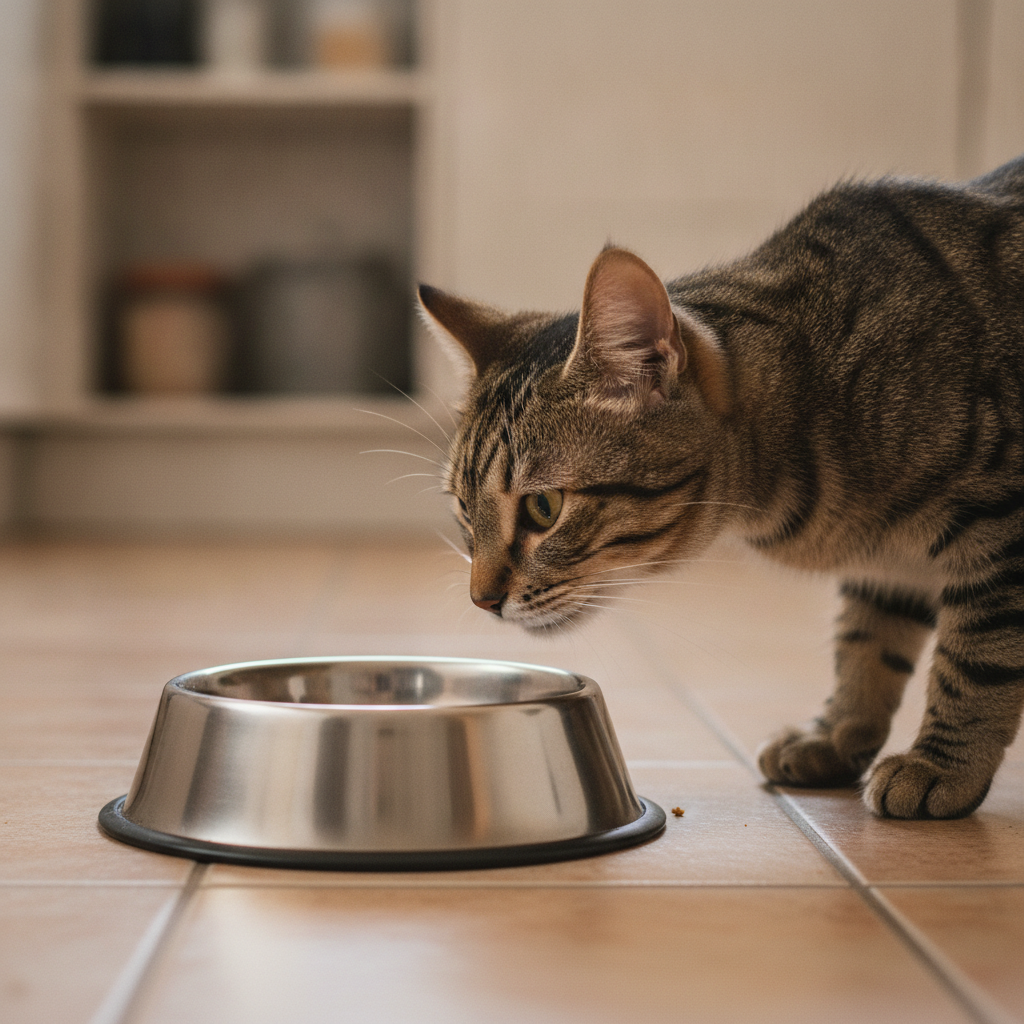
For the food in your cat’s bowl, the same logic applies at meal scale. Once your cat has eaten (or after four hours, whichever comes first), discard what’s left in the bowl and wash the bowl before the next meal. Wet food should never be left out for a full workday or overnight. Beyond the safety issue, cats are fussy enough that they’ll usually turn up their nose at food that’s been sitting out anyway; it starts to harden and dry on top, and the changed smell and texture are a turn-off.
Two more storage specifics worth locking in: set your refrigerator to 40 degrees Fahrenheit or below, which is the temperature that adequately slows bacterial growth, and know that even a properly covered, refrigerated can should still be tossed after three days. If your cat snubs cold food straight from the fridge, you’re not imagining it, many cats prefer their food at room temperature or slightly warmed, so a brief warm-up before serving can win them back.
Why it spoils at all
All food can spoil, thanks to the microbes and conditions all around us. Spoilage is simply food breaking down and becoming unsafe, usually because of contamination by bacteria or fungal spores, or because the food dried out, changed texture, or was damaged by temperature swings. There’s also a source of contamination people forget: your cat. When a cat eats part of a bowl and comes back later, microbes from their mouth are now in the leftover food, nudging it toward spoilage faster. Canning sidesteps all of this by sealing sterile food in a stable environment, right up until the lid comes off and every one of those factors comes back into play.
Current safe-handling guidance
None of this is a reason for anxiety, just for a routine. Public-health guidance from the FDA and CDC treats pet food like any other perishable: keep it out of the temperature “danger zone” where bacteria multiply fastest, refrigerate promptly, wash bowls and scoops, and wash your hands after handling it. That last part matters for you, not just your cat, since pet foods have occasionally been linked to pathogens like salmonella and listeria that can affect people in the household too. The four-hour rule and the three-day fridge limit aren’t fussy overkill; they’re the same food-safety math you’d apply to your own leftovers, sized for a can of cat food.
If the food is just sitting there untouched
Sometimes the issue isn’t safety at all, it’s that your cat keeps leaving the food, and you’re left wondering how long the untouched bowl can stay out. A sudden change in appetite always deserves a vet’s attention, because it can signal a medical problem. But if your cat is simply an unenthusiastic eater, a few common culprits are worth ruling out:
- They don’t love the food. Cats develop strong preferences for particular textures, flavors, and formats. If interest is low, experiment a little. Offering variety, especially to kittens, also helps prevent a cat from becoming so rigid that a future medical diet switch turns into a standoff.
- They’re bored. Cats are hunters wired to work for small, frequent meals throughout the day. A bowl that appears once or twice a day can be dull. Daily play, interactive toys, climbing structures, and food puzzles help fill that gap for an indoor cat.
- They’re stressed. Stress shows up in cats in all sorts of ways, and a dampened appetite is one of them. A move, a routine change, a new person or pet, construction, or a loss in the household can all do it. Give a stressed cat a calm, private place to eat, sealed off from other pets, and consider pheromone diffusers or a hiding box. A cat that goes a full day without eating warrants a call to the vet.
- It’s a feeding-style mismatch. Because cats naturally eat many tiny meals, some do best with small portions spread across the day rather than one or two big servings, which can also curb overeating. And make sure the portions are actually appropriate, a cat routinely leaving food behind may simply be getting too much.
- They’re unwell. Always take note of appetite shifts alongside any other changes in behavior or health. Cats are experts at hiding illness, so a subtle change in eating is sometimes the only clue, and it’s a reason to get them checked.
“The four-hour number sounds arbitrary until you remember what opening the can actually does,” says Dr. Amara Solis. “You’ve broken a sterile seal, and now room-temperature food is a growth medium. Cover it, date it, refrigerate it within four hours, and toss it at three days. If your cat isn’t eating it at all, that’s a different conversation, and sometimes a medical one.”