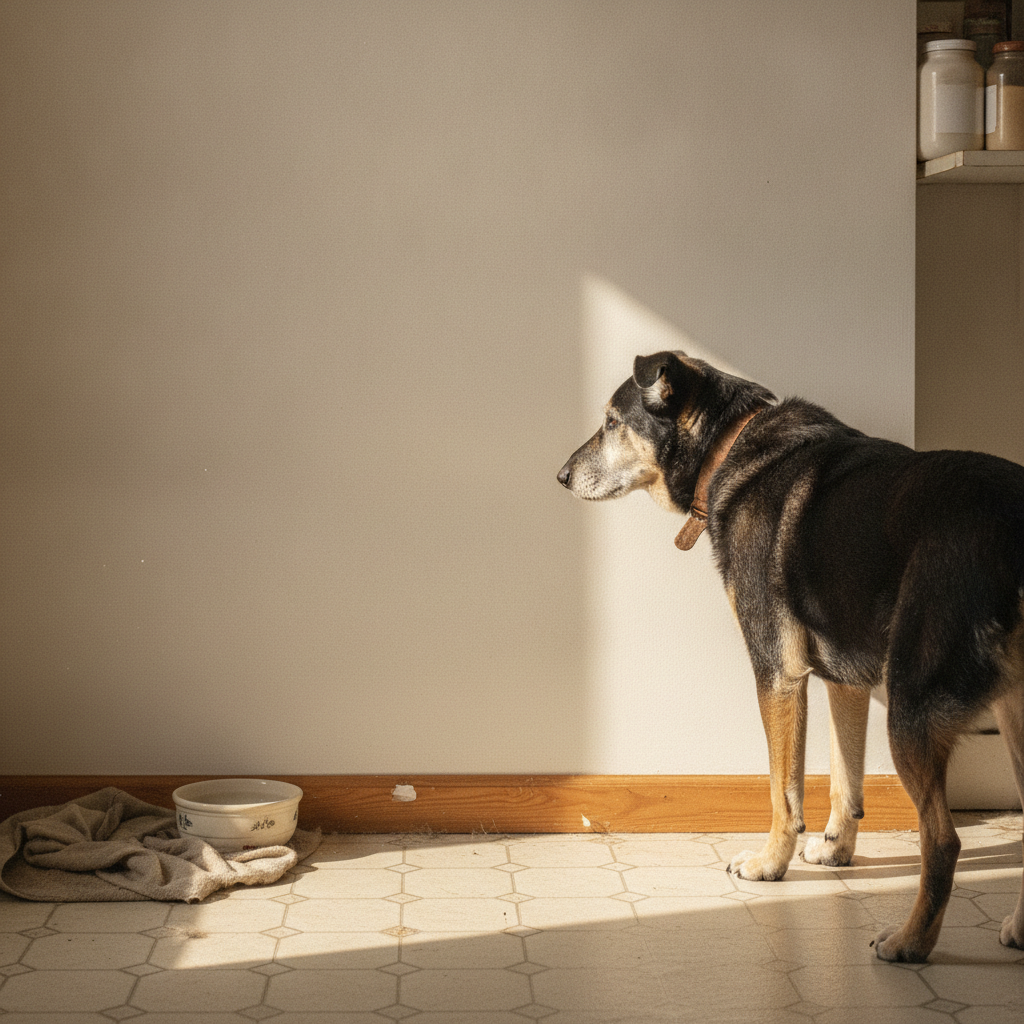
Your dog is standing in the corner of the kitchen, facing the wall. Not sniffing it. Not scratching at it. Just standing there, still, for a minute or more, apparently looking at nothing.
If your dog is two, this is almost certainly a bug, a shadow, or a mouse behind the plasterboard, and it isn’t worth another thought.
If your dog is ten, this is one of the most under-recognised clinical signs in small-animal medicine, and the numbers behind that claim are genuinely startling.
The number that should reorganise how you read this behavior
Studies of canine cognitive dysfunction, dementia in dogs, find prevalence estimates ranging from around 14 per cent to 35 per cent of dogs over the age of eight, climbing steeply with age. In one dataset, 28 per cent of dogs aged 11 to 12 showed at least one symptom category. By 15 to 16 years old, it was 68 per cent.
Now the other number. Only about 1.9 per cent of dogs over eight are formally diagnosed with it.
Put those side by side. A condition that affects somewhere between one in seven and one in three older dogs is being diagnosed in roughly one in fifty. Research suggests that up to 85 per cent of affected dogs are never identified.
That is not a small gap. That is a system-wide miss, and it happens for a reason that’s easy to sympathise with: the signs look like getting old. The dog sleeps more. The dog seems a bit vague. The dog stands in a corner sometimes. Everyone, owners and vets alike, files it under “he’s just an old man now,” and nobody says it out loud in the exam room.
Wall-staring is one of the earliest and most visible things on that list. Which makes it worth taking seriously in a way almost nobody does.
But first: is your dog old?
Everything below splits on that question, so answer it before you read on. If your dog is young and healthy and this is occasional, the boring explanations are almost certainly right, and here they are.
Something is there. Dogs detect motion far better than we do, hear ultrasonically, and smell at a resolution we can’t imagine. A bug. A shadow moving across the wall from a car outside. A reflection. A pipe. A mouse. Genuinely, a mouse: dogs hearing rodents in a cavity wall is common and correct, and more than one infestation has been diagnosed by a dog before an exterminator.
They’ve learned it works. If your dog stared at a wall once and you rushed over, gasped, and gave them attention and a treat, congratulations: you have trained a wall-starer. Dogs are excellent at finding out what generates a reaction. If the staring only happens when you’re in the room and stops the second you engage, this is the answer.
They’re bored, or stressed. A dog with nothing to do will find something to do, and staring into space is one of the cheaper options. Environmental change, a move, a new baby, a change of routine, can also produce odd, self-soothing, disengaged behaviors.
Check the wall. Genuinely, get up and look. Then rule out the attention loop by not reacting for a few days and seeing whether it fades.
If your dog is young, that’s usually the end of it.
The four that need a vet
Now the other half, and this is what the article is actually for.
1. Canine cognitive dysfunction
The big one, and the reason for the numbers above.
CCD is progressive neurodegeneration. It’s biologically similar to Alzheimer’s disease in humans, right down to the accumulation of beta-amyloid plaques in the brain. And crucially, it is treatable, in the sense that its progression can be slowed — which is exactly why the diagnosis gap matters. A missed diagnosis is a lost opportunity, not just a label.
Vets use the mnemonic DISHAA:
- Disorientation: getting stuck behind furniture, standing on the hinge side of a door, going to the wrong door, staring at walls.
- Interaction changes: less interest in greeting you, or unusual clinginess.
- Sleep-wake cycle disruption: awake and pacing at 3am, asleep all day. This is often the sign that finally drives owners to the vet, because it wrecks their sleep too.
- House-soiling: an old dog who was reliably clean for a decade suddenly isn’t.
- Activity changes: aimless pacing, repetitive circling, or a general withdrawal from things they used to enjoy.
- Anxiety: new fearfulness, new separation distress, agitation at dusk.
The wall-staring specifically is the disorientation item. So is the dog who goes to the hinge side of the door and waits to be let out. If you’ve seen that one, take it seriously.
2. Focal seizures
A dog having a focal (partial) seizure can look like they’re zoned out or “paused.” No collapse, no thrashing, just a blank, unresponsive episode, sometimes with lip-smacking, chewing at nothing, twitching in one part of the face, star-gazing, or snapping at invisible flies.
The distinguishing feature is unresponsiveness. A dog staring at a bug will break off and look at you if you call them. A dog in a focal seizure won’t, or will respond slowly and strangely, and may seem disoriented afterwards.
Film it. Twenty seconds of phone video is worth more than any description you can give, and it’s often what turns a shrug into a diagnosis.
3. Vision loss
Dogs lose their sight gradually and compensate brilliantly, which is why owners often don’t notice until the furniture gets moved.
A dog with failing vision may stare because they’re trying to resolve something they can’t quite see, and they’ll often be more hesitant near walls and doorways, bump into things in unfamiliar places, or become reluctant on stairs and in the dark.
4. The rest
Liver disease (hepatic encephalopathy, where toxins the liver should be clearing affect the brain, produces exactly this kind of vacant, disoriented behavior), brain tumours, vestibular disease, and high blood pressure can all present with odd staring or disorientation.
These are the reason “wait and see” is the wrong call in a dog whose behavior has genuinely changed.
The test that closes the gap
Here’s the practical, actionable thing, and it’s free.
There is a validated screening questionnaire called the Canine Cognitive Dysfunction Rating scale (CCDR). It’s 13 questions about your dog’s behavior, it takes about five minutes, and it produces a score. It is not a vague vibe check: in the validation work, the CCDR showed around 98.9 per cent diagnostic accuracy, with a negative predictive value above 99 per cent.
That last figure is the useful one. It means that if your dog scores in the clear on the CCDR, the chances they actually have cognitive dysfunction are extremely low. You can stop worrying with real confidence.
And if they don’t score clear, you walk into your vet’s office with a completed, validated instrument instead of a hunch and an anecdote, which is a fundamentally different conversation.
If you have a dog over eight, take it. Ask your vet for it, or look up the CCDR. It is the single highest-value five minutes available to the owner of an old dog, and virtually nobody does it, which is precisely why the diagnosis rate sits at two per cent.
“Owners come in and apologise for wasting my time, and then describe six textbook signs of cognitive dysfunction,” says Dr. Nina Kohl. “They don’t mention it because they think it’s just age, and honestly, for a long time we told them that. The frustrating part is that there is a real window here: diet, enrichment, and medication genuinely slow this down, and they work best early. The dogs we catch late, we can comfort. The dogs we catch early, we can help.”
What actually helps
If your dog is diagnosed, the news is better than most people expect. Nothing reverses it. Several things measurably slow it.
- Diet. Prescription diets formulated for cognitive support, typically built around medium-chain triglycerides, which give the ageing brain an alternative fuel source, along with antioxidants, have clinical trial data behind them.
- Medication. Selegiline is licensed for cognitive dysfunction in dogs and helps a proportion of them. Anti-anxiety medication is often more useful in practice than owners realise, particularly for the night-time agitation.
- Supplements. Omega-3 fatty acids, antioxidants, and specific formulations with evidence behind them. Ask your vet which ones actually have trial data, because most don’t.
- Enrichment, which is genuinely medicine here. Mental work slows cognitive decline in dogs, and the effect is real. Short training sessions, food puzzles, scent games, novelty. An old dog is not too old to learn, and the learning is doing something protective.
- Structure. Rigid routine, night lights, blocking access to the places they get stuck, and keeping the furniture where it is. A predictable environment is worth a great deal to a brain that has lost some of its map.
What newer research adds
Two developments matter.
The first is that screening is finally being taken seriously, and there’s now a small family of validated tools, the CCDR, the Canine Dementia Scale (CADES), and the Canine Cognitive Assessment Scale (CCAS). Recent comparison work has looked at how they perform against each other, and the honest finding was that the tool you use changes how many dogs you catch. It also found that even under screening, a large fraction of dogs showing genuine signs were still undiagnosed. The takeaway isn’t that one questionnaire is perfect. It’s that using any of them beats using none, which is the current default.
The second is a broader shift in attitude: veterinary professionals themselves report that CCD is under-diagnosed, and that the barriers are practical, time in a consult, owner reluctance to raise it, and a perception that little can be done. That last belief is the one that’s out of date, and it’s the reason to bring this up yourself rather than waiting for it to come up.
Which is the whole point of this article. Your vet may not ask. You should tell them.
FAQ
My young dog stares at the wall sometimes. Should I worry? Almost certainly not. Check for bugs, shadows, reflections, and noises in the wall, and make sure you’re not accidentally rewarding it with attention. If it’s occasional and your dog is otherwise normal, it’s a curiosity, not a symptom.
How do I tell a seizure from ordinary staring? Responsiveness. A dog watching something will break off when you call them. A dog in a focal seizure won’t, and may seem disoriented afterwards. Film it and show your vet.
Is dementia in dogs actually treatable? Not reversible, but genuinely slowable. Diet, medication, supplements, and mental enrichment all have evidence behind them, and they work best when started early, which is why the diagnosis gap matters so much.
What’s the CCDR? A validated 13-question screening questionnaire for canine cognitive dysfunction. It takes five minutes, it’s highly accurate, and if you have a dog over eight, it’s the best five minutes you can spend on their health this year.
When should I go to the vet about wall-staring? If your dog is a senior, if the behavior is new, if it’s escalating, if they’re unresponsive during it, or if it comes with pacing, night-time waking, house-soiling, disorientation, or a change in how they interact with you.
References
- Salvin, H.E., et al. “The canine cognitive dysfunction rating scale (CCDR): A data-driven and ecologically relevant assessment tool.” The Veterinary Journal, 2011. https://pubmed.ncbi.nlm.nih.gov/20542455/
- “Comparing standard screening questionnaires of canine behavior for assessment of cognitive dysfunction.” Frontiers in Veterinary Science, 2024. https://www.frontiersin.org/journals/veterinary-science/articles/10.3389/fvets.2024.1374511/full
- “Assessment of risk factors in dogs with presumptive advanced canine cognitive dysfunction.” PubMed Central, 2022. https://pmc.ncbi.nlm.nih.gov/articles/PMC9622924/
- “Updates on Cognitive Dysfunction Syndrome.” Today’s Veterinary Practice. https://todaysveterinarypractice.com/behavior/updates-on-cognitive-dysfunction-syndrome/
- “Attitudes of Australian Veterinary Professionals to Diagnosing and Managing Canine Cognitive Dysfunction.” PubMed Central, 2025. https://www.ncbi.nlm.nih.gov/pmc/articles/PMC11945432/
- “Seizures in Dogs.” American College of Veterinary Internal Medicine. https://www.acvim.org/