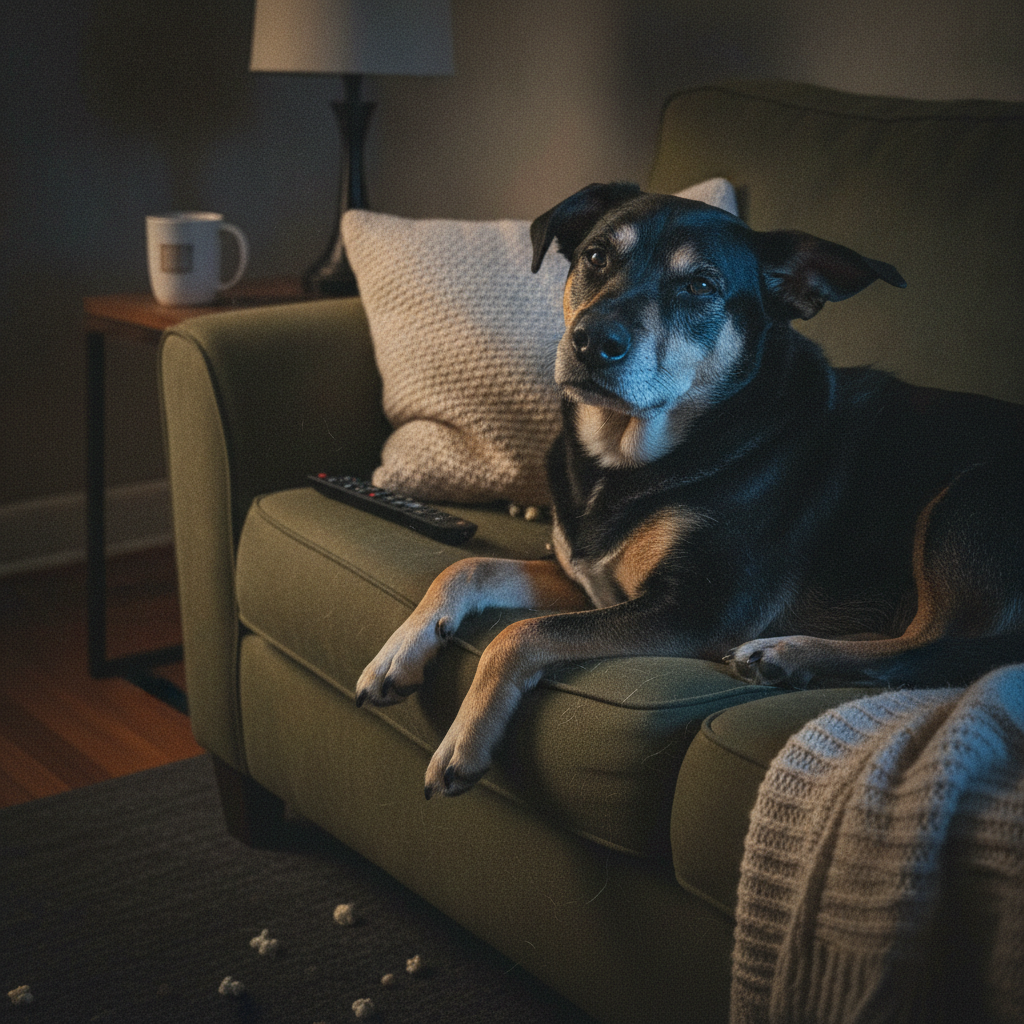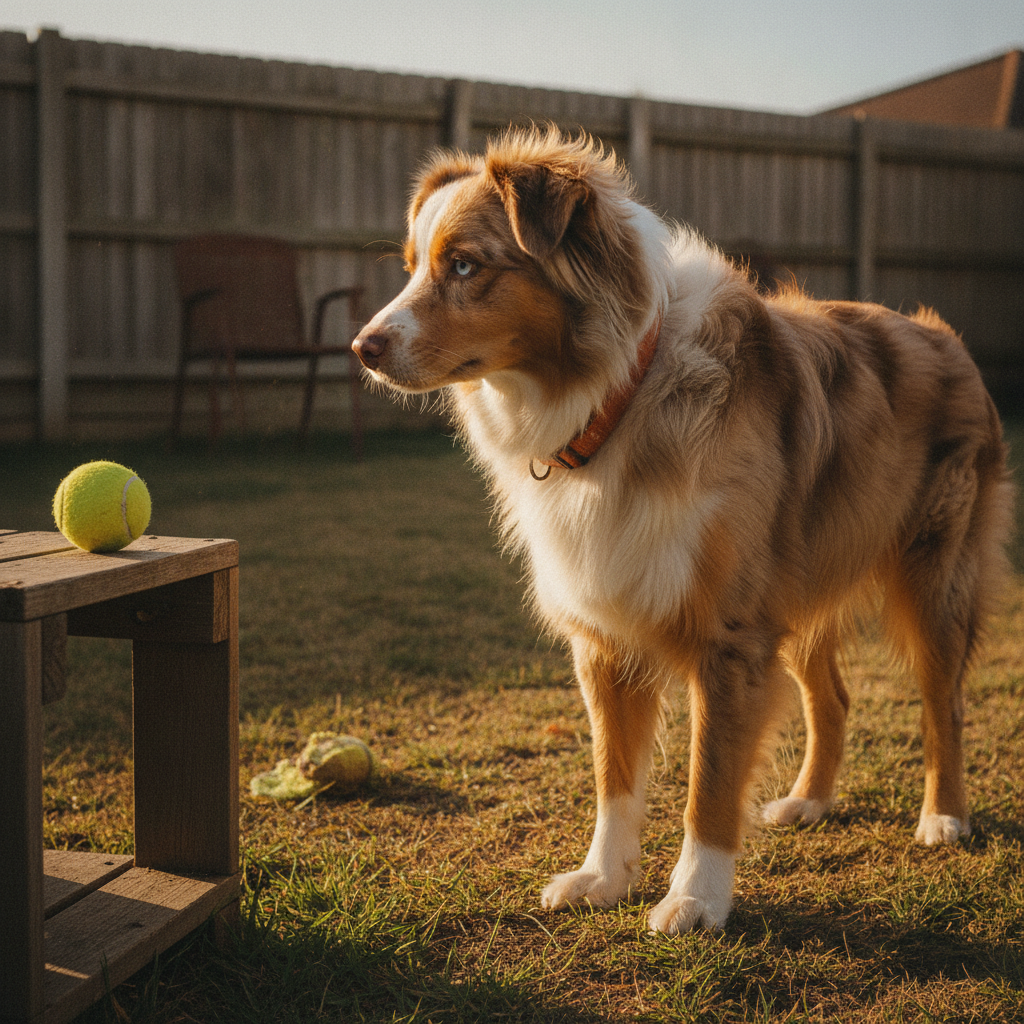
Two dogs, same yard, same tennis ball. One vibrates at 8,000 RPM and would happily chase it until they collapse. The other watches it roll into the grass with the expression of someone being shown a stranger’s holiday photos.
Neither of them is broken. But if you have the first dog, there is a decent chance you are misreading the situation, because the version of ball obsession that people brag about is often the version worth looking at closely.
Start with what the ball actually is
To a dog, a rolling ball is a small animal running away.
That is the whole trick. The chase sequence in dogs runs roughly orient, eye, stalk, chase, grab, kill, dissect, consume, and selective breeding has amplified some links in that chain and suppressed others in different types of dog. A ball hijacks the front half of it, brilliantly. It moves erratically, it flees, it is catchable, and it never fights back. The reward system built for hunting fires anyway.
That is why fetch is so much more compelling to most dogs than, say, a chew: it is not a toy so much as a simulator.
Which also explains the dogs who shrug. If the chase links in that chain are weak in a given animal, a ball is just an object. It is not an insult and it is not a training failure. It is a dog whose hardware is tuned for something else.
The breed story is real, and much smaller than you think
You will hear that retrievers retrieve, herding dogs cannot stop chasing movement, and terriers were built to go after small scurrying things, and all of that has a basis. Sporting dogs were selected to pick objects up and bring them back to a person, which is an unusual and quite specific behavior to have running in the background. Herding dogs, the Border Collies and Aussies and Shepherds and Malinois and Cattle Dogs, were shaped to control the movement of anything in their field of vision, animate or not. Terriers were bred to hunt rodents, are independent thinkers about it, and their interest in a ball is closer to hunting than to fetching.
Here is the correction. In 2022, a team led by Kathleen Morrill published a study in Science covering 18,385 dogs, with more than 2,000 genomes sequenced, and found that across eight behavioral factors, breed accounted for an average of only about 9 percent of the behavioral variation between individual dogs.
So breed shifts the odds. It does not deal the hand. The Labrador who has never once returned a ball and the Basset who will not stop are both entirely ordinary outcomes, and you should be planning around the dog in front of you rather than the group they were filed under.
Energy level and age move the needle too. Dogs outside the sporting, herding, and terrier groups often lean toward a lower-key life, and for plenty of them a daily amble of somewhere between half a mile and a mile, taken slowly, with the nose allowed to do its work, is all the stimulation the day actually requires. Almost all dogs, even the constitutional couch potatoes, run hotter as puppies than as adults, so a young dog’s interest in a ball may be youth rather than drive, and it may fade. A dog with true chase or retrieve drive, on the other hand, does not usually grow out of it. They just get less stamina to act on it.
Often, it was never about the ball
Watch closely and you will notice that many fetch-obsessed dogs are not obsessed with the object at all. They are obsessed with the fact that you are participating.
Dogs are social animals, and we are social animals, and that overlap is most of why the arrangement has worked for tens of thousands of years. For one dog, fetch is about the chase. For another, the chase is incidental and the point is that their person is on the floor, engaged, throwing something, watching them, doing this together. Take away the human and the ball loses most of its magic.
A lot of dogs treat fetch as a job, and get the same drive out of it that a working dog gets out of stock work. That is not pathology, that is a dog with a vocation.
“Half the fetch-obsessed dogs I see are not obsessed with a ball, they are starved for a shift,” says Dr. Priya Nair. “The ball is just the only clock they get to punch.”
When enthusiasm turns into a problem
Now the part the internet gets wrong, because a dog who will chase a ball to the point of collapse is treated as a charming quirk rather than a flag.
The distinction is not intensity. It is the off switch.
Run the test. Make the ball unavailable, then look at what the dog does with the next twenty minutes. A healthy fetch fanatic is disappointed, casts about, then finds something else to do. A dog sliding toward compulsion will keep working the problem: fixating on where the ball went, barking at the cupboard, refusing food, refusing other kinds of play with you, unable to settle. A dog who will pass up dinner and pass up your attention in a determined effort to get back to the ball has stopped playing.
Two other markers matter. First, the frantic dog who becomes stressed and anxious when they cannot get their fix, rather than a dog whose anxiety drove them to the ball in the first place. The causation usually runs the way you would not guess. Second, the drift into related behaviors: shadow chasing, snapping at reflections on the wall, staring at the spot where light hits the floor. That is the point where a fixation stops being a hobby and starts being a welfare problem, and it is worth a veterinary behaviorist rather than a longer throw.
And the most useful reframe available: a dog labeled “too obsessed with the ball” is very often an understimulated dog whose fetch session is the single hour of the day when they get to be fully alive. The obsession is not the disease. It is the symptom of a life with exactly one outlet.
The dogs who do not care, and the ones who stopped caring
An indifferent dog is usually just an individual with a low chase drive, and the honest advice is to stop trying to install one. You can absolutely make fetch more fun through training and play, and some dogs learn to love a game they did not initially understand. But the better use of your energy is to find out what actually lights your dog up. Tugging. Digging. Chewing. Flirt poles. Scent games. Puzzle toys. Long, unhurried walks with the nose down. Every dog has a thing. Find theirs rather than campaigning for yours.
There is one exception, and it deserves a hard line: a dog who used to love fetch and has quietly stopped is a medical question, not a personality development.
The usual culprits:
- Weight. Obesity is extremely common in pet dogs, it is devastating to their long-term health, and a heavy dog physically cannot do what a lean dog does. Loss of interest in play is often loss of ability to play.
- Joint pain. Arthritis, hip and elbow disease, and cruciate injuries all take the fun out of sprinting and stopping.
- Dental pain. A dog with a painful mouth does not want to carry things in it. Dental disease is easy to miss and very common.
- Vision loss. Dogs are remarkably good at compensating for fading sight and hearing, and by the time an owner notices, the decline has usually been progressing for months. Sometimes the first visible sign is a dog who stops chasing things they cannot track anymore.
A dog who no longer enjoys what they used to enjoy is telling you something. Book the exam.
Playing fetch better, if your dog is a fetch dog
Watch the surface and the stop. Repeated high-speed sprints ending in a hard skidding brake are rough on joints, particularly on hard ground and particularly for growing dogs. Rolling the ball, throwing shorter, and playing on grass are all easier on the body than long, flat, maximum-velocity throws.
Build in an off switch on purpose. Ask for a sit before each throw. Teach a clean “drop” and a “that’s enough” that ends the session and is followed by something calm. A dog who has practiced stopping can stop.
Do not let them self-regulate. Many high-drive dogs will run past exhaustion, past overheating, and past pain because the drive is louder than the feedback. You are the off switch. Watch for a change in gait, a dog going flat rather than fast, and the heat, which kills more fetch dogs than anything else on this list.
Rotate the outlets. Even if your dog would do this forever, mix in tug, scent games, chew time, and training. A dog with five outlets is far less likely to slide into a fixation on one.
What newer research adds
The 2022 genomics work is the single most useful update here, and it should change how people shop and how they plan. If breed explains roughly 9 percent of behavior, then buying a Border Collie to guarantee a fetch obsession, or avoiding one to avoid it, is a bet with much worse odds than you were promised. The individual dog is the unit that matters.
The other shift worth knowing about is in how behavior professionals now talk about repetitive behaviors. Fetch fixation, shadow chasing, and light chasing are increasingly discussed on a spectrum with canine compulsive disorder rather than as isolated quirks, which means the right response to a dog who cannot stop is enrichment and a professional assessment, not more throws to “tire them out.” Tiring out a compulsive behavior tends to strengthen it.
The bottom line
If your dog does not care about balls, they are fine, and they are probably telling you what they would prefer instead if you watch for a week.
If your dog is wildly into it, that is a gift, right up until they cannot put it down. The question is never how hard your dog chases. It is whether they can stop when the ball goes away, and whether fetch is one of the good things in their day or the only one.
References
- Morrill, K., et al. “Ancestry-inclusive dog genomics challenges popular breed stereotypes.” Science, vol. 376, no. 6592, 2022.
- Coppinger, R., & Coppinger, L. Dogs: A Startling New Understanding of Canine Origin, Behavior and Evolution. Scribner, 2001.
- Association for Pet Obesity Prevention. “Pet obesity prevalence survey.”
- Overall, K. L., & Dunham, A. E. “Clinical features and outcome in dogs and cats with obsessive-compulsive disorder.” Journal of the American Veterinary Medical Association, vol. 221, no. 10, 2002, pp. 1445–1452.