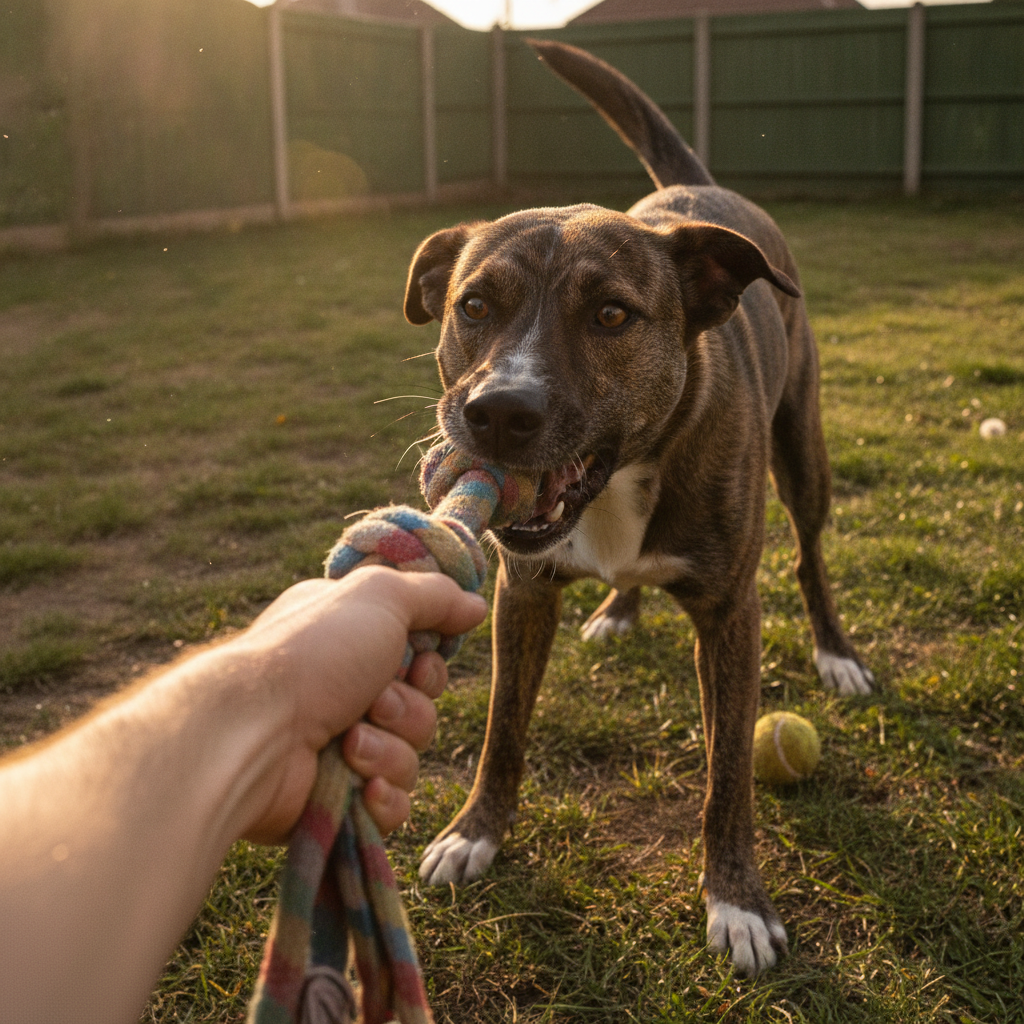
Go look at your dog’s tug toy. Really look at it. Odds are it is a rope, or a rubber ring, or a rubber ring with a rope through it, and the entire design conversation happened on the dog’s end: how tough is it, will it survive the molars, does it squeak.
Now look at your end. There is a decent chance there is no “your end” at all. You are just grabbing rope.
That is the flaw at the center of most tug toys, and it is why so many people quietly give up on the best interactive game they own. Not because the dog lost interest. Because the human’s hand hurt, or the human’s wrist got wrenched, or the human’s knuckles kept meeting teeth. The dog’s end of a tug toy is a chew-durability problem, and it is basically solved. The human’s end is an ergonomics problem, and almost nobody is solving it.
So this list is organized around your hand.
A quick note on the game itself, because the old fear still circulates: tug does not make dogs aggressive, and the “never let them win” rule was retired years ago. The real risks are over-arousal and your fingers, and both are handled by the toy you pick and the rules you keep. We have covered the behavior side at length elsewhere. Here we are shopping.
“The dog end of a tug toy gets all the engineering, and the human end gets a knot,” says Dr. Ravi Mehta. “Then people wonder why their shoulder aches and they quit playing. Pick the toy by how it fits your grip, and you will actually play it three times a week instead of three times a year.”
First, the four grips
Every tug toy hands you one of four grips, and each has a different failure mode. Knowing which one you are buying is 80 percent of the decision.
| Grip type | What it does well | Where it fails you |
|---|---|---|
| Bare rope | Cheap, floppy, dogs love the texture | Rope burn, no leverage, hands drift toward the teeth |
| Closed loop / handle | Real leverage, hand stays back | A hard yank transmits straight into your shoulder |
| Two-handed bar or long body | Distributes load, best for big dogs | Bulky, no good for small dogs or small hands |
| Flexible / stretchy | Absorbs the shock of a lunge | Less control, springs back at your face if the dog lets go |
If your dog is over about 50 pounds and pulls like they mean it, a stretchy or two-handed toy is not a luxury. It is the difference between a game and a rotator cuff.
The picks
Ten toys, sorted by the grip they give you. Prices are what these ran when this was written and they move.
1. Triangle rubber tug, about $16
A natural-rubber triangle with a reinforced core, made for puppies and adolescent chewers who have just discovered that shoelaces are food. The triangle geometry is the point: two of the three sides are always available to you, so you can rotate your grip mid-game instead of white-knuckling one spot.
Grip: closed loop. Right for: puppies and small-to-medium dogs. Tradeoff: the rubber is grippy enough that a wet-mouthed dog will win more than you expect. That is fine. Let them.
2. Rubber can with a pull tab, about $19
Non-toxic rubber, durable enough to take real pressure, with a molded pull tab that gives you something to hook a whole hand around. Compared to the triangle above, the tab is a deeper handle: you get more leverage but less ability to shift your grip.
Grip: closed loop. Right for: medium dogs, floor-level play. Tradeoff: the single handle means the load lands in one place. If you have wrist issues, size up to something two-handed.
3. S-shaped soft tug, about $20
Lightweight, flexible, and made for gentle chewers, which is a category the tug aisle mostly ignores. Small dogs need to pull too, and handing a 10-pound dog a toy built for a mastiff just means the toy sits on the floor.
Grip: flexible loop. Right for: teacup-to-small dogs, seniors, and dogs whose bark is genuinely worse than their bite. Tradeoff: a determined power chewer will get through it. It is not pretending otherwise.
4. Decagon rubber ring, about $14
A ten-sided rubber ring that looks like modern housewares and happens to be a very good tug object. The flat facets give your fingers somewhere to seat, which is more than a smooth ring will ever do, and the texture works the gums while they pull.
Grip: open ring. Right for: people who resent looking at neon plastic in their living room, and dogs who need chew-and-tug in one object. Tradeoff: an open ring means your fingers are inside the loop. Keep them at the far arc.
5. Tennis ball on a strap, about $5
The cheapest good idea in the aisle. Take the object your dog already wants and attach a handle to it, and you have bridged fetch and tug into one game, which is exactly how you get a dog to bring the ball back.
Grip: strap. Right for: moderate chewers, ball-obsessed dogs, and anyone whose fetch retrieve is falling apart. Tradeoff: a strap has no rigidity, so all the shock goes into your arm. Fine for a 30-pound dog, rough for a 90-pound one.
6. Solid rubber ring, about $40
The armored option: a thick circular toy rated for hard chewers and dogs up to about 120 pounds. The premium buys you a toy that outlives several others, and a wall thickness that keeps teeth away from your fingers by simple geometry.
Grip: open ring, two-handed if you want it. Right for: power chewers and big dogs. Tradeoff: it is heavy and it is the most expensive thing here. For a gentle 15-pound dog it is overkill you will never use.
7. Stretchy rubber tug, about $16
The shock absorber. It stretches under load, which does two things: it takes the jolt out of a hard lunge before it reaches your shoulder, and it lets two dogs play a three-way game with you without anyone getting yanked off their feet.
Grip: flexible, comfortable. Right for: enthusiastic pullers, multi-dog homes, humans with cranky joints. Tradeoff: when the dog releases, it snaps. Do not play it at face height.
8. Wide-handled trail loop, about $25
Built for both ends, which is rare enough to be worth calling out. The handle is wide and padded rather than a thin cord, so a hard pull spreads across your palm instead of cutting a line into it. It is waterproof and trail-rated, and it doubles as a reward object for training “drop it.”
Grip: wide handle. This is the best pure handle on the list. Right for: hikers, water dogs, and anyone using tug as a training payoff. Tradeoff: the price is real for a toy that floats.
9. Fleece “flirt pole” tug, about $25 (added)
Not on anybody’s tug list, and it should be. A flirt pole is a pole, a bungee line, and a lure, and it is the only tug-family toy that keeps the dog’s mouth an entire arm’s length plus a pole’s length away from your hands. For a dog who gets genuinely wired during tug, it is how you get the workout without the arousal spiraling into your forearm.
Grip: two-handed pole. Right for: high-drive dogs, adolescents, anyone with a dog who “creeps” up the toy toward your hand. Tradeoff: you need space, and it is an enormous cardio event for the dog. Five minutes is a lot. Do not run it on a young puppy’s growth plates or on hot pavement.
10. Long two-handled fire-hose tug, about $22 (added)
The other missing category: a long, flat, two-handled tug in heavy woven material. Two handles means two hands, which means the load goes through your core instead of one shoulder, which is the single biggest ergonomic upgrade available to anyone with a large dog.
Grip: two-handed, the best option for big-dog physics. Right for: dogs over 50 pounds. Tradeoff: the fabric frays eventually. It is a consumable, not an heirloom.
The two rules that keep the game safe
Whichever toy you buy, the game has rules, and they are short.
Keep your hands at the far end and keep them there. Dogs re-grip during tug, and a re-grip travels up the toy. If your hand is halfway along a rope, a re-grip lands on your knuckles, and that is how people get bitten by dogs who were not remotely trying to bite them. Buy length. Use the end.
End it before the dog is done. The point of stopping while they still want more is that you leave the game as the best thing that happened all day, and you stop it before arousal tips over into something frantic. A “drop it” that has been trained calmly, away from the toy, before you ever needed it, is what makes that possible.
What newer research adds
The old advice about tug was that letting a dog win would teach them they outrank you. That framing has not held up, and the dominance model it came from has been abandoned in mainstream behavior science, which now treats tug as ordinary cooperative play rather than a status contest.
What has held up is the arousal point. Tug is a high-arousal game, and high arousal is where mouths get sloppy and dogs stop hearing you. That is why the modern instruction is not “always win,” it is “always be able to stop.” A dog who reliably drops the toy on cue and then sits, waiting for you to start it again, is a dog you can play tug with forever.
Which loops back to the toy. The best-behaved tug game in the world falls apart if you dread picking the thing up. Buy the handle.
References
- American Veterinary Society of Animal Behavior. “Position Statement on the Use of Dominance Theory in Behavior Modification of Animals.” https://avsab.org/resources/position-statements/
- Rooney, N. J., & Bradshaw, J. W. S. “An experimental study of the effects of play upon the dog-human relationship.” Applied Animal Behaviour Science, 2002. https://doi.org/10.1016/S0168-1591(02)00120-8
- American Kennel Club Canine Health Foundation. “Growth plates and exercise in young dogs.” https://www.akcchf.org/