The moment the vet says the word “amputation,” most people hear something the vet did not say. They hear that the dog’s life is essentially over, and that whatever is left of it will be a diminished, pitying version of the one before.
Then the surgery happens, and here is what the research finds. In a study of 64 dogs who underwent limb amputation, 91 percent of owners reported no change at all in their dog’s general attitude. Eighty-eight percent said the dog made a complete or near-complete recovery to their pre-amputation quality of life. Seventy-three percent said the dog’s recreational activities did not change. And 78 percent said the recovery went better than they had expected.
That last number is the one that matters, because it says the same thing that every three-legged dog’s owner eventually says out loud: the grief was ours, and we brought it with us into the exam room.
What the research actually shows
The evidence here is unusually consistent, and unusually reassuring for a subject people approach with dread.
Across studies of dogs who lost a limb, owner satisfaction with the decision runs extremely high. In the 64-case series, every single owner rated their satisfaction as excellent, good, or fair, with the overwhelming majority in the top band. In a separate series of dogs whose adaptation was tracked closely, 41 out of 44 adapted very well, and the majority of owners had braced for a longer, harder adjustment than the one they got.
Even in the harder cases, the picture holds. A study of dogs and cats who underwent double limb amputations, which sounds unthinkable, found that owners reported a good to normal quality of life in almost every case, and most reported good to excellent satisfaction with the outcome even where some lameness persisted.
None of this means amputation is a small thing. It means the thing owners fear most, that they are condemning their animal to a miserable life, is largely not what happens.
“The hardest part of an amputation conversation is not the surgery. It is convincing the person across the table that their dog does not have the concept of ‘lost a leg,’” says Dr. Mara Chen. “The dog has the concept of ‘my leg hurt, now it doesn’t.’ Those are very different problems.”
What the dog is actually experiencing
Here is the reframe that carries the whole subject.
In the great majority of cases, the leg being removed is a leg that hurts. It hurts because of a tumor, or a crush injury, or a wound that will not heal. The dog has been guarding it, limping on it, and rearranging their whole body around not putting weight on it, sometimes for months.
Which is why the thing owners report so often after the surgery is not sorrow. It is a dog who seems, improbably, lighter. The leg was the source of the pain. The leg is gone. The pain is gone with it.
The phrase that circulates in the tripod community, and it earns its cliché status, is that dogs are born with three legs and a spare. The corollary is the part people forget: dogs live in the present. They do not compare themselves to a former self, mourn a symmetry they have lost, or feel embarrassed on the sidewalk when strangers point.
The people do all of that. The dog just gets up and goes to find the ball.
The community that exists because nobody had answers
In 2006, Rene Agredano and Jim Nelson adopted a puppy named Jerry G. Dawg. When Jerry was eight, his vets diagnosed terminal bone cancer and gave him four months.
They knew nothing. Not about canine cancer, not about amputation, not about what a dog’s life looks like afterward. They went ahead with removing his front leg to take the cancer out, and Agredano describes picking him up after surgery and being met with a huge smile. He was happy to see them. Taking the cancer out of the leg had taken the pain with it. Jerry ran, fetched, and lived.
So they started writing about it, which is how they found everyone else who had been handed the same conversation with no map. That blog became Tripawds, now a community of roughly 23,000 members, with a motto that tells you everything about its temperament: it’s better to hop on three legs than limp on four. At one point Agredano, Nelson, Jerry, and their second tripod, Wyatt Ray, drove more than 30,000 miles across the country in an RV, talking to anyone who asked about the dogs.
Wyatt’s story is the darker end of how dogs end up on three legs. A German Shepherd, he lost his leg after being chained to a post in a yard; he tried repeatedly to free himself, and the chain wrapped tight and cut off the circulation.
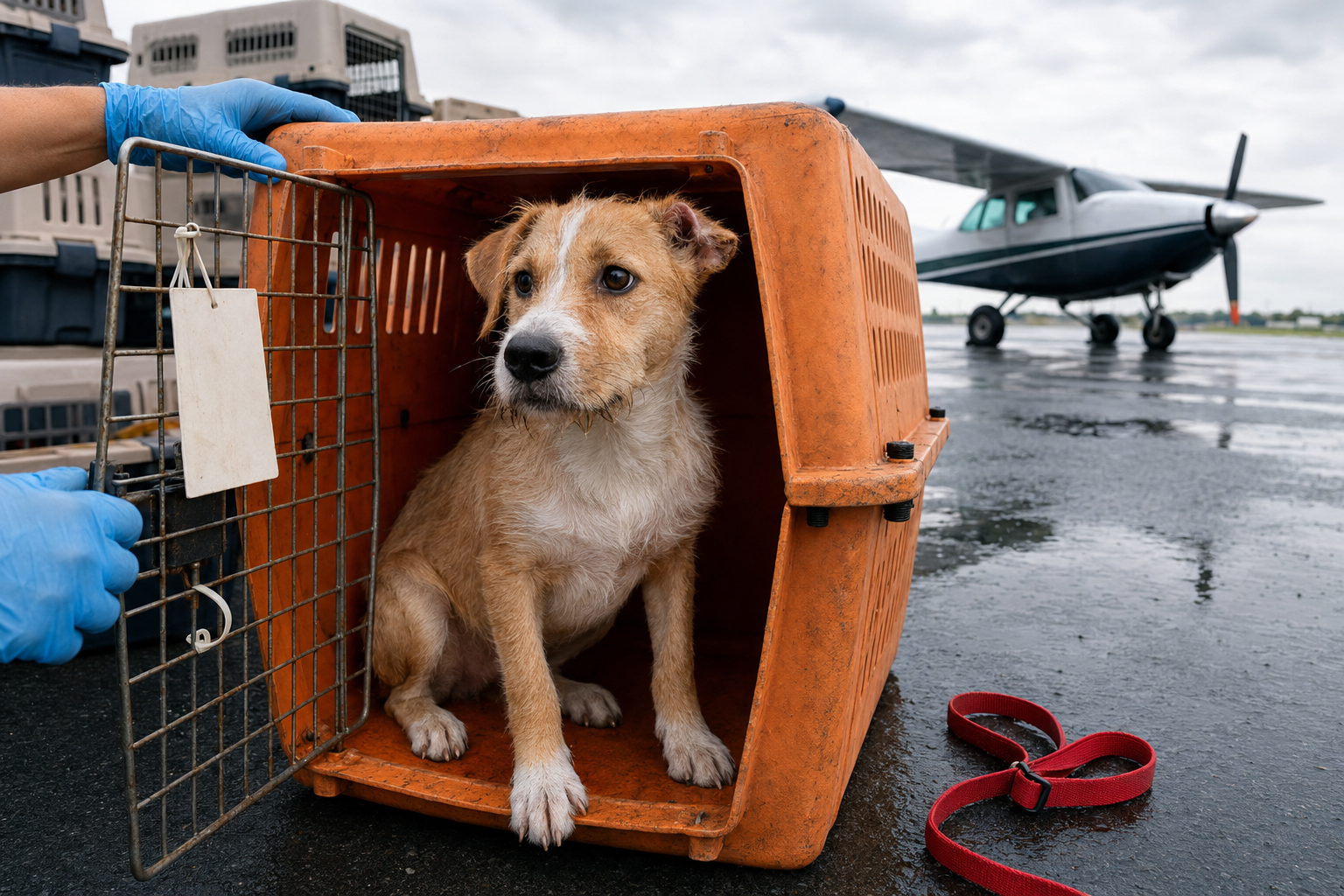
Nora’s is worse. A Middle Eastern Village Dog from Iran, part of her front right leg was cut off with a chainsaw. She came to the United States through an Iranian rescue and the Beagle Freedom Project, was operated on at the Animal Medical Center in New York City to amputate the infected stump, and was supposed to be a temporary foster. The volunteer who was going to take her backed out. Vibeke Alstad Jagne, who runs a dog-training company, took her instead, and then adopted her.
Nora is now 10. She runs. She plays. She jumps on the furniture. Alstad Jagne has watched the same conversation happen on the sidewalk for years: a stranger clocks the missing leg and their face collapses into pity. Then Nora accelerates, and the pity is replaced, mid-sentence, by something closer to astonishment.
And she has, over the years, methodically chewed the leg off every plush toy she owns, until all of her favorite toys have three legs, which nobody taught her to do and which nobody has been able to explain.
Front leg versus back leg: the difference that matters
This is the practical distinction that most owners are never told before the surgery.
Dogs carry roughly 60 percent of their weight on their front legs. Losing a front leg is therefore the harder version, because the remaining front leg absorbs a load it was never designed to carry alone, and the whole body has to rebalance around it.
That does not stop them. Nora lost a front leg and runs. But it changes what your job becomes afterward:
- Weight is now a medical issue, not a cosmetic one. Every extra pound is carried by three legs instead of four. A lean tripod is a mobile tripod at 12 that an overweight one will not be.
- Traction is everything. Slick floors are the enemy. Rugs, runners, and yoga mats along the routes your dog actually uses are not fussy, they are structural.
- Stairs are the risk. Nora is not allowed to take the stairs alone. Her people carry her up at bedtime, and a gate at the top stops her attempting the descent. She has learned to wait at the top for someone to come. Mona Patel’s Golden-Lab mix Cash lived on the first floor of a four-story house for the same reason.
- Exercise still matters, and it matters more. Cash swam, played in the snow, and trained alongside Patel while she competed in Ironman events. Muscle is what holds the remaining structure up.
Cash was 11 when a tumor appeared on his back right leg. Two surgeries failed to clear it, and the vet recommended amputation. He lived to 13. Patel describes the two years that bought her as pure surplus, time she had already been told not to expect, which is the other thing you hear constantly in this community, and which is not a consolation prize.
Cats do it too, and they do it differently
Stefanie Comerford, a healthcare worker in Charlotte, adopted her orange tabby Dexter at about 18 months old. At 11, she felt a mass on his leg while holding him. He was not putting weight on it. X-rays found a lump, and the lump was cancer.
Cats hide pain. That is the first thing to carry away from Dexter’s story, because it is why feline tumors are so often found late and by accident, the way this one was.
The second is the anatomy. Cats rely on their front legs more than their back legs, particularly on the landing when they jump. A front-limb amputee cat is not merely walking differently. They are relearning the physics of every descent.
So Comerford rebuilt the house around it: small steps beside the bed and along the counters so the drop was never too far, and a new litter box with no cover and low sides so stepping in and out was easy.
The cone was the real fight. Dexter is a committed groomer who likes his neck scratched, and he loathed the thing. Comerford’s compromise was supervision rather than compliance: cone off at mealtimes, cone off long enough for him to clean himself properly, cone back on the moment the stitches were unattended. A month out he was himself again, back on the scratching post, back up the cat tree, and balancing on a single hind leg.
Comerford’s takeaway, watching him, is the one nearly everyone in this community lands on eventually. Dexter never treated the leg as a loss to be processed. He worked out what his body could still do and got on with doing it, which is not a lesson she was expecting to get from a cat.
The part that actually costs money
Here is the honest asterisk on all of this, and it is not medical.
Routine veterinary care for a three-legged pet is no different from care for a four-legged one. There is no tripod tax on checkups.
The cancer is what costs. Because a substantial share of amputations are oncological, the amputation is usually not the end of the bill. It is the beginning of a treatment plan. That is the conversation to have with your vet before the surgery, not after: not just can he live on three legs, which he almost certainly can, but what are we treating, what does the treatment cost, and what is the realistic runway.
The Tripawds Foundation takes donations specifically to help families facing exactly that bill, and if you cannot help financially, the community’s other ask is simpler: adopt or foster a three-legged animal, or just talk about the ones you know, so the next person who hears the word “amputation” has already met a dog it did not ruin.
When Jon Stewart lost Dipper, his three-legged brindle Pit Bull who had been hit by a car as a puppy and whom his family adopted from the New York rescue Animal Haven, he could not get through the monologue. He called him the best of all the good boys, and then, visibly struggling, told the audience he hoped every one of them would someday get a dog like that.
Nobody watching that was thinking about the missing leg. That is the entire point.
What newer research adds
The gait research has caught up with what these owners have been saying for twenty years.
Studies using force plates and motion capture have measured what actually happens to a dog’s body after a hind-limb amputation, and the picture is one of rapid, efficient compensation: the remaining limbs redistribute load, the spine and pelvis adjust their motion, and dogs settle into a stable new gait rather than a permanently struggling one. MRI work looking at the muscles doing that extra work has not found the catastrophic deterioration people fear.
What it does confirm is the practical advice above. Compensation means other joints and muscles are working harder, which is why lean body weight, muscle maintenance, and good footing are not optional extras for a tripod. They are the maintenance plan for the legs that are left.
Ask your vet about a rehab consult while you are still in the pre-surgery conversation. Structured strengthening, controlled swimming, and a plan for the remaining limbs is now a normal part of good post-amputation care, and it is the single best thing you can buy your dog for the years after the surgery.
References
- Dickerson, V. M., Coleman, K. D., Ogawa, M., Saba, C. F., Cornell, K. K., Radlinsky, M. G., & Schmiedt, C. W. (2015). Outcomes of dogs undergoing limb amputation, owner satisfaction with limb amputation procedures, and owner perceptions regarding postsurgical adaptation: 64 cases (2005–2012). Journal of the American Veterinary Medical Association, 247(7), 786–792. https://avmajournals.avma.org/view/journals/javma/247/7/javma.247.7.786.xml
- Carr, B. J., Canapp, S. O., et al. Analysis of patient outcome and owner satisfaction with double limb amputations: 14 dogs and four cats. Journal of the American Animal Hospital Association. https://pubmed.ncbi.nlm.nih.gov/35333746/
- Jarvis, S. L., Worley, D. R., Hogy, S. M., Hill, A. E., Haussler, K. K., & Reiser, R. F. (2013). Kinematic and kinetic analysis of dogs during trotting after amputation of a thoracic limb. American Journal of Veterinary Research. https://pubmed.ncbi.nlm.nih.gov/23879846/
- Kirpensteijn, J., van den Bos, R., & Endenburg, N. (1999). Adaptation of dogs to the amputation of a limb and their owners’ satisfaction with the procedure. Veterinary Record, 144(5), 115–118. https://pubmed.ncbi.nlm.nih.gov/10097341/
- Tripawds Foundation. https://tripawds.org/