Ask a behaviorist which kinds of dogs are the most dangerous and watch them brace, because they know what you mean by “kinds.” You mean breeds. And breed is close to the least useful thing you can look at. The honest answer to “what’s a dangerous dog” is not a name on a list. It’s a dog whose signals nobody bothered to read.
That reframe matters because it changes what you do with it. If danger lived in breeds, safety would mean avoiding certain dogs. It doesn’t, so safety means something harder and more useful: learning to read the dog in front of you. Dogs rarely, almost never, bite without warning. The signs of trouble often run for months, sometimes years, before a bite happens. The problem was never unpredictable dogs. It’s misunderstood dogs, animals working hard to say “I’m uncomfortable, please stop,” to an audience that never learned the language.
The situations where bites actually cluster
Bite risk isn’t random and it isn’t breed-shaped. It concentrates around a dog’s emotional state and the circumstances they’re in. Not every dog in these situations is dangerous, but the odds of a bite climb, and knowing them tells you when to slow down.
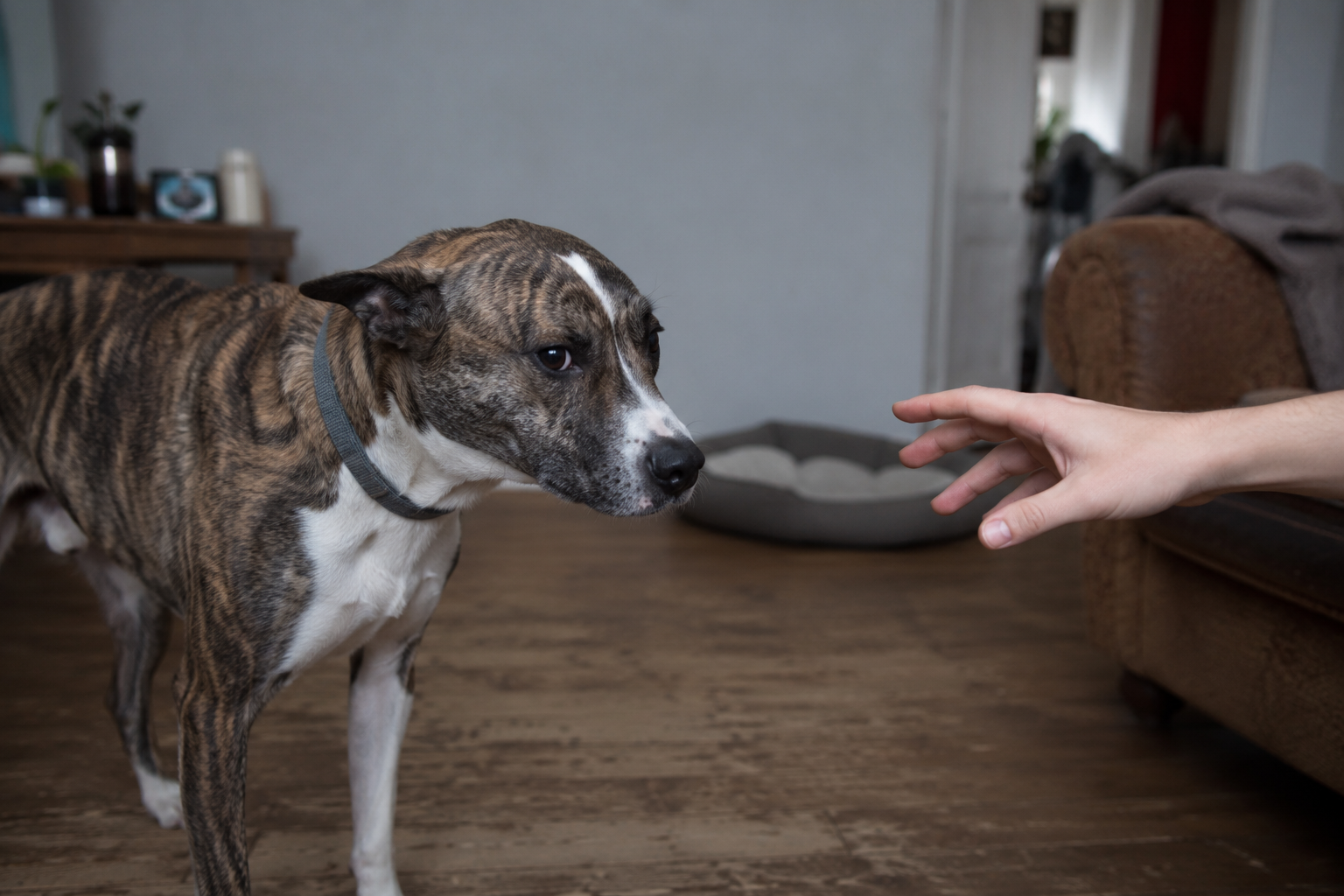
A frightened dog. This is the big one. Fear sits at the root of more aggression than any other single factor. A scared, nervous, or cornered dog may lash out purely to make the scary thing go away. And a wagging tail does not cancel this out, a wag signals arousal, not friendliness, and a stiff high wag can precede a bite.
An untrained dog. A dog who was never taught boundaries isn’t malicious, but they’re more likely to hurt someone by accident, knocking a child down, chasing, mouthing too hard, because nobody showed them where the lines are.
A dog you can’t read. When a dog’s behavior doesn’t follow an obvious pattern, it’s easy to blunder into the one thing that sets them off. So give them room around their vulnerable moments: don’t touch a dog who’s sleeping, eating, or chewing something they value. Startled dogs bite.
A sick or exhausted dog. Like us, dogs are at their worst when they feel terrible, and they have almost no way to tell you they’re in pain or want to be left alone. A dog who already tried to walk away and got followed may escalate to a growl, snap, or bite because the polite request didn’t work.
An unfamiliar dog. Not every dog thinks you’re their friend on sight. Many need time to warm up and dislike being greeted like a long-lost buddy within five seconds. If you love every dog you meet, remember the feeling isn’t always mutual, and crowding a dog who hasn’t decided about you yet is how strangers get bitten.
So are some breeds really more dangerous?
Stereotyping breeds to predict aggression is neither fair nor accurate, and the predictive power of breed is wildly overrated. Breed bans and “this dog’s relatives misbehaved” reasoning don’t make anyone safer. Certain breeds carry more fear than they’ve earned, and the aggression stereotype sticks even when it’s wrong. Most people who live with a Pit Bull know their dog is far likelier to lick an intruder than bite one, yet the coverage is all about Pit Bull aggression and never about excessive licking. Rottweilers and Dobermans get the same unearned flinch.
There’s a real point on the other side, and it’s worth stating plainly rather than hiding. Aggression is easy to breed for when someone intends to, and specific lines of dogs bred for it do show it. But that’s about lines and breeding history, not breeds as a whole, and plenty of dogs from those breeds come from lines with no such history. Nurture does the heavy lifting here. Anyone can create a fearful, aggressive dog through bad handling, regardless of breed.
Here’s the detail that punctures the whole breed theory. In a behaviorist’s actual caseload, some of the breeds that show up most often for aggression are Golden Retrievers and Labrador Retrievers. Is the golden retriever secretly a menace? Obviously not. There are simply an enormous number of them, and sheer population drags a breed to the top of every list you can build, including this one. Any breed can develop an aggression problem. Past behavior predicts aggression far better than breed ever will.
“The question I get is always ‘is this breed safe,’ and it’s the wrong lens,” says Dr. Mara Chen. “I’ve been bitten by breeds people coo over and trusted my hand with breeds people cross the street to avoid. What I actually watch is the individual dog and the moment they’re in. A dog telling you to back off is not a dangerous dog. A dog nobody listened to is how you get there.”
Why dogs bite, and the warnings that come first
To help an aggressive dog, you have to understand why they’re biting. Most bite out of fear, feeling threatened, pain, or being overwhelmed. Using their mouths is normal dog behavior, and the vast majority of puppies develop good bite inhibition, a learned sense of what they can and can’t do with their teeth. The dangerous exception is the dog who bites in an out-of-control way, the canine version of a toddler’s tantrum, driven by frustration and high arousal when they don’t get what they want. Those dogs genuinely can’t stop themselves mid-bite, and they’re much harder to rehabilitate than the far larger group biting out of fear.
The warning signs almost always show up first. A prior bite history, especially a prolonged attack that was hard to interrupt, is the loudest red flag there is. Past that, the tells cluster into a few families. There’s the loud, obvious set, growling, barking, lunging, a charge at anything that catches their interest. There’s the facial and postural set, lips pulled into a tense “offensive pucker,” a body gone rigid, a hard stare drilling into a person or another dog, the quick tongue-flick. There’s the arousal set, a short fuse for frustration, real trouble coming back down after being wound up, mouthiness when excited, and anxious ground-sniffing when they should be socializing. And there’s the resource-and-fear set, standing guard over food or toys, plus a broad wariness of people, animals, or objects. Spot these and a bite stops being a bolt from the blue; you get months of warning, not seconds.
What to do if you’re seeing them
Any of these signs, or even a vague sense that something’s off, is reason enough to bring in a professional trained in serious canine behavior problems: a certified applied animal behaviorist, a qualified trainer, or a veterinarian who is board-certified in behavior. Getting ahead of aggression with good early training beats managing a crisis later. An outside eye on how you interact with your dog and how your home runs often helps too, because aggression frequently traces back to stress or fear, and sometimes the real fix is simply de-stressing the dog’s life.
The genuinely hopeful part: for the vast majority of dogs who have bitten before, the odds turn in their favor once you pair real behavior work with a management plan that keeps them from practicing the behavior again. There’s a rare dog whose prognosis is poor because they lack any self-control and bite when frustrated and aroused, and honesty requires naming that exception. But for most dogs, this is a story that never needs to move past a warning growl, if someone reads it in time. Give your dog grace, give them care, and above all, learn to listen.