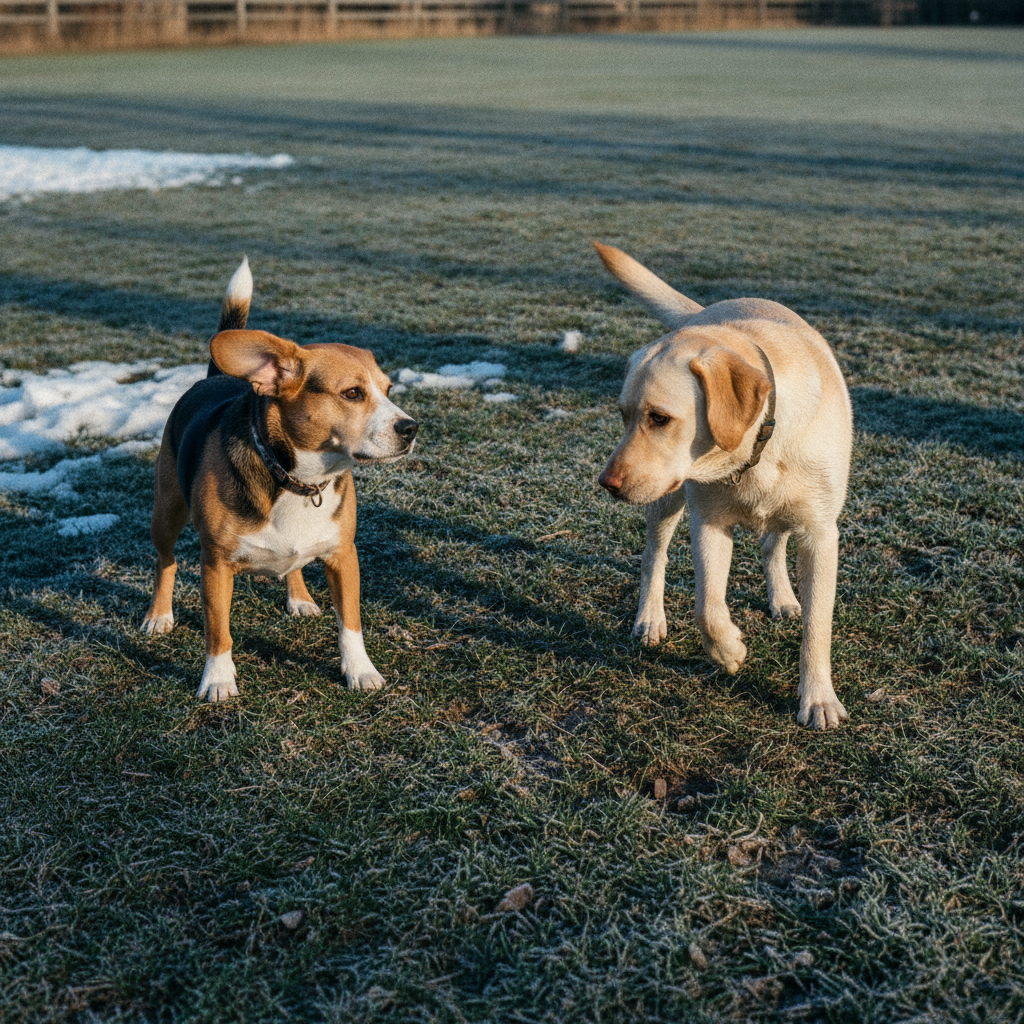
We have one word, “aggression,” and we use it for two completely different things. We use it for a dog who hunts other dogs down and hurts them. We also use it for a dog who curls a lip when another dog leans over their chew.
Those are not the same event. They don’t come from the same emotion, they don’t predict the same future, and they don’t call for the same response. But because they share a label, they get the same reaction from us: alarm, then intervention, then, often, a shrinking social life for a dog who never actually did anything wrong.
The word is doing real damage. Dogs get pulled out of playgroups, banned from the park, rehomed, or written off as dangerous over exchanges that were, in dog terms, entirely ordinary. So it’s worth learning the distinction the people who study this stuff actually use.
The word behavior scientists reach for instead
Ethologists studying conflict between animals of the same species tend to use a different term: agonistic behavior. It covers the whole repertoire an animal uses in a conflict situation, and it’s deliberately neutral about intent.
In dogs, agonistic behavior includes:
- Threats — muzzle-puckering, growling, hard staring
- Submissive signals — crouching, lowering the head, tucking the tail, licking at another dog’s mouth
- Offensive moves — lunging, snapping, body-slamming
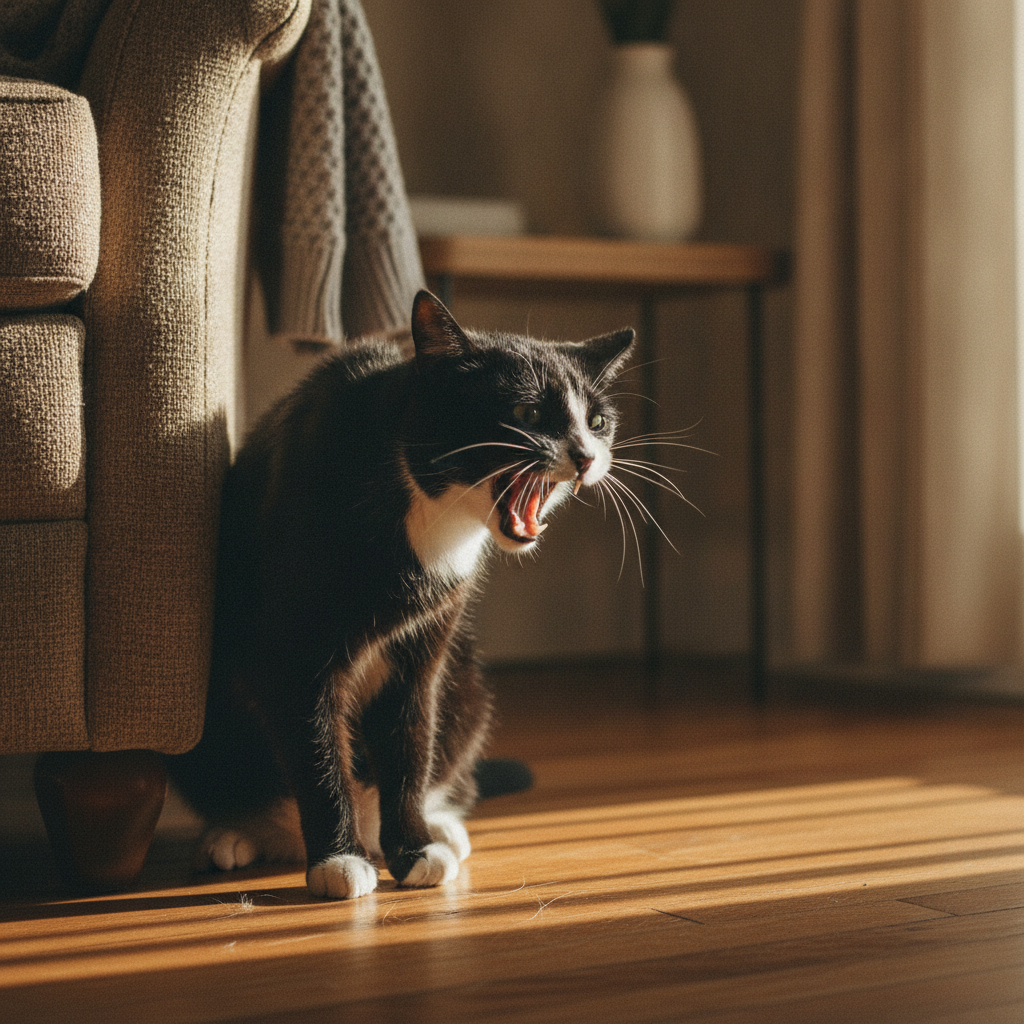
- Defensive displays — pulling the lips back to bare the teeth
- Attacking behavior — biting
Notice that biting is on the list. Here’s the thing that trips people up: with the single exception of a bite that punctures or tears, none of those behaviors necessarily indicates any intention to injure. They reveal an emotion (irritation, fear), state an intention (I want to keep this bone, I want you to leave), or function as ordinary components of play.
The practical upshot: describe what you actually saw before you name it. “He growled and she backed off” is a description. “He was aggressive” is a verdict, and you probably reached it too fast.
Why a dog who wants peace would growl at all
Here’s the puzzle. If these displays don’t reliably lead to violence, what are they for? The answer runs almost exactly opposite to how it looks. Their entire function is to stop a fight from happening.
Look at wolves. They live in family groups that cooperate to hunt, defend a territory, and raise young. Families argue. But an injured adult is a liability to the whole group, so a wolf pack cannot afford to settle disputes with damage. What evolves instead is a rich signalling system: postures, faces, sounds, and gestures that let a conflict get resolved before anyone’s skin is broken.
Humans do the same thing with sentences. “Hey, that’s mine.” “Leave me alone.” “Sorry.” Wolves do it with their bodies. Dogs, descended from wolves, inherited both the signals and, most of the time, the motivation not to escalate.
The bared teeth are the argument. The bite is what happens when the argument fails. And it usually doesn’t fail.
The numbers back this up
This isn’t a hopeful theory. When researchers Melissa Shyan, Kristina Fortune, and Christine King observed interactions at off-leash dog parks and published their findings in the Journal of Applied Animal Welfare Science, they logged well over a hundred agonistic exchanges — the growling, snapping, lunging kind — and found that none of them produced injury. Not one.
That’s the base rate people are missing. The scary-looking exchange at the park, the one that made everyone gasp and grab collars, statistically ends with two dogs walking away and going back to sniffing.
There’s more. Work by Cools and colleagues, published in Ethology, found that after a conflict, domestic dogs frequently reconcile — approaching, licking, and affiliating with the dog they just argued with, sometimes with a third dog stepping in to smooth things over. Dogs don’t just avoid escalating. They actively repair.
“The thing that makes people panic is the noise, and the noise is precisely the part that’s doing the work,” says Dr. Priya Nair. “A loud, ugly, three-second exchange that ends with both dogs shaking off and walking away is a system functioning normally. Silence is what worries me.”
The decision framework: watch, or step in?
You still need a rule you can apply in two seconds in a real park. Here’s the one I use.
Lean toward watching when all of these are true:
- Both dogs are well socialized and have no history of biting that broke skin
- They already know each other and have a generally friendly relationship
- The intensity is not climbing — it flares and then falls
- Bodies are loose in between the flare-ups, and there are signs of the exchange ending: a shake-off, a play bow, a turn away, one dog going back to what they were doing
- No one is injured
Step in — early — when any of these are true:
- Arousal is ratcheting upward with no sign of abatement
- The dogs are badly mismatched in size, age, or fragility, so one bad landing could do real harm
- A third dog is joining in, which is how a two-way disagreement becomes a pile-on
- One or both dogs are strangers to each other, and you don’t yet know their history
- You see punctures, tears, or blood
- You genuinely can’t read it, and you’re not willing to gamble
That list isn’t a compromise. It’s the honest boundary. Most exchanges live in the first column, and most people act as if everything lives in the second.
The grouch problem
Some dogs are simply blunt. They’ll charge an unfamiliar dog, mouth open, making an unholy racket, and then never lay a tooth on anyone in their entire lives. Their social style is loud.
Dogs like that get sentenced to a life alone, because their opening move looks like a felony. And often the dog on the receiving end is completely unbothered — they stand there, wait for the tantrum to end, and go back to sniffing. Give it two sessions and the same pair are playing for hours.
The point is not that everyone should let their dog meet the neighborhood grouch. The point is that a dog whose style is loud is not the same as a dog whose intent is harm, and we lose a lot of perfectly good friendships by refusing to tell them apart.
The caveats, and they’re not optional
Everything above comes with limits. Please read these as carefully as the rest.
- This applies to socialized dogs with no history of injurious biting. Socialization is what teaches a dog to use these signals correctly in the first place, and it’s what stops a dog from treating every stranger as a threat. A dog who has actually damaged another dog is not who this article is about.
- This applies to pairs who already know each other. Before you introduce two dogs for the first time, even two well-socialized ones, the humans should trade honest information about each dog’s history and temperament, and then go slowly until the pair have repeatedly interacted well.
- Vulnerability changes the math. Large dog and small dog, young dog and old dog: intervene sooner. The margin for a mistake is thinner.
- This is about pairs. Once a third dog is in the mix, group dynamics can turn against one individual fast, and the rules above stop applying.
- This is mostly about non-play interactions. Play has its own grammar, and rough play is a separate topic.
What newer research adds
The reconciliation research is the piece that’s shifted most in the last decade. It used to be assumed that dogs, unlike primates, didn’t bother repairing relationships after a conflict. The evidence now says they do — that post-conflict affiliation is a real, observable part of how dogs live together, and that some dogs will even be comforted by an uninvolved third party.
What that means for you at home is simple and a little humbling. If you break up every disagreement between your two dogs at the first growl, you may be interrupting a repair sequence you didn’t know was coming. Sometimes the most useful thing you can do is stay still, keep your hands to yourself for three more seconds, and watch how they finish it.
More often than not, they know what they’re doing.
References
- Shyan, M. R., Fortune, K. A., & King, C. (2003). “Bark parks”: A study on interdog aggression in a limited-control environment. Journal of Applied Animal Welfare Science, 6(1), 25–32.
- Cools, A. K. A., Van Hout, A. J.-M., & Nelissen, M. H. J. (2008). Canine reconciliation and third-party-initiated postconflict affiliation: Do peacemaking social mechanisms in dogs rival those of higher primates? Ethology, 114(1), 53–63.
- Bekoff, M. (1995). Play signals as punctuation: The structure of social play in canids. Behaviour, 132(5–6), 419–429.
- American Veterinary Society of Animal Behavior. Position Statement on Punishment.