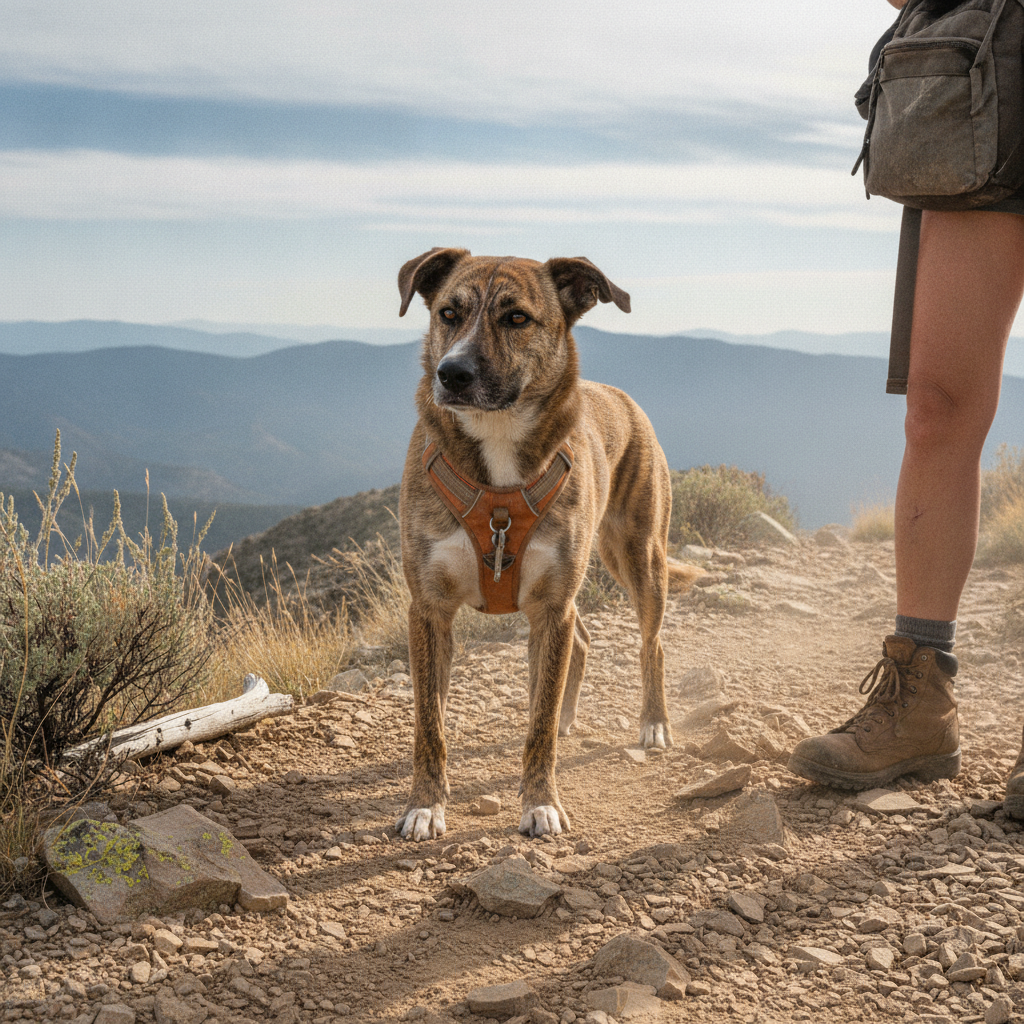
There is a specific kind of trailhead sign that should make every dog owner wince: No Dogs Permitted.
Nobody wakes up wanting to write that sign. It gets written after a season of loose dogs bolting at horses, poop bags decorating the switchbacks, and a runner getting jumped on at mile four. It gets written because a land manager ran out of patience.
Which reframes the entire subject. Trail etiquette is not about being nice. It’s about access. Every rule below exists because somebody broke it and a trail got closed.
You are, on any given hike, an ambassador for every dog owner who wants to use that trail after you. That’s not sentiment. It’s the actual mechanism.
The eight rules
1. Leash, or a recall that genuinely works
Dogs on trails should be on a leash, or under strict voice control, and it’s worth being honest about what that second phrase actually means.
Strict voice control means: your dog comes back immediately, on the first call, and heels, and stays at heel, and does not bark. In the presence of another dog. In the presence of a horse. In the presence of a deer breaking cover. Every time.
Almost nobody has this. The people who most confidently claim it usually have a dog who comes back eventually, which is not the same thing and is not enough. If there is any daylight between your dog’s recall and that description, use the leash. It costs you nothing and it’s what keeps the trail open.
2. You yield. Always.
When you meet anyone on the trail — hikers, runners, climbers, cyclists, riders — you and your dog step well off the trail and let them pass.
Not “move to the side.” Step clear, so nobody has to negotiate a sniff or wonder what your dog is about to do.
This is not a courtesy question, it’s a physics one. It’s far easier for you to step off the trail than for a cyclist to dismount and lift a bike, or a rider to steer a horse into the brush. The person with the least effort to expend does the yielding, and that is you.
3. Horses: the rule most people get wrong
This one deserves its own section because getting it wrong can genuinely injure or kill someone.
A horse can spook badly at a strange dog. A spooked horse can throw a rider onto rock. This is the single highest-consequence encounter on any shared trail.
What to do:
- Yield immediately and get well off the trail.
- Move downhill from the trail where possible. Horses are less alarmed by something below them than above them.
- Hold your dog close to your side. Physically. Not “call them over.” Have a hand on them.
- No barking. No movement toward the horse. At all.
- Stay in clear view and talk to the riders in a normal voice. A calm human voice tells the horse you’re a person and not a threat, which is exactly what a horse needs to know. Hiding behind a bush and going silent is the worst possible move.
- Stay put until the horses are well past you. Not level with you. Past.
The rider will thank you, and that gratitude is a small deposit in the account that keeps trails multi-use.
4. Stay on the trail
You and your dog both. No cutting switchbacks, no shortcuts, no braiding a new path through the vegetation because the mud looks bad.
Switchback cutting causes erosion that cascades, and social trails are how a single footprint turns into a scar. If you need to leave the trail, leave it perpendicular, directly away, and only adjust your route once you’re well clear.
5. Know the local rules before you drive out
Some trails are not dog-friendly, full stop, and finding that out at the trailhead is a wasted morning.
In national parks, follow the B.A.R.K. rules:
- Bag your dog’s waste
- Always leash your pet
- Respect wildlife
- Know where you can go
That last one is the one people skip. National parks are largely closed to dogs on trails, which surprises visitors every single year. National forests and BLM land are generally far more permissive. If you want a dog-friendly big hike, that distinction is the one to learn.
When in doubt, check before you go.
6. Leave the wildlife alone
Observe from a distance, and don’t let your dog do otherwise.
This matters most in winter, when animals are running on tight energy budgets and a flight response can cost them more than they can afford, and in calving and nesting seasons, when disturbance can mean an abandoned nest or a separated calf.
There’s a selfish version of the argument too: wildlife carries disease, some wildlife fights back, and a dog who chases a porcupine, a skunk, a snake, or a moose is a dog whose day is about to get very expensive.
7. Pack it out, including the poop
All of it. Including yours, including your dog’s, including the bag.
And this is worth saying plainly because it is the single most common failure on any trail near a city: do not leave a full poop bag on the side of the trail to collect on the way back. You will forget. Everyone forgets. What you have actually done is leave a plastic bag of dog waste in the woods, and it’s now worse than if you’d left the poop, because now it won’t break down.
Carry enough bags. Carry them out.
8. Consider a pack
A dog carrying their own gear — water bowl, poop bags, a bit of food — is a dog doing a job, and dogs like jobs. A pack or a bright vest also makes your dog more visible, which helps on a trail and helps enormously if they ever get away from you.
There’s a social effect too, and it’s real: people who are nervous around dogs read a packed, harnessed, working-looking dog as a dog under control. That perception is currency, and it buys goodwill for the next dog owner up the trail.
Fit and load matter. A pack should sit on the shoulders and chest, not the spine, and a healthy adult dog should carry a modest fraction of their body weight, not a hiker’s idea of a fair share. Build up gradually, and don’t pack a puppy whose growth plates are still open.
What the source guides always leave out: your dog’s body
Etiquette keeps the trail open. This keeps your dog alive.
Heat is the killer. Dogs cool by panting, and panting fails in humidity and fails harder under exertion. A dog on a trail is working far harder than you are, in a fur coat, with their belly six inches off hot ground. Heat stroke in dogs is a genuine emergency and it moves fast: frantic panting, bright red gums, drool, staggering, vomiting, collapse. Hike early. Turn back sooner than you think you need to.
Water is not optional and puddles are not water. Carry more than you think. Standing water carries Giardia, Leptospira, and in warm still conditions, blue-green algae, which can kill a dog within hours. If a pond looks like pea soup or has a scummy film, your dog does not swim in it and does not drink from it.
Paws take the beating. Rock, scree, ice, and hot rock all shred pads. Check them at every break, not at the car.
And know your dog’s actual range. A flat-faced dog, an overweight dog, a senior dog, or a puppy has a much shorter ceiling than a fit adult, and the point at which a dog stops being able to continue arrives suddenly. Carrying a 60-pound dog off a ridge is not a plan.
What newer research adds
A large 2020 study in Scientific Reports, drawing on UK primary-care veterinary records, found something worth internalising before your next hike: exertion, not hot weather, was the most common trigger of heat-related illness in dogs. The classic image is a dog left in a car. The reality, in the data, is a dog being exercised.
That flips the safety advice. It isn’t just “don’t hike on hot days.” It’s that a dog who is running, climbing, and working can overheat on a day you’d call pleasant, particularly if they’re unfit, overweight, brachycephalic, or simply having too good a time to stop.
Dogs will not self-regulate. A retriever will chase a stick into heat stroke. You are the brake, and the study is a decent argument for using it earlier than feels necessary.
Bottom line
Yield to everything. Talk calmly to the horses and hold your dog. Stay on the trail. Know the rules before you leave the house. Pack out every bag.
None of it is complicated, and all of it is the reason the trail you love is still open to your dog next year.
Then watch the heat, watch the water, and check the paws. Etiquette protects the trail. That part protects the dog.
References
- “Pets in National Parks: B.A.R.K. Ranger Program.” National Park Service. https://www.nps.gov/subjects/pets/index.htm
- Hall, Emily J., et al. “Incidence and Risk Factors for Heat-Related Illness (Heatstroke) in UK Dogs Under Primary Veterinary Care in 2016.” Scientific Reports, vol. 10, 2020, 9128. https://doi.org/10.1038/s41598-020-66015-8
- “Harmful Algal Blooms and Pets.” Centers for Disease Control and Prevention. https://www.cdc.gov/habs/be-aware-habs/pets.html
- “Leptospirosis in Dogs.” American Veterinary Medical Association. https://www.avma.org/resources-tools/pet-owners/petcare/leptospirosis
- “Leave No Trace Seven Principles.” Leave No Trace Center for Outdoor Ethics. https://lnt.org/why/7-principles/
- “Heat Stroke in Animals.” MSD Veterinary Manual. https://www.msdvetmanual.com/emergency-medicine-and-critical-care/heat-stress-and-heat-stroke/heat-stroke-in-animals