


Your Puppy Won't Hold Still Long Enough to Sit. Fix That First
With a hyper puppy, sit isn't the hard part, settling is. Train the arousal down first, then the behavior falls into place. A step-by-step guide.

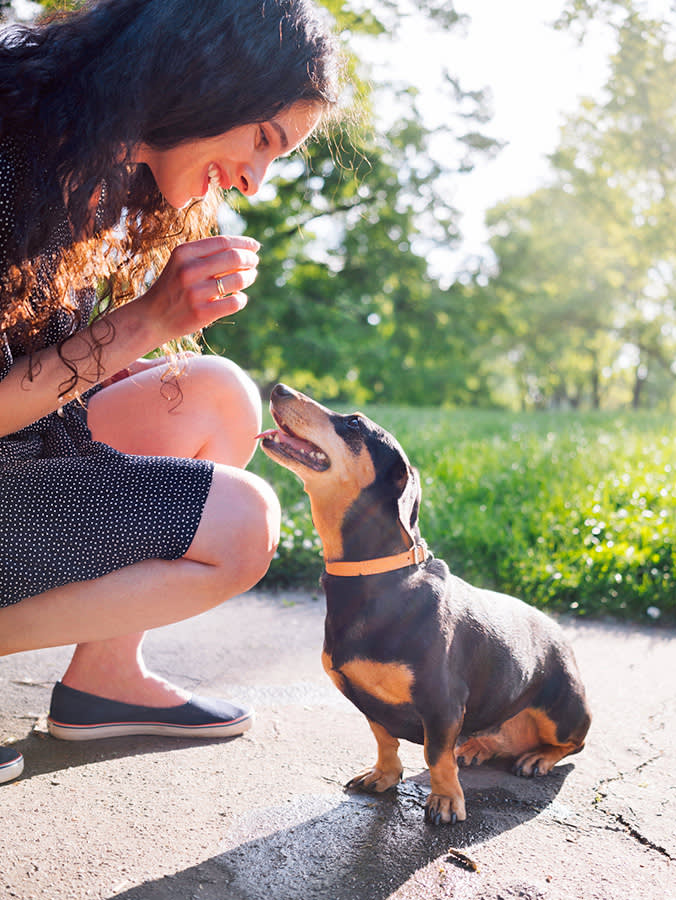
Teaching a puppy to sit is supposed to be the easy one, the first trick, the gateway to everything else. Then you meet an excited puppy, and suddenly a two-second behavior feels impossible. They are too busy vibrating, chewing your sleeve, and reacting to every leaf in a ten-foot radius to notice you exist.
Here is the thing most people get backwards. With a wound-up puppy, the sit is not the challenge. The arousal is. A puppy who cannot settle cannot learn, so your real first job is not the behavior at all. It is bringing the energy down to a level where their brain can actually take something in. Get that right and the sit almost trains itself.
Why an excited puppy is so hard to teach
Two things are working against you, and neither is bad behavior. The first is a genuinely short attention span. Puppy brains are still under construction, and everything in the world is brand new, so holding focus on you (the least novel thing in the room) is a big ask. It grows with age and practice, but early on it is measured in seconds.
The second is raw energy. Puppies run at full throttle until they crash, much like toddlers, and a puppy who has not moved their body in hours is in no state to sit calmly and think. Worse, an overtired puppy gets cranky, and cranky puppies bite and spiral. Recognizing which problem you are dealing with, too much energy or too little focus, tells you what to fix before you ask for anything.
Set the stage before you ask for a thing
Where and how you train matters as much as what you do.
Pick a boring room. A quiet, low-distraction space gives your puppy a fighting chance at paying attention. You can add small distractions later, on purpose, to help the skill hold up in the real world. If you are somewhere new, let them explore and sniff first so the novelty wears off.
Come armed with the good treats. Skip kibble and dry biscuits; they are too bland to compete with a distracting world. Use something small, soft, quick to eat, and strong-smelling, like a bit of chicken or a low-sodium hot dog. Have them ready before you start so you are not fumbling while your puppy checks out.
Keep sessions short. Five to ten minutes is plenty, and shorter is fine. The trick is to quit while your puppy is still winning. End on a great sit, hand over a couple of treats, and stop, so training stays a thing they want more of rather than a thing that drags on until everyone is frustrated.
The step-by-step
Once your puppy has burned off some energy and you are in a calm spot, the mechanics are simple:
- Get their attention. Bring a treat to your puppy’s nose so they lock onto it.
- Lure the sit. Move the treat slowly up and back over their head, toward their tail. As their nose tips up to track it, their rear end drops toward the floor. Go slowly so they stay glued to the treat rather than backing up or jumping.
- Reward the second it happens. The instant their bottom touches down, give the treat, praise warmly, and add a pet they like. Fast timing is everything; reward a half-second late and you may be paying for standing back up.
- Take a break. Ask for a few sits, then release your puppy to a game of tug, a nap, or a good sniff. The break is part of the training, not a failure of it.
- Add the cue last. Only once your puppy is sitting reliably from the lure, roughly nine times out of ten, start saying “sit” right before you move your hand. As they link the word to the motion, shift the treat into your other hand and let the empty luring hand become your visual signal. This is the most common place people rush; add the word too early and it just becomes background noise.
When it falls apart
Still too wired? Back up and drain some energy. A walk or a play session before training, not after, sets a hyper puppy up to succeed. And re-check your surroundings for anything too tempting to ignore.
Ignoring you completely? Ask the obvious questions first. Are they tired and due for a nap? Is the environment too busy? If not, look hard at your treat. Bland food will not hold a distractible puppy; upgrade to something they find genuinely thrilling.
Fading fast mid-session? You are probably asking for more than their attention span can give. Cut the session in half, end on a good note, and build the length back up gradually as they mature.
The habits that make it stick
The unglamorous fundamentals do the heavy lifting: stay consistent, because puppies learn through repetition, and the more reps you rack up in different places and around different distractions, the more bulletproof the sit becomes. Keep every session short. Burn off energy before you start. Use treats your puppy actually cares about. Practice a little every day rather than in one long marathon. And above all, be patient, both with your puppy and with yourself, because none of this is instinctive for a brand-new brain.
People assume a puppy who won’t sit is stubborn. Almost always they’re just over threshold, too excited to learn. Spend the first five minutes helping them settle, and the sit stops being a battle.
What newer training research adds
The move toward very short, structured, reward-based sessions is not just a stylistic preference; it lines up with what studies of young working dogs suggest. Research on guide-dog puppies found that structured juvenile training and socialization were tied to better long-term outcomes, reinforcing the idea that brief, consistent, positive practice early on pays off far more than occasional long, frustrating drills. In other words, the modern advice (short, frequent, and fun) is not going soft. It is what actually works.
References
- Batt, L. S., Batt, M. S., Baguley, J. A., & McGreevy, P. D. (2008). “The effects of structured sessions for juvenile training and socialization on guide dog success and puppy-raiser participation.” Journal of Veterinary Behavior, 3(5), 199–206. https://doi.org/10.1016/j.jveb.2008.05.001
- Batt, L. S., Batt, M. S., Baguley, J. A., & McGreevy, P. D. (2010). “Relationships between puppy management practices and reported measures of success in guide dog training.” Journal of Veterinary Behavior, 5(5), 240–246. https://doi.org/10.1016/j.jveb.2010.02.004
- American Veterinary Society of Animal Behavior. “Position Statement on Positive Reinforcement Training.” https://avsab.org/resources/position-statements/
Dr. Solis is a board-certified veterinary dermatologist with over twelve years of clinical experience. She advises on skin conditions, allergies, and grooming practices that affect coat and skin health. All dermatology and allergy content at The Pet Times is reviewed by her team before publication.
Meet our experts ↗Keep reading
 TrainingNo Dog Is "Untrainable." Some People Just Quit.Dr. Nina Kohl · 8 min
 First DaysNighttime Crate-Training Usually Fails for One Reason: Bladder MathNina Vasquez · 8 min
 TrainingSome Dogs Fix a Tangled Leash. Yours Might Not, and It's Not About Smarts.Marcus Webb · 4 min
 TrainingPointing at Your Dog Doesn't Work. Pointing and Staring Does.Jordan Ellis · 5 min
 TrainingThe Trick Isn't the Bell. It's the Language You Build Teaching ItSasha Ford · 5 min
 First DaysThe Simple Math That Ends Puppy Potty AccidentsDr. Lena Park · 6 min