Everyone teaching a dog to swim teaches the same lesson: how to get in.
They coax, they bribe, they wade in first, they cheer when the paws finally start churning. And then, once the dog is paddling, the lesson is declared over.
That’s backwards, and it’s the reason for the ugliest statistic in this whole subject: an estimated 5,000 pets drown in backyard swimming pools in the United States every year. Not in oceans. Not in rip currents. In the pool in the yard.
Almost none of those dogs died because they couldn’t paddle. They died because they got in, panicked, and swam the perimeter looking for a way out until they had nothing left.
So the first thing you teach is not the doggy paddle. It’s the exit.
The exit lesson
Do this before anything else, and do it from every angle.
- Put your dog in the water right at the steps, in a life vest, with you in the water beside them. Not the deep end. Not a jump. Right at the exit.
- Let them get out. Praise, treat, done. That’s rep one.
- Now move them three feet away from the steps and let them find the exit. Then six feet. Then across the pool. Then from the far corner. Then with their back to it.
- Do it from every side of the pool, so if they ever fall in at the wrong end, they can orient themselves and know where the way out is.
- Repeat until it’s boring. It should be so automatic that a panicking dog can do it.
That is the whole safety curriculum, and it takes about a week. Everything below is about making swimming enjoyable. This part is about making it survivable.
“Every drowning I’ve heard about had the same shape: the dog got in when nobody meant them to, and then couldn’t find the way out,” says Dr. Priya Nair. “You cannot teach a panicking dog to find the steps. You have to teach a calm one, over and over, until it’s the thing they do without thinking.”
Which dogs are actually at risk
The idea that all dogs are natural swimmers is a myth, and it’s a dangerous one. Body shape decides an enormous amount.
Built for it: dogs bred for water work, retrievers and spaniels and the like, with deep chests, powerful hindquarters, and a long rudder of a tail.
Built against it: dogs with short muzzles and barrel chests, so bulldogs and pugs, whose faces sit low to the waterline and whose body mass is front-loaded. Also dogs with very short or docked tails, who lack a functional rudder and tend to sink at the back end, and dogs with disproportionately short legs relative to body length, like dachshunds. Puppies and small dogs are also over-represented in drownings.
And then there’s the individual. Plenty of trainers will tell you they’ve met bulldogs who love water and Labradors who want nothing to do with it. Breed is a prior, not a verdict. Watch the dog in front of you.
The upshot: a life vest is not an admission that your dog is bad at swimming. It’s a hedge against the possibility that you’re wrong about which category they’re in, and you only find out you were wrong in the worst possible way.
The life vest comes before the water
Not at the same time. Before.
Put the vest on your dog on dry land and let them walk, trot, and play in it until they’ve forgotten it’s there. This matters more than people expect. Some dogs have a full freeze response to the unfamiliar pressure of a vest, and if you discover that in the water you now have two problems at once.
If your dog goes stiff, tucks, or refuses to move in the vest, that’s a separate training project, and it gets solved on the grass, not in the pool.
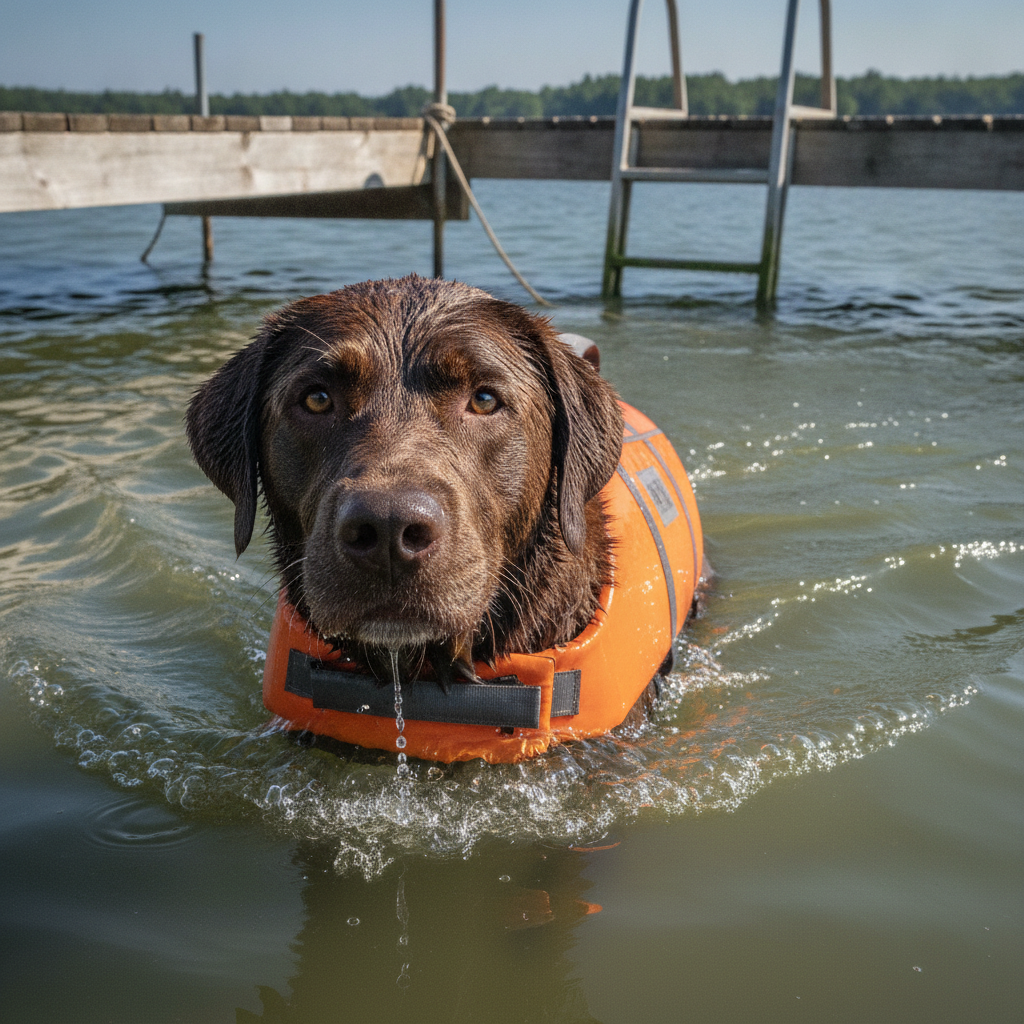
Fit it properly. It should be snug enough that it won’t ride up over the head, with a handle on the back that you can actually grab and lift with. Choose bright orange or red for visibility, not because it looks better but because you may one day need to find your dog in murky water fast.
Then build the water up in layers
The whole approach is one idea: make the water get slightly bigger, never suddenly bigger.
Layer one: a kiddie pool
A cheap plastic kiddie pool is the best swim-training tool nobody buys. Put your dog in it empty, and reward them for standing there. Then start adding water with a hose while they play. A few inches. Then a few more. Let them mouth at the hose and splash if they want to.
You’re not teaching swimming here. You’re teaching that water arriving under their feet is not an emergency. For small dogs, a filled kiddie pool is deep enough to produce the first strange sensation of floating, in a container they can step out of in one move.
Layer two: the real pool, at the steps
Now the big one, and now the exit drill above.
A note that surprises people: many dogs are more nervous in clear pool water than in a murky lake, probably because they can see how deep it goes. Starting in a pool is therefore harder in one way and easier in every other, because the edges are defined, the depth is known, and you can control everything.
Layer three: open water
A lake, a slow river, a calm bay. Expect a step backward. Every new body of water is a new environment, and a dog who is confident in your pool will still need a few sessions to trust a lake bottom that squelches.
And every one of these layers ends with a rule: never leave a dog unsupervised near water, no matter how good a swimmer they’ve become. Confidence is what makes a dog jump in when you’re not looking.
The rules of a good lesson
- Just you, the dog, and one very good treat or toy. No other dogs, no crowd, no cheering section. You want their attention on the water, not on managing a social situation.
- Get in yourself. You are the evidence that this is safe. A dog watching their person stand comfortably in chest-deep water is learning something no treat can teach.
- Reward every increment. One step further down the ramp. One paw wet. One second longer. That’s a win and it gets paid.
- Warm them up first. A dog who has just run around is loose, a little hot, and inclined to find cool water appealing. A dog who has been lying on the sofa for three hours is stiff and unmotivated.
- Never, ever push, carry, or throw them in. Not a nudge. Not a lift. The moment it stops being voluntary, it stops being training and becomes something your dog will remember, and you may have permanently closed the door. It also creates exactly the panic response that drowns dogs.
- Quit while it’s going well. End the session on a small success, before your dog gets tired or bored. Ten good minutes beats forty grinding ones.
When to give up, and why that’s fine
Some dogs are never going to be swimmers.
Rescues with unknown histories sometimes have a genuine water aversion, and no amount of patient shaping is going to fix it. Some dogs are simply built wrong for it. Some just don’t want to.
The kind thing is to stop. A dog who hates water and is being coaxed into it every weekend isn’t building confidence, they’re building dread, and they have a hundred other ways to have a good time.
Teach them the exit anyway. That part isn’t optional even for a dog who will never swim recreationally, because the pool is still in the yard.
What newer research adds
Two things worth knowing that go beyond the swim lesson itself.
Getting them out isn’t the end of the emergency. A dog rescued from a near-drowning can look perfectly fine and still be in trouble. Water in the lungs can trigger aspiration pneumonia and pulmonary edema, and hypothermia can set in afterward, with symptoms developing hours later. Veterinary guidance is consistent on this: any dog pulled from the water after a struggle should be seen by a vet, even if they seem normal. “He shook it off and went back to playing” is not a clean bill of health.
And the pool is a year-round hazard, not a summer one. The reason 5,000 pets a year drown in backyard pools is not that they were all out swimming. It’s that pools are permanently there, uncovered, and dogs fall in. A pool fence, a pool alarm, or a ramp exit designed for animals does more for your dog’s safety than any number of swim lessons, because it works when you’re asleep.
Neither of those is glamorous. Both are the actual answer.
Bottom line
Teach the exit first, from every corner, until it’s automatic. Fit the life vest on land. Build the water up in layers and never once push them in. Supervise forever.
Then, if they turn out to love it, you’ve got a swimming buddy. And if they don’t, you’ve still got a dog who knows where the steps are.
FAQs
Can all dogs swim? No. Short-muzzled, barrel-chested breeds like bulldogs and pugs, dogs with very short tails, and dogs with short legs relative to their body are all poor swimmers, and puppies and small dogs are over-represented in drownings. Individual dogs vary enormously within any breed.
Does my dog need a life jacket if they can already swim? Around a pool, yes. Around open water, yes. A vest costs you nothing and buys you a margin when your dog gets tired, cold, or panicked, and it gives you a handle to lift them out with.
What’s the first thing I should teach my dog about the pool? How to get out, practiced from every side of the pool until it’s automatic. Most pool drownings are exit failures, not swimming failures.
Can I just throw my dog in to see if they swim? No. It’s dangerous, it can create a lasting water phobia, and it produces exactly the panic that leads to drownings. Every step into the water has to be voluntary.
My dog seems fine after nearly drowning. Do I still need a vet? Yes. Aspiration pneumonia, fluid in the lungs, and hypothermia can develop hours later. A dog who was pulled from the water struggling should always be seen.
References
- Byers, C. G., et al. “Feline and Canine Drowning and Submersion Injury.” Journal of Veterinary Emergency and Critical Care, review of near-drowning management. https://onlinelibrary.wiley.com/journal/14764431
- “Drowning and Submersion Injury in Animals.” MSD Veterinary Manual. https://www.msdvetmanual.com/emergency-medicine-and-critical-care/drowning-and-submersion-injury/drowning-and-submersion-injury-in-animals
- “Aspiration Pneumonia in Dogs.” MSD Veterinary Manual. https://www.msdvetmanual.com/respiratory-system/respiratory-diseases-of-small-animals/pneumonia-in-dogs-and-cats
- American Veterinary Society of Animal Behavior. “Position Statement on Humane Dog Training,” 2021. https://avsab.org/wp-content/uploads/2021/08/AVSAB-Humane-Dog-Training-Position-Statement-2021.pdf
- “Pet Pool Safety.” U.S. Consumer Product Safety Commission, Pool Safely campaign. https://www.poolsafely.gov/