


Too Wild to Keep, Perfect to Save Lives
The relentless energy that gets a dog returned to the shelter is exactly what makes an elite disaster search dog. Inside the foundation that turns castoffs into first responders.

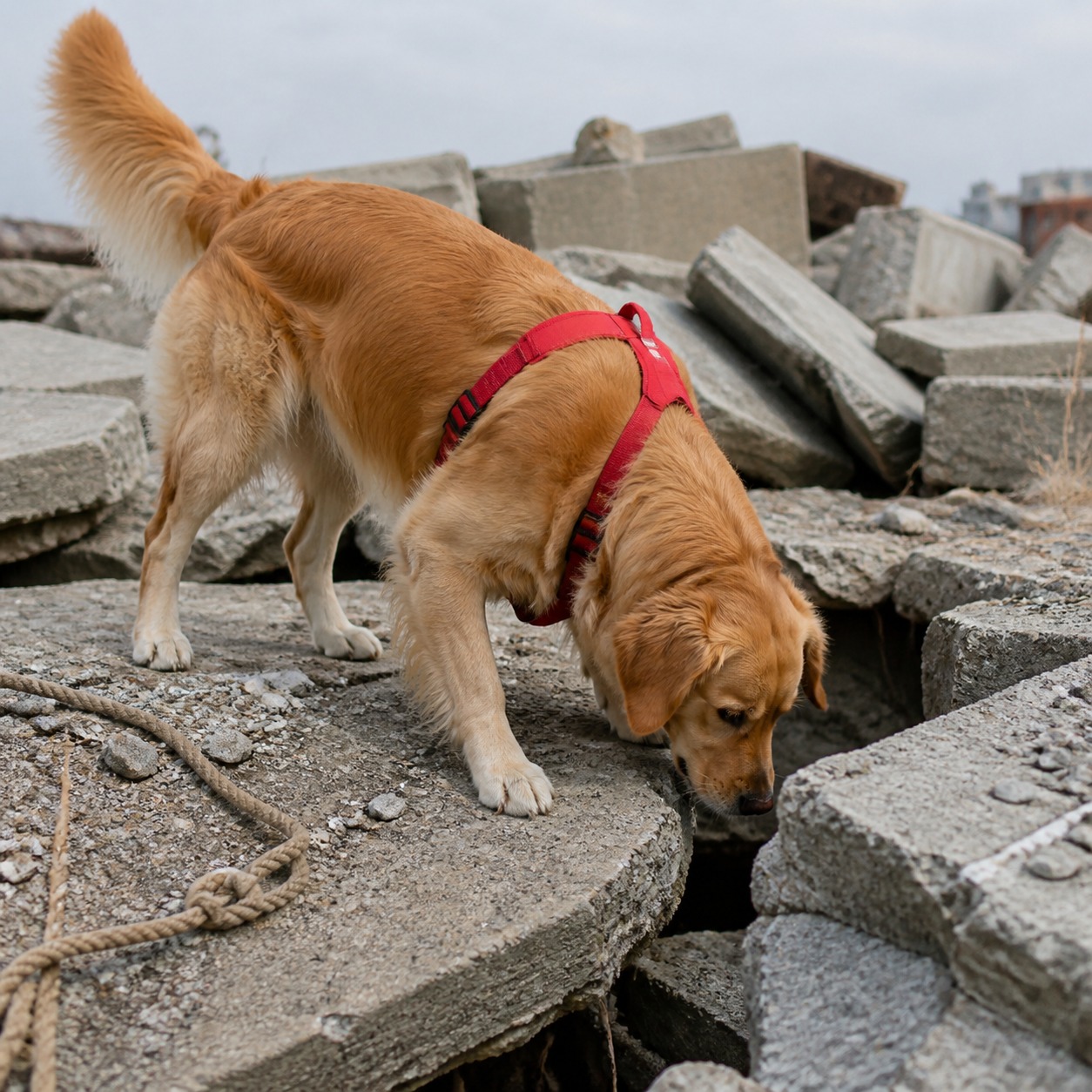
Cody was a problem dog. The Golden Retriever shuffled through six homes before he was even a year old, and every one of them returned him to a Wisconsin shelter for the same reason: too much energy, impossible to control. He was, by every ordinary measure, a throwaway. Today he’s among the most rigorously trained search dogs in America, an elite emergency worker certified to find people buried alive after a disaster. The trait that made him unadoptable is the exact trait that made him extraordinary. That paradox is the entire business model of the National Disaster Search Dog Foundation.
The foundation, known as SDF and based in Ventura County, California, works only with rescued dogs. It goes looking for the animals most families can’t handle, the obsessive fetchers, the ones who never wind down, and channels that drive into finding lost and trapped people. As Cody’s story shows, it’s often a rescue in both directions: the dog saves human lives, and the work saves the dog’s.
The dogs nobody wanted
Cody nearly didn’t get the chance. His handler, Linda D’Orsi, a captain with the Chula Vista, California fire department, doesn’t sugarcoat where he was headed, a dog with that much energy and no outlet was a strong candidate to be put down. What changed his fate was Dawn Christenson, who volunteers for Golden Retriever Rescue of Wisconsin and looked at the same manic play drive everyone else saw as a defect and recognized raw material. This was not an average Golden, in her read, it was a Golden who desperately needed a job. She contacted SDF, and the day after her call, Cody was on a plane to the foundation’s training campus in California.
That’s the pattern. SDF keeps a network of volunteers who comb shelters for exactly these high-drive dogs, the ones that are miserable in a normal living room and electric on a rubble pile. Placing them does double duty: it relieves shelter overpopulation and hands a purpose to dogs who were suffering without one.
One woman, one bombing, one idea
The foundation exists because of a retired schoolteacher named Wilma Melville. In 1995, she’d responded, with her dog Murphy, to the bombing of the Alfred P. Murrah Federal Building in Oklahoma City, and the experience opened her eyes to a national shortage, at the time, by her account, there were only about 15 certified canine search teams in the entire country. She decided to close that gap herself, founding SDF in 1996 with a conviction that she could build a faster, better, more affordable pipeline than existed.
Back then, getting a dog and handler FEMA-certified took roughly three to four years. Melville’s system cut that dramatically. Now the dogs themselves train in about six to eight months, then pair with a handler and need roughly a year more before they’re ready to sit the FEMA test. The foundation hands these fully trained dogs to fire departments for free, no charge to the handlers or their agencies, and stays with the teams throughout their careers. Since 1996, SDF has trained hundreds of search teams carrying FEMA’s advanced certification, and it currently fields dozens of active teams deployed under state and local agencies across the country. None of it runs on government money, each team costs more than $10,000 to train and support for the dog’s lifetime, all covered by private donations.
What the certification actually demands
The bar these dogs clear is genuinely hard. FEMA’s Type I Advanced Certification sits at the very top of the U.S. urban-search ladder, and unlike many public-service dogs, disaster search dogs must hold it to work. To pass, a dog has to search two piles of rubble and locate four to six hidden victims, in 20 minutes, while testers actively try to break their focus, planting food, live chickens, even cats in the debris. Lose focus, fail the test. It’s the same discipline behind the 125-acre national training center the foundation opened back in 2011.
Certified teams have shown up as first responders across nearly every kind of crisis: earthquakes, mudslides, hurricanes, building collapses, missing children, derailed trains, and the September 11 attacks. Melville is careful to frame the foundation as one piece of a larger disaster-response network rather than the whole of it, but she’s proud that other groups have watched SDF’s methods and copied them.
Cody’s second act
For D’Orsi, the payoff is personal. Cody has become a mentor dog, she says, helping train new handlers before they get their own partners, precisely because he knows the system so thoroughly that a rookie’s mistake can’t rattle him. The energy that once got him returned again and again is still there, only now it’s aimed at something. He’s comfortable in his own fur, D’Orsi says, and found his niche, and the two of them would happily deploy more often if the calls came. It’s a remarkable turn for the puppy nobody could keep.
What’s new
SDF’s model keeps expanding. The foundation now counts roughly 95 active, deployable search teams stationed across states including California, Nebraska, New York, Oklahoma, Pennsylvania, Texas, Utah, and Virginia, with dozens more dogs newly certified in recent years. In January 2025, SDF-trained teams deployed to the Los Angeles-area wildfires, one of the most visible reminders yet of why the pipeline matters, and of how far a shelter castoff can travel from a kennel to the front line of a disaster.
References
- National Disaster Search Dog Foundation: about, history, and search-team information.
- National Disaster Search Dog Foundation: deployment reports.
- Federal Emergency Management Agency: Urban Search and Rescue canine certification standards.
Marcus Webb writes about the gear, gadgets, and everyday choices that make life with a pet easier. His coverage runs from product picks to training and the causes worth paying attention to, always with an eye on what actually earns a place in your home.
Meet our experts ↗Keep reading
 LivingYour Rescue Can Win $1,000 for the Shelter That Saved ThemSara Lim · 4 min
 LivingA Drug Raid Opened a Door. Behind It: a Dogfighting Ring and a 9-Foot Alligator Fed on the EvidenceJames Okafor · 5 min
 LivingHe Left Jail After Five Days. One of His Dogs Was Already Dead.Sasha Ford · 4 min
 LivingHundreds of Thousands of Dogs Died Last Year. This Film Blames Us.Marcus Webb · 6 min
 LivingNobody Wanted Elvis. Then an Elvis Impersonator Walked In.Nina Vasquez · 3 min
 LivingMissouri Tops the 'Horrible Hundred' for a 14th Year. The 2026 Report Is Grim.Nina Vasquez · 6 min