Ask families raising autistic children which daily battle grinds them down most, and bedtime comes up constantly. Sleep problems are dramatically more common in autistic kids than in their peers, and a child who cannot fall asleep has parents who cannot either. So it matters that when researchers went looking for measurable effects of autism service dogs, the clearest signal showed up in exactly that battered corner of family life: sleep.
What the study did
The research, published in Frontiers in Psychiatry by a team led by Kerri Rodriguez, compared 75 families of autistic children. Thirty-nine of the families already had an autism service dog; the other 36 were on the waitlist for one. That waitlist design is quietly clever, because every family in the study had already decided a service dog was right for them, which strips out a chunk of the you-chose-a-dog-because-you’re-different bias that muddies simpler comparisons. Caregivers in both groups completed detailed surveys about their child’s habits and their own.
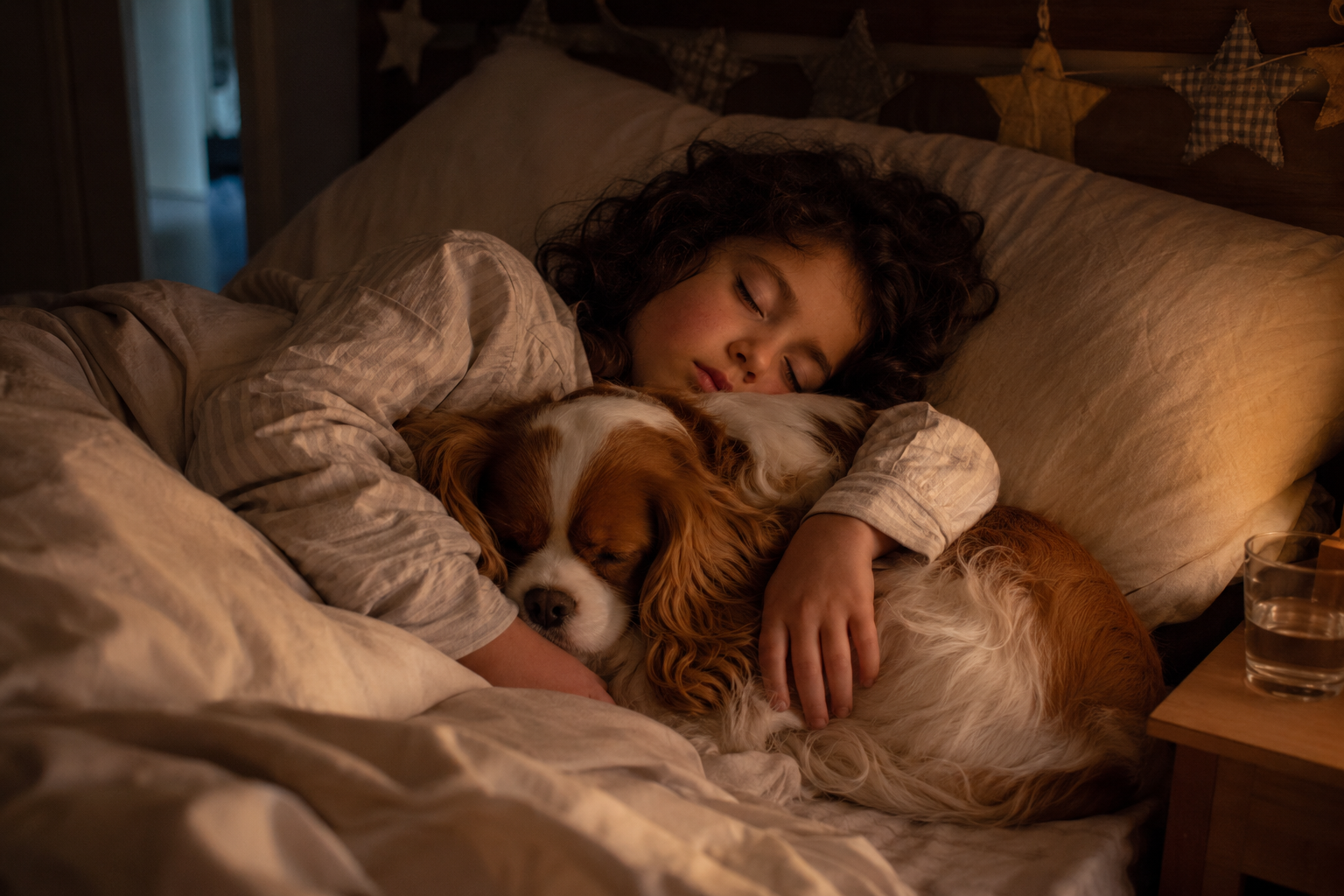
The sleep differences were significant across the board. Compared with the waitlist kids, children living with a service dog fell asleep more easily, slept longer, showed less anxiety around bedtime, and were less likely to need to co-sleep with a caregiver.
Why a dog would move the sleep needle
The study could not pin down the mechanism, but the researchers’ leading explanation rings true to anyone who has watched a child relax against a big calm dog: the animal functions as a portable sense of security. Night is when an autistic child’s anxieties are least distracted and the house is at its most silent and strange, and a warm, steady, familiar presence in the room may take the edge off in a way that no white-noise machine can. Less bedtime fear plausibly cascades into everything else measured: easier sleep onset, longer sleep, and less need to seek out a parent’s bed.
There is an irony here worth naming. In the general population, research has actually found that sharing a bed with a dog slightly fragments human sleep; for the average adult, a canine bedmate means measurably more disrupted nights, not fewer. The autism finding cuts the other way, and the contrast is the point: for a child whose main barrier to sleep is anxiety rather than a dog kicking them at 3 a.m., the trade is heavily net-positive.
One honest null result: caregivers in the service-dog group did not report significantly better sleep themselves. The authors note their sample of caregivers reported few sleep problems to begin with, leaving little room for improvement to show, and other qualitative work has captured parents describing life-changing sleep improvements after a service dog’s arrival, often in the first nights.
Beyond bedtime
Sleep was this study’s headline, but it slots into a broader evidence base for autism service dogs. Other published work has found reduced stress and increased positive emotion in autistic children interacting with dogs and horses, decreases in aggressive behavior, and caregiver reports of dogs interrupting meltdowns, easing isolation, and calming children in overwhelming moments. Demand reflects it: Assistance Dogs International’s directory has listed dozens of accredited organizations placing dogs with autistic handlers and their families, and waitlists remain long.
None of this makes a service dog a universal prescription. They are expensive, take years to obtain, and are working animals with needs of their own, and a service dog is a different tool from an emotional-support animal or a family pet. But for families weighing that long waitlist, this study adds something concrete to the scale: the dog may buy your child, and eventually you, real sleep.
What newer research adds
The sleep thread has continued. A 2024 longitudinal study tracked families’ sleep before and after an autism service dog actually arrived in the home, moving beyond the snapshot comparison of dog-versus-waitlist toward measuring the change itself, and researchers affiliated with programs like Canine Companions have continued publishing on family-wide effects, including caregiver wellbeing and family functioning. The field is young and the studies still lean on caregiver report, but the direction of the evidence has been consistent: for many of these families, the service dog’s job description includes the night shift.
References
- The effects of service dogs for children with autism spectrum disorder and their caregivers: a cross-sectional study (Frontiers in Psychiatry)
- Changes in Sleep of Families After the Arrival of an Autism Service Dog (PubMed)
- Service dogs for autistic children and family system functioning (Frontiers in Psychiatry)
- Evaluating the Effects of Service Dogs on Children with ASD and Their Caregivers (HABRI)
- Assistance Dogs International member programs (ADI)