


Your Dog Isn't 'Just Getting Old.' He's in Pain.
Owners write off the earliest signs of arthritis as normal aging, and that delay costs dogs years of comfort. Here's how to spot it early, what a diagnosis involves, and the new monthly injection changing how vets treat it.

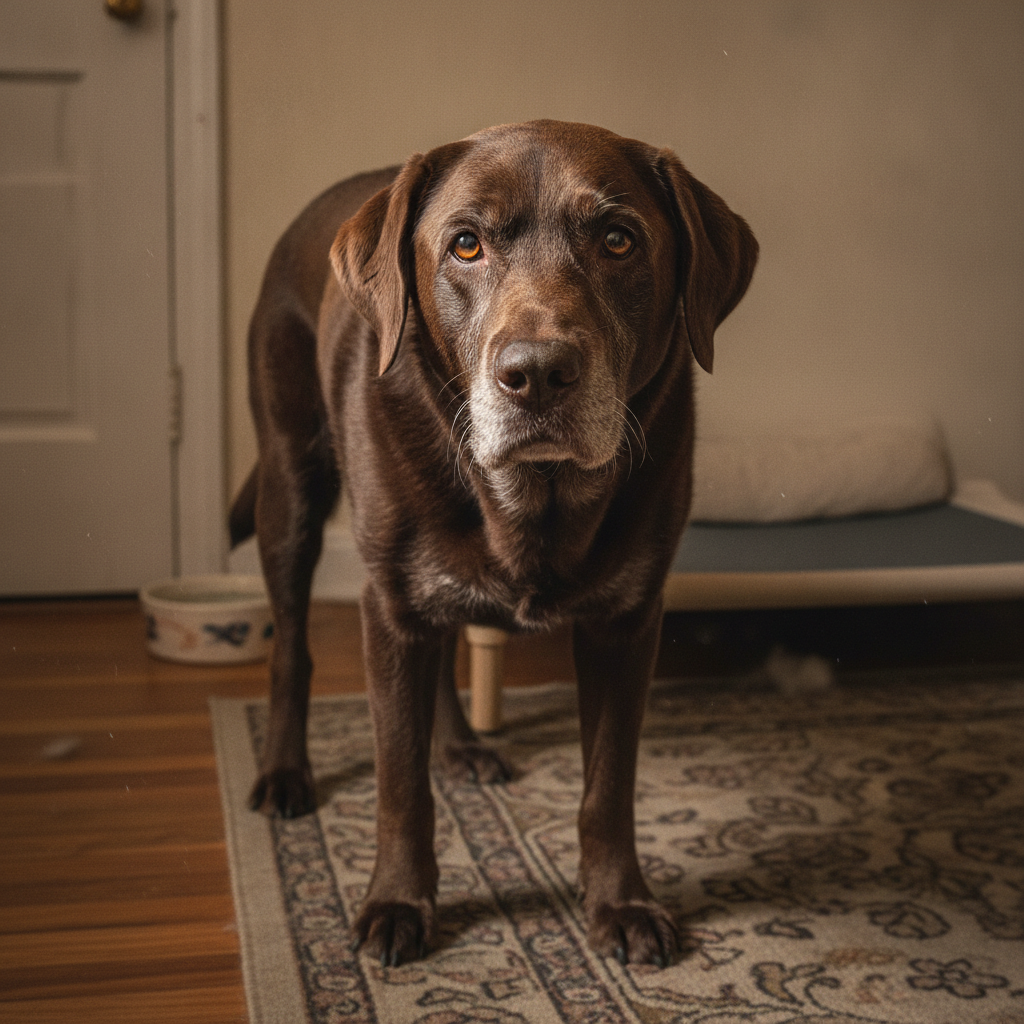
Here is the trap almost every dog owner walks into: your dog starts taking the stairs a little slower, hangs back on the second half of the walk, needs a beat longer to get up from the floor, and you file it under “he’s just getting older.” That instinct is exactly how arthritis goes untreated for years. Slowing down is not a personality change that comes with age. It is very often pain, and pain from arthritis responds to treatment, especially when you catch it early.
Arthritis, also called osteoarthritis or degenerative joint disease, is one of the most common conditions in dogs, and it is especially common as they age. But common is not the same as normal or acceptable. Reading the early signs and acting on them can hand your dog more good years with less pain and more freedom to move.
What is actually happening in the joint
A healthy joint is an engineering marvel. The ends of the bones are capped with cartilage, a smooth, slightly flexible surface, and the joint capsule bathes everything in a slick fluid. Together they let bone glide against bone with almost no friction, and the cartilage doubles as a shock absorber, soaking up the force of every landing and hard step.
Arthritis is what happens when that system breaks down. With age, injury, or an underlying condition, cartilage wears thin or gets damaged. The body responds by laying down new bone, forming spurs, and hardening the tissue around the joint in a bid for stability. Unfortunately those changes stiffen the joint and hurt. Worse, the process is self-perpetuating: injured cartilage releases substances that break down still more cartilage, so arthritis tends to accelerate itself. It is not reversible, and it is generally progressive, which is why the goal of every treatment plan is to slow it and control the pain rather than cure it.
The types worth knowing
Most canine arthritis is degenerative joint disease. It can arrive as a primary condition tied to aging, or it can be triggered by a joint injury or by inherited developmental problems like hip or elbow dysplasia. Less common are immune-mediated arthritis and septic, or infectious, arthritis. Those two progress much faster than ordinary DJD and are treated very differently, which is one more reason not to self-diagnose.
The early signs people miss
Because the first signs are subtle and easy to blame on age, they are the ones that get overlooked. Watch for:
- Doing less than they used to, or tiring faster
- Trouble moving between sitting, lying down, and standing
- Less interest in play
- Stiffness while walking, especially after rest
- Limping
- Creaking or cracking in the joints
- Swollen joints
- Muscle loss, particularly over the hind end
- Signs of outright pain
You are better positioned to catch these than anyone, because you see your dog every day. Arthritis cannot be diagnosed by sight alone, though, so a cluster of these signs is your cue to book a vet visit, not to start medicating on your own.
How vets confirm it
Diagnosis usually pairs a physical exam with joint X-rays. Your vet will take a history, feel each joint for pain, swelling, instability, and crepitus, that abnormal grinding sensation when a joint moves through its range, then watch your dog’s gait for signs of a limp and feel along the limbs for lost muscle. X-rays can reveal joint swelling, bone spurs, hardened bone beneath worn cartilage, and underlying triggers like dysplasia. Many dogs need light sedation for good X-rays, which lets the joints be positioned properly without causing pain. In tricky cases, joint-fluid analysis, a CT scan, or gait testing may be added, but most dogs are diagnosed with basic tools right at the clinic.
How it’s treated
There is no cure, but there is a lot you can do, and a good plan usually combines several tools matched to how severe the arthritis is, how mobile your dog is, and their overall health.
Weight management and appropriate exercise form the foundation. On the medication side, NSAIDs made for dogs are the workhorse for pain and inflammation. A crucial safety note: none of the over-the-counter human options, including so-called “dog aspirin” products, are safe, so let your vet choose the drug and dose. Some dogs with advanced disease need an NSAID twice daily; others only need one during flare-ups.
Many dogs also benefit from an add-on pain medication. Drugs like gabapentin, amantadine, and amitriptyline do not reduce inflammation the way NSAIDs do, but they change how the nervous system processes pain and are often used long-term. On the joint-protection side, Adequan is an FDA-approved injection that feeds the raw materials cartilage needs to rebuild; the oral joint supplements are a mixed bag in the evidence, though working fish oil into the diet is likely to help.
The daily-life adjustments that matter
Managing an arthritic dog is as much about the house as the medicine cabinet, and getting a stiff, sore dog moving comfortably again is genuinely satisfying. Orthopedic bedding takes pressure off sore joints. Rugs or runners laid over slick floors along their usual routes stop the skids and give a wary dog the confidence to move again. A little dog can simply be carried on the stairs; a big one does better with a ramp. A gentle exercise plan, mapped out with your vet or a canine rehab specialist, keeps muscle on the frame without hammering the joints, and rehab clinics often add underwater treadmills, therapeutic lasers, balance work, acupuncture, and massage.
The factors you can influence early
You cannot prevent arthritis outright, but you can delay and limit the damage.
Body weight is the big one you control. Lean dogs live longer and tend to develop arthritis later, because heavy joints absorb extra force, wear faster, and stay more inflamed. The effect is dramatic in both directions: arthritic dogs who lost as little as 6.1 percent of their body weight showed measurable gains in mobility and activity. Keeping your dog lean for life is the best single thing you can do, and if they are already a bit heavy at diagnosis, a weight-loss plan can bring quick relief.
Genetics load the dice through conditions like hip and elbow dysplasia, both more common in large and giant breeds and both frequent paths to arthritis.
Injuries matter too. Direct trauma can damage cartilage, but injuries elsewhere can cause arthritis indirectly, because a dog compensating for pain shifts how weight lands on other joints and wears them unevenly.
What newer research adds
The biggest change since this used to be standard advice is a genuinely new class of drug. In May 2023, the FDA approved Librela (bedinvetmab), the first monoclonal antibody cleared for dogs. Instead of acting like a traditional painkiller, it binds to nerve growth factor, a protein elevated in arthritic joints that helps drive the pain signal, and it is given as a single injection once a month at the vet. For dogs who cannot tolerate NSAIDs, that is a meaningful new option.
It is not a free lunch, and this is the honest part your vet will walk you through. After the U.S. launch, the FDA and manufacturer updated the label in early 2025 to reflect real-world reports of adverse events in some treated dogs, including neurologic signs. It remains a useful tool for many arthritic dogs; it is also a decision to make with your vet rather than a guaranteed fix. Also worth asking about is Galliprant (grapiprant), a targeted anti-inflammatory that works a bit differently from older NSAIDs and is often used in earlier or milder disease. The takeaway is that dogs with arthritis have more paths to comfort than they did even a few years ago, which is one more reason to stop calling it “just getting old” and get it looked at.
References
- U.S. Food and Drug Administration. “FDA Approves First Monoclonal Antibody for Dogs with Osteoarthritis Pain.” fda.gov/animal-veterinary/cvm-updates/fda-approves-first-monoclonal-antibody-dogs-osteoarthritis-pain
- U.S. FDA. “Dear Veterinarian Letter: Adverse Events Reported in Dogs Treated with Librela (bedinvetmab).” fda.gov/animal-veterinary/product-safety-information
- WSAVA Global Pain Council. “Guidelines for Recognition, Assessment and Treatment of Pain.” wsava.org
- Marshall, W. et al. “The Effect of Weight Loss on Lameness in Obese Dogs with Osteoarthritis.” Veterinary Research Communications.
- Kealy, R. D. et al. “Effects of Diet Restriction on Life Span and Age-Related Changes in Dogs.” Journal of the American Veterinary Medical Association.
- American College of Veterinary Surgeons. “Osteoarthritis in Dogs.” acvs.org/small-animal/osteoarthritis
This article covers a medical condition and current medications; it is general information, not a substitute for your veterinarian’s guidance on your individual dog.
Common questions
Does arthritis get worse over time?
It is a progressive condition. Damaged cartilage releases substances that break down more cartilage, so it tends to feed itself. A treatment plan from your vet is aimed at slowing that cycle.
Are some breeds more likely to get it?
Any dog can develop arthritis, but large and giant breeds are more prone to inherited hip and elbow problems that lead to it earlier.
Not a substitute for your vet. Our guidance is educational. For urgent symptoms, contact a vet or emergency clinic right away. Editorial standards
Dr. Mehta is a board-certified veterinary nutritionist who evaluates pet food formulations, ingredient quality, and the science behind dietary trends. He writes and reviews all nutrition content at The Pet Times, including our food rankings and feeding guides.
Meet our experts ↗Keep reading
 Health & WellnessYour Straining Dog Might Not Be Constipated at AllDr. Lena Park · 6 min
 Health & WellnessHalf of What You Call 'Old Age' in Your Dog Is TreatableDr. Amara Solis · 9 min
 Health & WellnessA Worm Can Smell Cancer. That's the Idea Behind the At-Home Dog Test.Dr. Mara Chen · 7 min
 Health & WellnessYour Dog Can Take the Anti-Aging Pill Today. Read the Fine Print First.Dr. Ravi Mehta · 7 min
 Health & WellnessThe Dog Longevity Pill Is Almost Real. It Won't Buy You Forever.Dr. Ravi Mehta · 8 min
 Health & WellnessThat New Lump Feels Like Nothing. That's Exactly the Problem.Dr. Mara Chen · 7 min