


She Built Her Cat a Sparkly Palace. The Cat Wanted the Cardboard.
Sam Reece named her tabby Emma Stone and glued beads to her furniture. The one craft the cat rejected turns out to be the most scientifically interesting thing in the apartment.

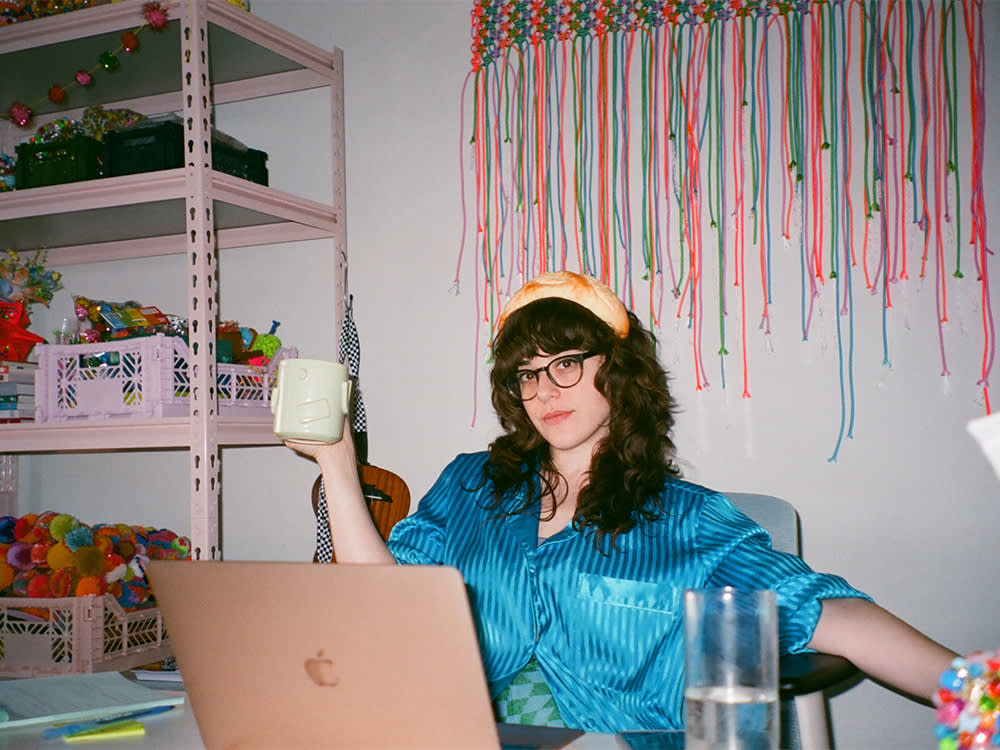
The cat’s name is Emma Stone. That is the first thing you learn, and it is a good enough joke that people usually stop there.
Do not stop there. The better story in Sam Reece’s apartment is a box.
The comedian, briefly
Reece is a comedy writer and performer, one half of the sketch duo Girls With Brown Hair, and the founder of Shitty Craft Club, which began as a hot-glue-and-beads internet phenomenon and became a Chronicle Books hardcover in September 2023, illustrated by Lizzie Darden. She has written for and appeared in the sort of places comedy writers write for and appear in, but the thing that made her name is a philosophy: make the ugly thing, glue the beads to the trash, and get over yourself. The club’s entire premise is that the point of a craft is not that it comes out well.
She grew up in a house full of cats: a 16-pound black-and-white named Bill, who once spent most of his life in a Philadelphia frat house and was rehomed after an act of jealous retaliation involving her crib; a patient tabby named Goldie; a nose-biting cat named Coco; a chubby calico named, inevitably, Cali. Then, in her first studio apartment, Emma.
The origin story is garbage, literally
Reece got Emma from a loose acquaintance who was giving away a free tabby on Facebook, with a backstory about a bodega cat too sweet to spend her life in a box of Doritos. A year later, running into the same guy, she learned the actual provenance: the kitten had been found in the trash outside a bar.
Which, as Reece has pointed out, only improves the name. A garbage kitten who ascends to a Hollywood-adjacent existence, mostly through the sheer force of her own opinion about mealtimes, is a more Emma Stone arc than the one she was sold.
Emma is a mackerel tabby with green eyes, roughly four years old at the time of that telling, and a temperament Reece describes as radiating landlord energy: an animal with exactly two settings, one of which is feed me or I will die and the other of which is I have been alive for three thousand years and I do not have the patience for this.
The palace, and what happened to it
Here is where it gets good.
Emma became obsessed with a cardboard box. Sat in it every day, for months. Reece, a person whose entire career is the transformation of junk into something covered in glitter, did the obvious thing: she upgraded it. She turned the box into a gorgeous sparkly crafty palace.
Emma sat in the palace for about two days and then ignored it forever.
Reece took the correct lesson, which is that Emma does not get crafts anymore. But there is a second lesson underneath, and it is one every cat owner has paid for at least once, usually in the form of a $90 cat tree standing next to the Amazon box the cat actually lives in.
The box was never about the box
The reason cats collapse into cardboard is not aesthetic and it is not ironic. It is stress physiology.
In a study of newly arrived shelter cats, researchers gave one group a hiding box and gave the other group nothing. The cats with boxes had significantly lower stress scores and settled into their new environment faster. A box is not furniture. It is a controlled environment: three walls, one exit, no approach you cannot see coming, and a temperature that suits an animal whose thermal comfort zone runs warmer than ours.
Which means that a box wrapped in glitter, tinsel, and hot glue is a box with a new smell, a new texture, and unfamiliar rustling surfaces. From the cat’s side of the transaction, the renovation removed the entire feature set.
“People are always slightly hurt that the box beats the thing they bought,” says Dr. Priya Nair. “But a cat isn’t rejecting your taste. They’re choosing a small, enclosed, escapable space that smells like nothing, because that’s the space where their nervous system can stand down. If you want them to use the nice bed, put it somewhere with a wall behind it and stop washing it.”
There is a stranger footnote, too. Cats will sit in a shape that only looks like a box: in one crowd-sourced study, cats settled into a two-dimensional square taped on the floor, and even into a Kanizsa illusion, an arrangement of shapes that merely implies a square that is not there. The pull is that deep.
What the cat is teaching, whether or not she means to
Reece’s whole public argument is that things do not have to come out well. Emma is not graceful, plays rough, and, in Reece’s telling, eats like an angry crocodile. She knocks craft supplies off the desk as a reminder that dinner is a live issue. She reportedly put her paw on the leg of Reece’s writing partner and has never once done it to Reece.
None of that is charming in the way a card would be charming. It is charming in the way an animal is charming, which is to say by being completely unmanaged.
And the box is the punchline of the entire philosophy. A woman who has built a following on the freedom of making the imperfect thing spent hours making a beautiful thing for her cat, and the cat’s verdict was that the plain, ugly, unimproved version was better. She was right. It was.
References
- Vinke, C. M., et al. “Will a hiding box provide stress reduction for shelter cats?” Applied Animal Behaviour Science, vol. 160, 2014, pp. 86-93.
- Smith, G. E., et al. “If I fits I sits: A citizen science investigation into illusory contour susceptibility in domestic cats.” Applied Animal Behaviour Science, vol. 240, 2021, 105338.
- Ellis, S. L. H., et al. “AAFP and ISFM Feline Environmental Needs Guidelines.” Journal of Feline Medicine and Surgery, vol. 15, no. 3, 2013, pp. 219-230.
- Reece, Sam. Shitty Craft Club. Chronicle Books, 2023.
Nina Vasquez writes about life at home with pets and the relationships at the heart of it. Her work covers day-to-day living, people-and-pet stories, and the products that fit into a real household, with a warm, grounded take on everyday pet ownership.
Meet our experts ↗Keep reading
 LivingWhy Agathe Singer Paints Every Cat as a Person, Never a PatternNina Vasquez · 6 min
 LivingAnimal Communicators Aren't Reading Your Cat. They're Reading You.Leila Torres · 8 min
 LivingThe Cat Burglar of Mairangi Bay Has 150 Victims and Zero RemorseSasha Ford · 4 min
 LivingYour Cat Picks the Foot of the Bed on Purpose. Here's the LogicClaire Sutton · 6 min
 LivingThe Bewitching History of Black Cats and HalloweenLeila Torres · 7 min
 LivingThe Cats in Her Art Aren't Decoration. They're the Coping Mechanism.Sasha Ford · 6 min