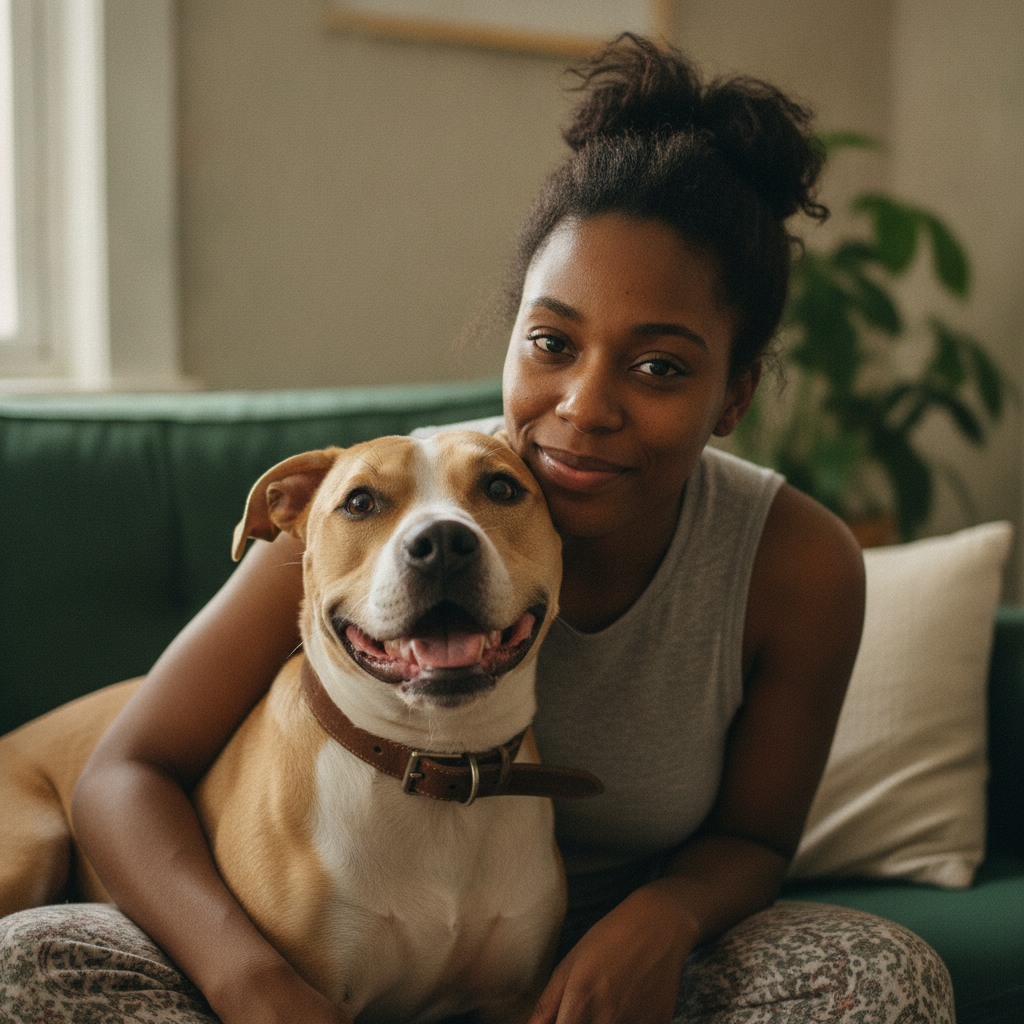
Scroll far enough through the Instagram account @gingers_naps and you get whiplash in the best way. Between adoring photos of a honey-colored Black Mouth Cur and pit bull mix named Ginger, you hit a mini-lecture on nineteenth-century history, a breakdown of what a dog actually costs in a year, or a hard question about who American shelters are really built to serve. The account belongs to Kassidi Jones, a Yale PhD candidate in African American Studies and English who has become one of the more compelling voices in animal advocacy by insisting on a link most pet content avoids: the story of dog ownership in the United States has always been entangled with race.
An argument she didn’t set out to make
Jones did not adopt Ginger as a research project. She wanted a dog her whole life, once made a Microsoft Word pamphlet as a kid arguing her case to her grandparents, and finally brought Ginger home in September of 2020. What is striking is that Jones studies race and racism for a living, yet by her own account she had not connected her scholarship to pet ownership until after she had Ginger. Working through a spreadsheet of local shelters and their adoption requirements, she started to notice that the strictest ones seemed designed, intentionally or not, to screen out people like her.
That observation is the seed of her whole platform. Look at common adoption gates, she argues, and a pattern emerges: proof of a certain income level, references from a vet or from other pet owners, a fenced yard. Each sounds responsible in isolation. Stack them up in a country where the wealth gap runs sharply along racial lines, where entire neighborhoods have no nearby veterinarian, and where the requirements assume a suburban life, and you produce a predictable outcome. The families most likely to clear every bar are white and middle-class, and then the resulting statistics about who owns pets get treated as natural rather than manufactured.
The history most pet lovers never learn
Jones’s feed became a following when she began sharing what she was reading about Black Americans and dogs across history, tucked in between the cute pictures. The record she points to is uncomfortable. For stretches of U.S. history, Black families were prevented from keeping family dogs at all, in part out of a fear that Black people might use dogs the way white people had used dogs against them. She notes that newspapers once advertised dogs specifically bred and trained to hunt down enslaved people who had escaped toward freedom. That is the backdrop, she argues, against which the “generations of a dog in the house” experience so many families take for granted was never evenly available.
Her history of the pit bull specifically has drawn a lot of attention. There was a time, she points out, when the pit bull was read as a wholesome, patriotic American dog, a symbol of grit. As the civil-rights era brought deepening residential segregation and communities that were policed rather than protected, some families in those neighborhoods took safety into their own hands and kept guard dogs, often pit bulls. The breed’s image shifted with the demographics attached to it. Now, Jones observes, the pendulum is swinging again as pit bulls become associated with middle-class white women, a shift she reads with some wariness.
Rescue, saviorism, and a harder look in the mirror
That wariness extends to rescue culture, and it is where Jones is most provocative. She recounts an anecdote that has stuck with her: a Latino man forced to surrender his dog because he could no longer feed himself, never mind the animal, breaking down in tears as he did it. After he left, the shelter posted a story framing the dog as having been discarded like trash, someone to be rescued from. The reframing, Jones argues, quietly recast a grieving, struggling owner as a villain, another way of looking down on Black and brown families under the banner of doing good.
None of this makes Jones anti-rescue. She has thought about going into rescue work herself and would like to do more of it face-to-face once her degree is finished. She has also built resources rather than just critiques, including directories that point people toward pet services that are welcoming to people of color. Her point is not that rescue is bad. It is that good intentions do not exempt an institution from the biases it inherited.
Why the dog matters to the message
There is a personal thread running under all of it. Jones has spoken candidly about depression that, at its worst, keeps her asleep for much of the day, and about how Ginger reorders her mornings and gets her moving. The dog is also, in a sense, her co-author. One of the quieter cruelties Jones describes is that a Black woman walking an excitable pit bull cannot let the dog do what it desperately wants to do, bound up to strangers to make friends, because both she and the dog get fewer second chances if anything goes wrong. So they present carefully, greet politely, and sometimes simply decline the introduction. It is a small, daily calculation that a lot of her followers had never considered until she named it.
What’s new
Jones has kept building on the platform since she started. She has appeared on a range of animal-welfare and conservation podcasts to talk through antiracism in the pet world, continued her graduate work at Yale, where her scholarship centers on nineteenth-century African American eco-poetics, and expanded @gingers_naps into a hub that pairs her research with practical resources. Part of what has resonated, she has said, is simply offering people a place to talk about discrimination in the pet industry without being attacked, a need that turned out to reach well beyond any single community.
The bottom line
Kassidi Jones is doing something unusual: using a genuinely adorable dog to hold open a genuinely hard conversation. Her core claim is not that anyone should feel guilty for loving their pet. It is that the question of who gets to have one in America has never been neutral, and that seeing the history clearly is the first step toward a pet world that is actually open to everyone.