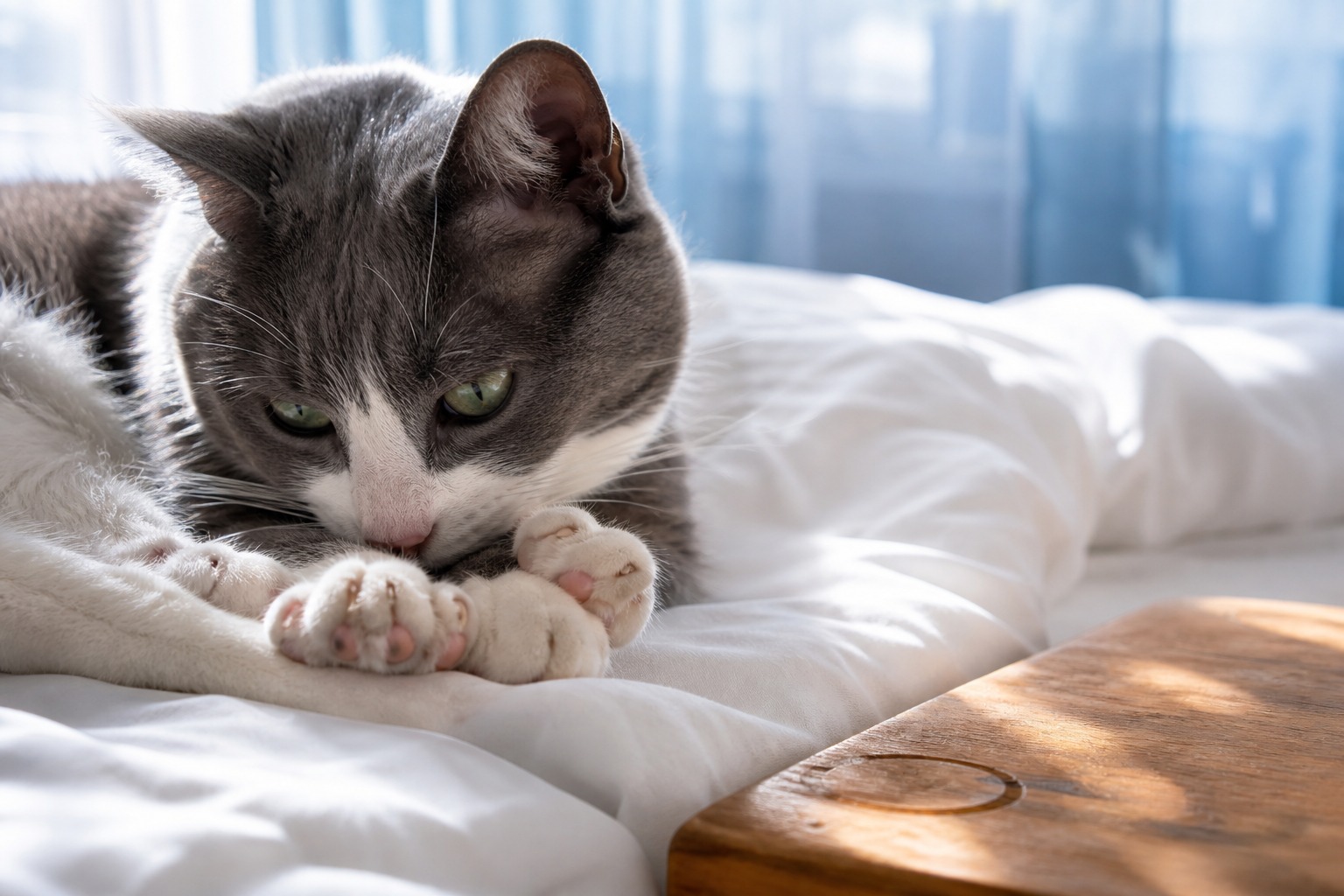
The story usually starts the same way. A cat who normally launches off the furniture is suddenly hesitant. Maybe there is a slight limp. You turn a paw over expecting to find a splinter, a scrape, or a burn, and instead the pad is soft, swollen, and oddly discolored, almost like a little bruise that will not go away. It looks like an injury. It is not.
That squishy, purplish pad is the calling card of a condition called feline plasma cell pododermatitis, better known as pillow foot or pillow paw. And the reason it matters so much is not the paw itself. It is what the paw is often trying to tell you about the rest of your cat.
The paw is a symptom, not the disease
Here is the part most people get backwards. Pillow foot is not damage from the outside working its way in. It is the immune system misfiring from the inside out.
In a healthy cat, a certain white blood cell produces the antibodies that fight off infection. In pillow foot, huge numbers of those cells flood into the paw pad tissue for no useful reason, with no infection to fight. All of that crowding is what makes the pad swell up soft and “pillowy.” Vets still do not fully understand the trigger, but the fingerprints point squarely at immune dysfunction rather than a wound.
That framing changes how you should read the symptom. A bruise heals and you forget about it. A paw pad that swells because the immune system is behaving strangely is worth paying closer attention to, because the immune system is rarely misbehaving in just one place.
Why the FIV link is the real headline
The single most important fact about pillow foot is one the swelling itself will never announce: it travels with feline immunodeficiency virus. Study after study keeps turning up FIV in roughly half the cats who develop pillow paw, and FIV is the virus that gradually wears down a cat’s immune defenses.
“I tell people the paw is the smoke, not the fire,” says Dr. Mara Chen. “When a cat comes in with those telltale spongy pads, one of the first things on my mind is checking their immune status, because pillow foot can be the very first outward sign that something like FIV is in the picture.”
Other conditions that tax or suppress the immune system, including feline leukemia virus, diabetes, and allergies, show up more often in these cats too. None of that means a puffy pad is a catastrophe. Plenty of cats with pillow foot are otherwise fine. It means the smart move is to treat the paw as an invitation to look at the whole cat, not to file it under “minor foot thing.”
What to actually look for
Pillow foot ranges from barely noticeable to genuinely raw. On the mild end, you might only see a bit of soft puffiness and some color change. On the worse end, pads crack open, ulcerate, and bleed, which opens the door to a secondary bacterial infection.
Signs worth checking your cat for:
- Paw pads that feel soft, spongy, or over-inflated
- Tenderness when you touch the feet
- Limping or reluctance to jump
- White streaks, faded pigment, redness, or a purplish bruised look on the pads
- Cracks, open sores, or bleeding
- In some cats, matching swelling on the bridge of the nose
It rarely stays in a single paw, and the big central pads tend to take the worst of it, though the toes can be involved too. Most cats keep the trouble confined to their feet, but a few feel bad enough to turn sluggish or stop eating, which pushes this from “keep an eye on it” to “call the vet now.”
How vets pin it down
A veterinarian can often make a strong guess just from the exam, because few things produce that particular soft, discolored swelling. To be sure, the definitive answer comes from sampling the tissue.
A quick in-clinic option is a fine-needle aspirate, where a thin needle draws a few cells from an affected pad to check under the microscope for that telltale flood of plasma cells. If a pad is already ulcerated, pressing a slide against it can pick up cells and, importantly, flag any bacterial infection that has moved in. When there is real doubt, a biopsy sent to a lab for histopathology settles it.
Treatment: managing, not always curing
Not every case needs medication. Some cats have mild, on-again-off-again symptoms that settle by themselves. But when treatment is needed, the goal is to calm the overactive immune response and get your cat comfortable again. For many cats this becomes a long game of managing flare-ups rather than a one-time fix.
The tools vets reach for include:
- Doxycycline. Often the opening move, this antibiotic also nudges the immune system to settle down. Cats usually stay on it until symptoms clear, which commonly takes around ten to twelve weeks. One handling note matters a lot: always follow the pill with a little food or water, because doxycycline can irritate or even scar the esophagus if it lodges on the way down.
- Steroids. Oral options such as prednisolone dial back the immune response and reduce inflammation.
- Other immune-modulating drugs. For stubborn cases, longer-term immunosuppressants may be used.
- Targeted infection care. If a sore has become infected, specific antibiotics or antifungals address that on top of everything else.
- Surgery. When lesions are severe and medication cannot bring relief, removing the damaged tissue is an option, and it has been curative for some cats.
At home, there is no remedy that treats the underlying condition, but you can keep your cat more comfortable. Switching to a softer, pelleted litter (wood or recycled paper types) keeps gritty particles out of open pads while they heal, and sticking precisely to the medication schedule does more than any supplement.
What newer research adds
The clearest shift in recent years is simply how firmly the immune-mediated picture has taken hold. Current veterinary reviews frame plasma cell pododermatitis as an immune-driven disease and continue to report the strong overlap with FIV, which is why a screen for underlying viral or immune conditions has become a routine part of the workup rather than an afterthought.
The other quietly good news is on treatment. Doxycycline remains a favored starting point precisely because it doubles as an immune modulator, and reported response rates are encouraging, with many cats improving markedly over a course of treatment and surgery reserved for the minority who do not. The practical takeaway for you has not changed: caught early, most cats with pillow foot can be kept comfortable, so the swelling is a reason to book a visit, not to panic.
When to call your vet
Any lasting change to your cat’s paw pads deserves a look, and not everything squishy is pillow foot. Reach out if you notice swelling, painful feet, limping, cracks or ulcers, bleeding, or any dip in your cat’s energy or appetite. Their comfort, and those precious toe beans, are worth the appointment.
References
- Brosseau, Gabrielle. “Feline plasma cell pododermatitis.” The Canadian Veterinary Journal 63.5 (2022): 545–548.
- Werner, Alexander, and Amanda Zetwo. “Diagnosis & Treatment of Feline Plasma Cell Pododermatitis.” Clinician’s Brief, 28 Feb. 2023.
- “Feline Plasma Cell Pododermatitis.” Veterinary Practice, Aug. 2014.