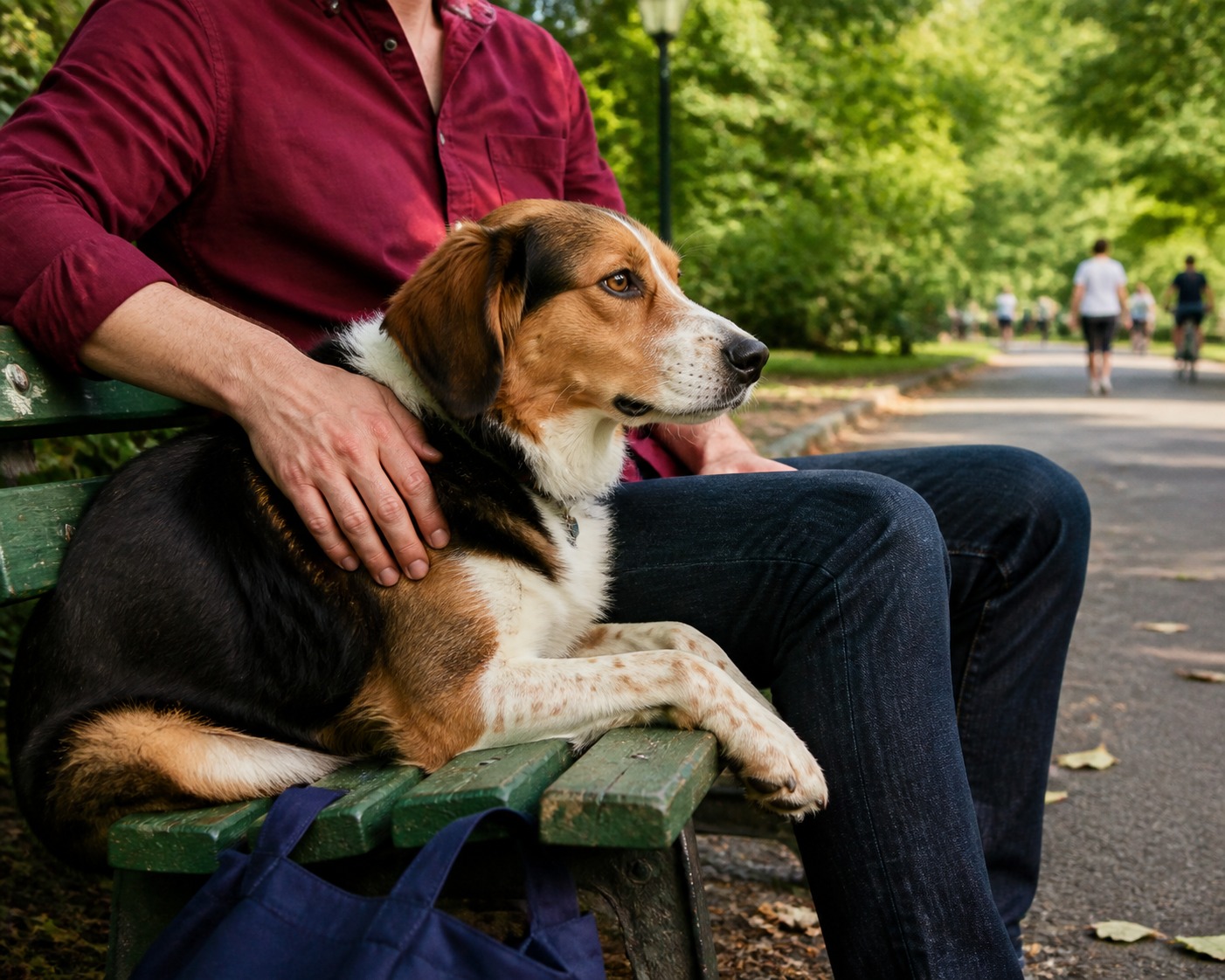
We tend to explain the dog-and-human bond in soft terms: they lower our blood pressure, lift our mood, help us unwind. All true. But a piece of brain-imaging research pushes past the warm-and-fuzzy and points at something you can practically watch happen: touching a dog switches on the specific part of the brain you rely on to be a decent, tuned-in human to other people. And the more hands-on you get, the brighter it burns.
The region doing the work
The area in question is the prefrontal cortex, the front of your brain that handles emotional regulation and social interaction. It’s the machinery behind picking up on a friend’s body language, reading the room, and knowing the exact beat to laugh at a joke someone spent five minutes setting up. It’s central to feeling steady and connecting well with others, which is why anything that reliably activates it is worth paying attention to.
That’s the thread animal-assisted therapy has always pulled on. Therapy dogs seem to help people, and if you can show why at the level of brain activity, you can design that help to work better. Understanding the mechanism is what turns a nice idea into a treatment.
What the study actually did
Researchers at the University of Basel, led by Rahel Marti, ran participants through six short sessions over two weeks. Three of the sessions involved a real dog; three involved a plush stand-in: a stuffed lion (the researchers called him Leo) warmed by a concealed hot-water bottle so it carried the heat and heft of a living animal. Each 10-minute session was broken into five two-minute stages that steadily raised the contact: no animal in the room, then watching it from about a meter away, then the animal resting beside the person, then actively petting it, then the animal gone again.
Throughout, sensors on each person’s head tracked blood-oxygen changes in the prefrontal cortex using functional near-infrared spectroscopy, or fNIRS, which estimates how hard a brain region is working by measuring its oxygen use. The results, published in PLOS ONE, were clear in two ways.
First, activity climbed as contact deepened. Simply seeing the animal did a little. Touching did more. Petting did the most, and hands buried in real fur beat the plush lion. Second, and more striking, the boost from a real dog lingered. After someone petted an actual dog, their prefrontal activity stayed elevated even once the dog was out of the room. With the stuffed lion, the effect dropped off the moment it was gone.
“What stands out to me is the afterglow,” says Dr. Lena Park. “The brain didn’t just spike while the dog was there and reset the second it left. Contact with a living animal left the social-processing system running warm. That’s the part that makes me optimistic about using dogs in therapy, because it suggests the benefit outlasts the visit.”
There was another tell. People’s engagement with the plush animal flattened out over repeated sessions, the way novelty fades. Their brains lit up for a real dog every single time, session after session, which will surprise exactly none of us who still say “a dog!” out loud like we’ve spotted water in a desert.
Why this matters beyond the cute factor
If interacting with a dog reliably increases emotional engagement and social-brain activity, then animal-assisted therapy may be especially useful for people who have a hard time with drive, focus, and connecting emotionally. When a session pulls someone into more engagement, other therapeutic goals, like learning or communication, may get easier to reach on top of it. For clinicians and researchers, findings like these also make it easier to fund and refine the work, which is how the whole field moves forward.
None of this replaces the obvious. You don’t need an fNIRS cap to know that a few minutes with your dog leaves you calmer and a little more human. But it’s satisfying to see the machinery confirm what your hands already told you.
What newer research adds
Since that first study, the same Swiss group extended the question to a much harder setting. In a 2025 controlled trial, they measured prefrontal brain responses in patients in a minimally conscious state, people with severe brain injury and very limited awareness, during contact with a dog. Even there, contact with the animal produced measurable changes in prefrontal activity. It’s early, small-scale work and not a therapy on its own, but it hints that the response to a warm, living animal reaches deeper and more universally than anyone assumed, which is a genuinely hopeful direction for how dogs might support recovery and care.
References
- Effects of contact with a dog on prefrontal brain activity: A controlled trial (PLOS ONE, 2022)
- Effects of contact with a dog on prefrontal brain activation in patients in a minimally conscious state (Neuroscience, 2025)
- Petting dogs engages the social brain, according to neuroimaging (University of Basel / EurekAlert)