


He Paints Monsters So You'll Stop Being Afraid of Them
Travis Louie's black-and-white portraits look like Victorian photographs of creatures that never existed. The joke is that the creatures are the kindest thing in the frame, and that is entirely the point.

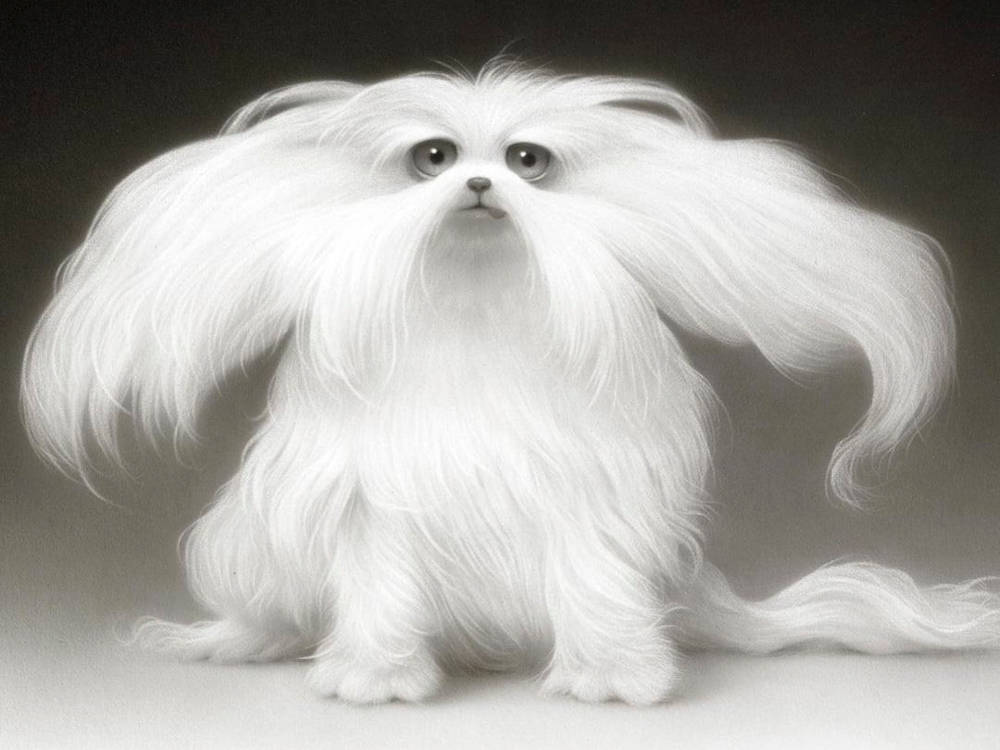
The first thing you notice in a Travis Louie painting is the fur, or the horns, or the wrong number of eyes. The second thing you notice, a beat later, is the expression: patient, faintly weary, unmistakably decent. His creatures look like they have been waiting a long time for someone to stop staring.
That order of noticing is not an accident. It is the whole machine of the work. Louie builds his portraits so that the strangeness lands first and the sympathy lands second, which means every viewer runs a tiny private version of the exact thing his paintings are about: seeing a face, deciding it is other, and then being quietly corrected.
His paintings, all of them in black and white, borrow their grammar from two places: the stiff formality of Victorian portrait photography, and the 19th-century photographic record of traveling sideshow performers. The work has run on New York Times covers and shown internationally, with a solo exhibition at KP Projects in Los Angeles among the stops. But the pedigree is beside the point. The point is that a man who grew up feeling watched decided to paint the watched, and let them look back.
The immigrant is the monster, and the monster is fine
Louie has been direct about where the creatures come from. His family emigrated from China, and he has described his animal-like characters as stand-ins: figures representing the many ethnicities that arrived in America hoping for a better life. The immigrant experience, he says, is the current running under the work.
That reframing reorganizes the entire body of paintings. The horns and the extra fur stop reading as whimsy and start reading as a description of how it feels to be looked at as a category rather than a person. His sympathy for the so-called monsters, by his own account, grows out of a fear of being misunderstood, which he traces back to encountering racism as a very young child. The sense of being cast as an outsider persisted, he has said, even though his family has lived in this country since the closing years of the 19th century.
Notice what he does not do with that material. He does not paint suffering. He paints dignity, and then puts something absurd on its head.
Where the faces come from
He calls himself a professional people-watcher, and he means it operationally.
The faces are borrowed from real people: strangers he has clocked around Redhook, New York, where he lives, or picked up while traveling. What he is hunting for is the one feature that will not sit still. A man around town once had a set of enormous mutton chops and a nose that could go toe to toe with Walter Matthau’s, and he ended up in a painting as a cheerful, horned fellow giving a thumbs up.
That is the process, laid bare. A real face, remembered. One impossible addition. Then the painting does the arithmetic.
There is a genuine archive under the work, too. He collects photographs from the 1800s, thousands of them, filed away. And he keeps returning to Maria Sibylla Merian, the Renaissance-era naturalist whose exacting insect studies he finds remarkable.
Which is a fascinating tension to sit with. Merian and the artist-naturalists were reaching for objectivity: this is the specimen, here is what it is. Louie borrows their cold, documentary posture and then smuggles an interior life inside it. The frame says record. The eyes say person.
Coney Island, and the business of being looked at
Weekends of his childhood were spent at Coney Island, and the sideshow has held him ever since. So has the wider history of the American amusement park, P. T. Barnum’s American Museum included, which stood in what is now Tribeca in the middle of the 19th century.
The sideshow is the perfect subject for him, and not only because it is spooky. Sideshow performers were frequently immigrants, people navigating a foreign world who found that their difference could be converted into a wage. Being stared at was the job. Louie’s paintings put those figures back in the portrait studio, where the sitter, not the crowd, sets the terms.
He writes backstories for the characters, working out what they did for a living. Inside the small alternate universe he has assembled, a number of them turn out to have worked the sideshow themselves.
The stories come first, and then they get out of the way
Ask him how narrative works in the paintings and what he describes sounds less like plot than like kindling. A story is where a character begins, the thing that gets a face breathing. What sets one off can be almost nothing at all, drawn from whatever he happens to have lived through or looked at: a stranger working through a sandwich at a county fair, somebody out walking a dog. A trigger like that is enough to put him in a diner booth filling a paper placemat with thumbnails. The whole process, by his account, is largely unplanned.
The result is that the paintings are legible without being solvable. You can tell there is a story. You cannot quite have it. That is the same deal a real stranger’s face offers you, which is presumably the idea.
The monsters got there early
The soft spot for movie monsters goes back to childhood: copies of Famous Monsters of Filmland bought at the Five and Dime, old sci-fi caught on local channels. F. W. Murnau’s Nosferatu (1922) arrived by accident, on a public broadcast station running a week of influential foreign cinema that also included Akira Kurosawa’s Rashômon (1950).
He was six years old. By his own account it left him transfixed and, he suspects, a little damaged.
There is a version of that story in which the child grows up to make frightening things. Louie went the other way, which is the harder and more interesting move. He looked at the figure everyone in the room was supposed to flinch from and decided the flinch was the mistake.
The house is a small zoo, which will surprise nobody
He and his wife keep several species of amphibian at home, plus tarantulas and one small Pug. The daily rhythm of the place, he says, is roughly that of an amateur zookeeper’s. He is devoted to all of them.
Of course he does. A man whose life’s work is arguing that a strange face deserves a careful, affectionate portrait was always going to end up sharing a house with frogs.
References
- KP Projects Gallery. Artist exhibitions and archives. https://kpprojects.net/
- The Metropolitan Museum of Art. “Maria Sibylla Merian and Daughters: Women of Art and Science.” https://www.metmuseum.org/
- Museum of the City of New York. “P. T. Barnum’s American Museum.” https://www.mcny.org/
- Library of Congress. “Nosferatu (1922).” National Film Preservation Board resources. https://www.loc.gov/
Leila Torres leads our Living coverage, from home life and travel to the products and rescue stories that come with sharing a life with animals. She edits and writes across the section, with a soft spot for pieces about the bond between people and their pets.
Meet our experts ↗Keep reading
 LivingGive Your Pet a Job: The Case for a Capricorn-Season ResetNina Vasquez · 6 min
 LivingHow to Get a Landlord to Say Yes to Your PetJames Okafor · 6 min
 LivingThe Vet at the Ukrainian Border Treats Animals to Reach the People Holding ThemDr. Amara Solis · 6 min
 LivingThe 'Rainbow Bridge' Feels Ancient. A Grieving 19-Year-Old Wrote It in 1959.Claire Sutton · 6 min
 LivingYour Cat Can't Pick Your Face Out of a Lineup. It Doesn't Need To.Dr. Mara Chen · 5 min
 Health & WellnessYour Vet Might Answer Your Email. Here's How Not to Get Ignored.Dr. Lena Park · 6 min