


Science Finally Cracked Orange Cats. The Gene Pulls a Trick No Other Animal Does.
Sixty years of looking, two teams, one answer. Orange fur comes from a deleted stretch of DNA that switches on a gene where it has no business being. Here's what that actually means for your ginger menace.

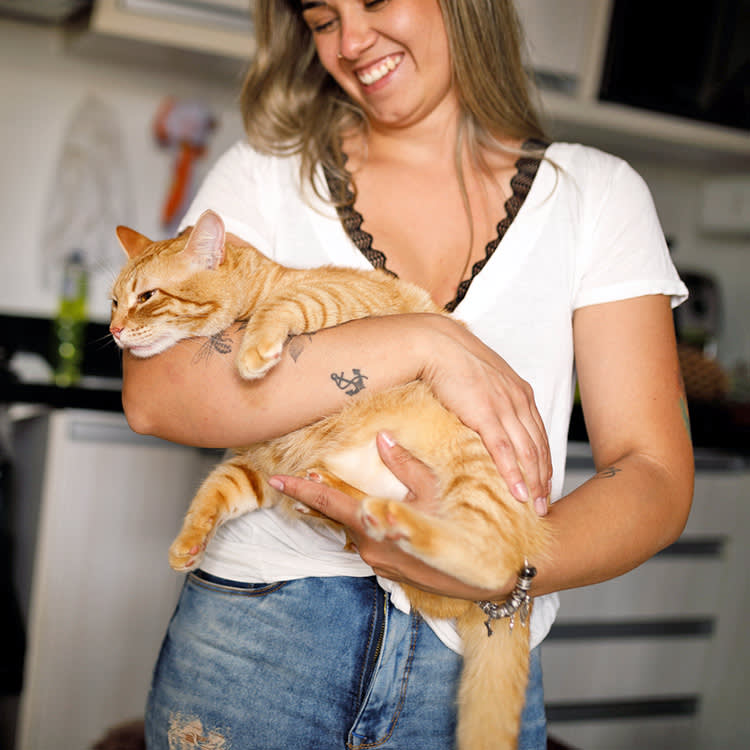
Everyone has a theory about orange cats. They are the class clown of the species, the single brain cell shared across a global network, the one who will absolutely knock your water glass off the table while maintaining eye contact.
What nobody could tell you, until recently, was why they were orange. Not in a poetic sense. In a molecular one. Researchers had been chasing the ginger gene for about sixty years and kept coming up empty, and the reason they kept coming up empty turns out to be the most interesting part of the whole story: cats do not do orange the way anything else does.
The clue that was hiding in plain sight
Start with the pattern everyone notices. About 80 percent of orange cats are male. Meanwhile, the overwhelming majority of calicos and tortoiseshells, which are essentially a mosaic of orange and non-orange patches, are female.
That distribution is a fingerprint. It says the variant controlling orange-versus-not sits on the X chromosome. Males inherit one X, so one copy of the variant is all it takes. Females inherit two, and in a cat with one orange X and one non-orange X, the random silencing of one X or the other in each cell produces the patchwork you see on a calico.
So geneticists knew where to look. They just could not find what they were looking for.
Why the obvious answer was wrong
In humans, red hair and fair skin usually trace back to a gene called MC1R. It is the standard-issue answer for orange coloration across mammals, and it would have been the tidy explanation here too.
Except MC1R is not on the X chromosome in cats. And most orange cats carry no MC1R mutation at all. The tidy explanation was simply not available. Something else was doing the work, and for six decades nobody could say what.
The answer: a gene switched on in the wrong room
In late 2024, two research teams working independently, one led by Hidehiro Toh in Japan and one by Christopher Kaelin at Stanford, arrived at the same conclusion at almost the same moment.
The gene is ARHGAP36, and it sits on the X chromosome.
Here is the strange part. Nobody found a mutation inside ARHGAP36 that changes the protein it makes. What they found was a small deletion in the DNA near it, a missing stretch that acts like a stuck switch. In orange cats, melanocytes, the cells that make pigment, were producing roughly 13 times as much ARHGAP36 RNA as they should.
ARHGAP36 is not supposed to be active in pigment cells at all. It is a gene doing its job in the wrong room. And its rogue activity interrupts the pigment pathway, nudging the cell away from producing dark pigment and toward the light red pigment that gives you a ginger cat.
The teams checked their work in the way you would want them to. One scanned a database of 188 cat genomes and found the identical deletion in orange, calico, and tortoiseshell cats. The other confirmed the mutation across 258 cat genomes. In calico skin, the orange patches carried more ARHGAP36 RNA than the black or brown patches did, exactly as the mechanism predicts. And when researchers artificially increased ARHGAP36 in melanocytes, the cells duly started making light red pigment.
That last experiment is the one that closes the case. It is not correlation. It is cause.
Why this counts as genuinely weird
Coat color genetics is a well-trodden field. Orange, red, and yellow coloration in mammals almost always routes through the same familiar signaling pathway, at a point that is well understood.
Cats found a different door. The orange variant does not break the usual gene; it hijacks an unrelated one and points it at the pigment machinery. Researchers have been blunt that no other animal is known to color its coat this way, and that is not marketing language. It is a mechanism with no precedent, which is precisely why sixty years of looking in the expected places came up empty.
What’s new since this was written
The two 2024 findings were preprints, which means they were public but not yet peer-reviewed. That has since changed. Both teams published in the journal Current Biology in 2025, with the papers appearing in the spring. The Kaelin team’s paper describes the causal mutation as a roughly 5-kilobase deletion that switches on Arhgap36 specifically in melanocytes, where it is not normally expressed at all.
Peer review mattered here, because two independent groups converging on the same answer with different datasets is about as strong as this kind of evidence gets. The orange gene is no longer a hypothesis. It is a finding.
One small caution for anyone hoping this explains the personality: it does not, and it probably cannot. ARHGAP36 does its work in pigment cells. There is no evidence linking it to feline temperament, and researchers have been careful not to imply one. The reason your orange cat is like that remains, as ever, entirely unaccounted for.
References
- Kaelin, C. B., et al. (2025). Molecular and genetic characterization of sex-linked orange coat color in the domestic cat. Current Biology.
- Toh, H., et al. (2025). A deletion at the X-linked ARHGAP36 gene locus is associated with the orange coloration of tortoiseshell and calico cats. Current Biology.
- Stanford Medicine. Scientists track down mutation that makes orange cats orange.
- Science. Gene behind orange fur in cats found at last.
Common questions
Does the orange gene affect a cat's personality?
There is no evidence that it does. ARHGAP36 turns on in pigment cells and changes what pigment they make. The chaos-agent reputation is a cultural story, not a genetic one.
Is it the same gene that makes people redheads?
No. Red hair in humans is usually tied to MC1R. That gene is not on the X chromosome in cats, and most orange cats have no MC1R mutation, which is exactly why this mystery stayed open for so long.
Claire Sutton writes about life with pets, from the first days home to the small daily routines that make a household work. Her reporting spans people-and-pet relationships, training basics, and the practical side of bringing a new animal into the family.
Meet our experts ↗Keep reading
 Health & WellnessYour Cat's Lifespan Isn't Fixed. Here's What Moves It.Dr. Mara Chen · 6 min
 TrainingToilet-Training Your Cat Means Throwing Away Their Health ChartDr. Ravi Mehta · 8 min
 Health & WellnessYour Indoor Cat Will Never Get Out. Until the Night She Does.Dr. Amara Solis · 6 min
 Health & WellnessThis Cat Is 26. Her Secret Is 15 Boring Habits, Not One Magic Trick.Dr. Priya Nair · 9 min
 Health & Wellness13 Small Cat-Care Upgrades Your Cat Will Actually NoticeDr. Priya Nair · 8 min
 Health & WellnessA Blind, Paralyzed Cat Isn't a Tragedy. It's a Setup Problem.Dr. Nina Kohl · 7 min