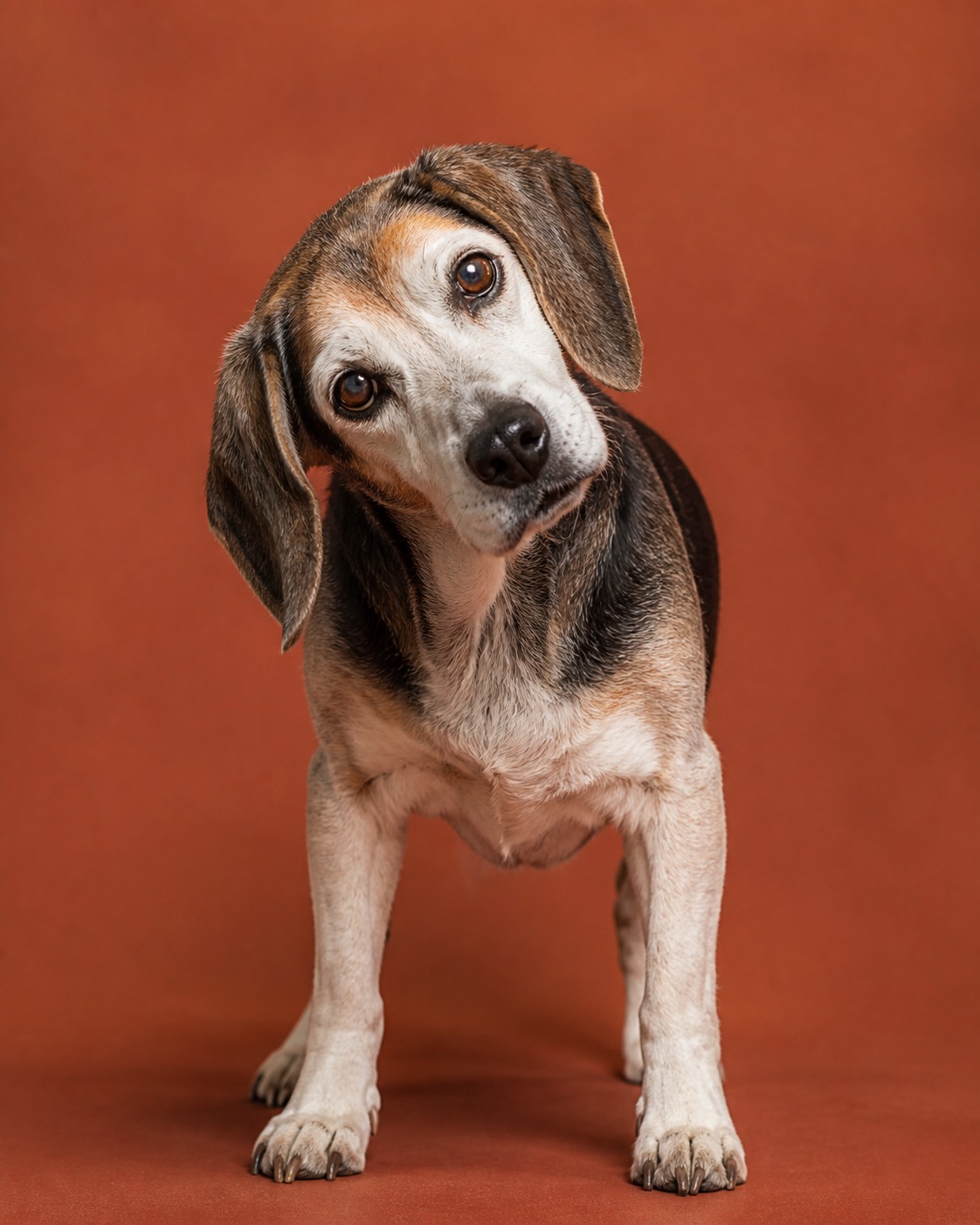
It happens fast and it looks like the worst thing you have ever seen. Your senior dog is suddenly on his side. His head is cocked hard to one direction and stays there. His eyes are flicking rapidly from side to side, on their own, and he cannot stop them. He tries to stand and falls over. He is drooling. He may vomit. He looks terrified, and so, reasonably, are you.
Almost every owner in that moment thinks the same three words: stroke, seizure, tumor.
Usually it is none of them. Usually it is a condition with a name that undersells how dramatic it is, idiopathic vestibular disease, better known as “old dog” vestibular disease, and the majority of dogs who have it recover almost entirely, without any specific treatment at all.
The hard part is that you cannot know that on day one. So this article is organized around the thing that actually distinguishes the harmless version from the serious one, which is not a scan and not a blood test. It is 72 hours.
What is happening inside him
Deep in the inner ear sits a small plumbing system, fluid-filled canals lined with sensors, wired straight into the brain. Its entire job is to report which way is up. Disrupt it and a dog loses his sense of orientation completely. He is not weak. He is not confused. He is violently dizzy, in the way a person with acute vertigo is dizzy, and everything you are seeing follows from that.
That system can be disrupted in two very different places, and the distinction is the whole ballgame.
Peripheral means the problem is outside the brain, in the inner ear itself or along the nerves running from it. Causes include inner ear infections, hypothyroidism, reactions to certain medications, and trauma.
Central means the problem is inside the brain, where the balance information gets processed. Causes include stroke, brain tumors, certain infections, and head injury.
Idiopathic vestibular disease is a peripheral problem with no identifiable cause. “Idiopathic” is medicine’s honest word for “we do not know why this happens.” The prevailing theory is that it comes from age-related changes in the vestibular system itself, which is why it lands so heavily on older dogs. Most dogs diagnosed with it are over five.
It is also, by a wide margin, the version vets diagnose most often, which is worth holding onto during the worst hour.
What you will see
Dogs with idiopathic vestibular disease show some combination of these:
- A head tilt, sometimes dramatic, as if his head is permanently tipped to one side
- Ataxia: an unsteady, drunken gait, loss of balance, falling over
- Circling, consistently in one direction
- Nystagmus: eyes moving rapidly side to side, involuntarily
- Drooling or vomiting, both secondary to the nausea that comes with the dizziness
- Standing with legs splayed wide to brace himself
- Changes in eating and drinking
If an ear infection is the cause, you may also see pain when his ears are touched, head-shaking, and a bad odor or discharge from the ear.
The signs that point to something worse are the ones that go beyond balance. A dog with a central problem may show changes in awareness or mental state, real deficits in how his limbs move rather than just where they land, and seizures. That distinction, dizzy but mentally present and neurologically intact versus dizzy and something else is wrong, is what your vet is looking for on exam.
The 72-hour rule, and why it is a test and not a delay
Here is the thing owners find hardest, and it is worth understanding rather than merely tolerating.
Idiopathic vestibular disease cannot be confirmed by a test. It is a diagnosis of exclusion: you get to it by ruling out everything else. There is no blood value that says “idiopathic.” There is no image that shows it.
But it has one property nothing else on the list has. It gets better, on its own, quickly.
So if your vet examines your dog, finds his awareness intact and his limbs working, checks his ears, runs bloodwork to look for hypothyroidism and infection, and then says “let’s watch him for 72 hours” — that is not your vet declining to investigate. The watching is the investigation. Gradual improvement inside 72 hours is, in practice, the confirmation. Continued deterioration, or new signs appearing, is the finding that sends you to imaging.
This is why the wait-and-see approach is not just cheaper. It is more informative than an MRI would be on day one, for the majority of dogs, and it spares an elderly animal a general anesthetic he may not be a good candidate for.
“Owners hear ‘let’s wait’ and they think we’re gambling with their dog,” says Dr. Mara Chen. “We’re not. We’re running the one test that separates the benign version from the bad one, and the test takes three days and costs nothing. If he’s improving by Thursday, we have our answer.”
Meanwhile your vet is not idle. Expect a full hands-on exam, blood and urine work, and a swab of the ears under the microscope, all of it hunting for the treatable conditions that can imitate this one.
Why the ear matters so much
Inner ear infections are a relatively common cause of vestibular signs, and they are treatable, which makes them worth ruling out properly.
They are also genuinely difficult to diagnose, because you cannot see the inner ear. The eardrum is in the way. Your vet will examine both ear canals, and the presence of an outer ear infection is a useful clue that there may be disease deeper in. In severe cases the vet may be able to see inflammation or pus on the inner surface of the eardrum. Beyond that, confirming it takes head X-rays, a fluid sample from the inner ear, or advanced imaging.
Breed matters here, though not in the way people assume. No breed is more prone to idiopathic vestibular disease; it can happen to any dog. But the non-idiopathic version, driven by ear infections, does cluster in the breeds prone to ear disease: Cocker Spaniels, Boston Terriers, Boxers, Shar Peis, Poodles, Golden Retrievers, Labrador Retrievers, Beagles, Basset Hounds, and flat-faced breeds such as French Bulldogs, Pugs, and Pekingese.
When imaging is actually the right call
An MRI is a genuinely excellent tool for evaluating the inner ear and brain, and it comes with three real drawbacks.
It is usually available only at specialty hospitals, emergency referral centers, and veterinary teaching hospitals. It requires the dog to be completely still, which means general anesthesia, and not every elderly dog with multiple health conditions is a good anesthetic candidate. And it typically costs upwards of $1,500 once you include anesthesia and hospital time.
Which is exactly why it is reserved for the dogs who need it: those with signs suggesting a central problem in the brain, and those whose vestibular signs are not improving after several days or are actively getting worse. For a dog who is clearly better on day three, an MRI is an expensive answer to a question that has already been answered.
Caring for him at home
Get the diagnosis first. Do not start treating at home on the assumption it is the harmless kind, because the causes look nearly identical at the outset and some of them need specific treatment quickly.
Once he is home, your vet can offer supportive care that makes a real difference: anti-nausea and motion-sickness medication for the dizziness, and fluids, either intravenous or under the skin, if he is not eating and drinking enough to stay hydrated. The first few days are genuinely miserable for him, and treating the nausea is not a luxury.
The rest is environmental, and the full step-by-step is in the how-to above. The short version: shrink his world down to one padded, hazard-free room, bring everything to him, turn him if he cannot turn himself, make food as appealing as you can, and use a harness with a handle to get him outside.
It is exhausting for a few days. It gets easier quickly, and it gets easier in a way that itself tells you the diagnosis was right.
The euthanasia question
People ask this, and they should not feel bad for asking it, because the first 48 hours look like a dog who is dying.
Do not euthanize a dog for idiopathic vestibular disease. He will very likely improve within days, and as he does, caring for him gets easier by the hour. The decision made on day two is being made at the worst moment of the illness, on the least information you will ever have.
The question is legitimately different when the cause is something like a brain tumor or a severe head injury. There, prognosis, treatment options, palliative care, and quality of life are all genuinely on the table, and that is a conversation to have with your vet rather than a decision to make alone at 2am.
Prognosis: what recovery actually looks like
Idiopathic vestibular disease is not fatal, and it does not shorten a dog’s life expectancy. Most dogs recover completely within a few weeks even with no treatment at all, and go back to living entirely normal lives.
The caveats are worth having in advance, because they surprise people.
Recovery is not always total. A residual head tilt is common and can be permanent, and a dog who keeps a slight tilt for the rest of his life is not a dog who failed to recover, he is a dog with a tilt. And it can take longer than the internet suggests. Marked improvement is expected in the first 72 hours, with continued neurological improvement over the following two to three weeks, but some dogs still have signs at five weeks.
The forms of the disease with an identifiable cause carry the prognosis of that cause, which is why the diagnostic work at the start matters so much.
Can it be prevented?
The idiopathic form, no. Nobody knows why it happens, so there is nothing to prevent.
The other forms, partly yes. Ear infections and hypothyroidism are both preventable-ish causes of vestibular disease, and both are exactly the kind of thing routine physical exams and periodic bloodwork are designed to catch early. Staying on top of a chronic ear problem in a floppy-eared dog is, among other things, vestibular-disease prevention. So is the general project of a good diet, daily exercise, and mental enrichment.
What newer research adds
Two findings from the recent literature are worth knowing, and both should make you feel better about the waiting.
The first is about how rarely this needs a specialist. A large study of vestibular disease in dogs under UK primary veterinary care found that only 3.6 percent of cases were ever referred onward, which the authors linked directly to how many of these dogs simply improve. The overwhelming majority of this is managed, successfully, by an ordinary general practice vet who watched and waited.
The second is about the long tail, and it is the part vets do not always mention. In a retrospective study of 148 dogs with peripheral vestibular disease, about 17.6 percent had a recurrence of clinical signs at least once over the following twelve months. And roughly half had some persistent neurological deficit afterward: a lingering head tilt in about a third of dogs, and facial weakness in roughly a quarter.
That is not bad news so much as a recalibration. “Full recovery” in this disease often means “back to himself, with a slightly crooked head, and possibly one more episode down the road.” Dogs are largely unbothered by this. Knowing it in advance means that when it happens again in eight months, you will recognize it for what it is rather than living through the same terrible first night twice.
The bottom line
The idiopathic form burns itself out. Left entirely alone, the great majority of these dogs are back to normal inside a few weeks, and the whole thing looks vastly more catastrophic than it turns out to be.
Get it diagnosed anyway. The same signs can be produced by an ear infection, a thyroid problem, a stroke, or a tumor, and those do not burn themselves out. Any dog who suddenly loses his balance needs to be seen, and seen quickly.
But if you are sitting on the floor tonight with a dizzy old dog and a vet who has told you to give it three days, you are not doing nothing. You are running the test.
References
- Radulescu, S.M., Humm, K., Eramanis, L.M., et al. “Vestibular disease in dogs under UK primary veterinary care: Epidemiology and clinical management.” Journal of Veterinary Internal Medicine, vol. 34, no. 5, 2020, pp. 1993–2004.
- Orlandi, R., Gutierrez-Quintana, R., Carletti, B., et al. “Clinical signs, MRI findings and outcome in dogs with peripheral vestibular disease: a retrospective study.” BMC Veterinary Research, vol. 16, no. 159, 2020.
- Brooks, W. “Vestibular Disease in Dogs and Cats.” Veterinary Partner, VIN, 2019.
- Kent, M., Platt, S.R., Schatzberg, S.J. “The neurology of balance: Function and dysfunction of the vestibular system in dogs and cats.” The Veterinary Journal, vol. 185, no. 3, 2010, pp. 247–258.
- MSPCA-Angell. “Acute Vestibular Disease in Old Dogs.” Angell Animal Medical Center.