The most useful thing to know about a new dog’s first month is that you are not, primarily, teaching commands. Sit and stay are nice, but they are not the real curriculum. What your dog is actually learning in those first 30 days is a bigger, quieter lesson: that this house has predictable rules, and that following them always, reliably pays off.
Get that across and the specific skills come easily for years afterward. Miss it, and you spend those years re-litigating the basics. So while the six foundations below are the things to work on, the principle underneath all of them is the one that matters most, and it is boring on purpose: consistency beats intensity. A calm, repeated routine teaches a dog far more than an occasional marathon training session. Every dog moves at their own pace, so treat these as a direction, not a deadline.
1. Their name, and coming when called
Most first-month checklists bury this or skip it, and that is backwards. Start here, because a dog who looks at you when you say their name and comes when you call is the foundation everything safety-related sits on: recall off a hazard, a check-in on a walk, getting your dog back to you when it matters. It is also the purest demonstration of this whole plan’s principle, that cooperating with you always pays.
Make the name a promise of good things. Say it in a bright voice, and the second your dog turns to look, mark it and reward. Never poison it by using the name for anything unpleasant. Then build “come” as a party, not a command: call in a happy tone, reward lavishly every single time your dog arrives, and in month one, never call your dog over to do something they dislike. A recall that always pays becomes a recall you can trust.
2. Being alone is a skill you teach on purpose
Independence comes second because month one is the window when it is easiest to build, and the easiest to accidentally sabotage. Spending every waking minute with a new dog feels loving, but it quietly sets up separation anxiety. Leave your dog alone for a minute to take out the trash or grab the mail, then stretch the absences gradually. This matters most for puppies making the jump from a litter to being a solo pet. Small, calm departures now prevent big problems later. If you are already seeing signs of true separation distress, loop in a professional behaviorist early.
3. The crate is a bedroom, not a time-out
A dog who loves their crate is safer and calmer for everything else, and it pairs naturally with alone-time training. The goal is for your dog to see the crate as a cozy den, not a place of punishment, which takes some deliberate salesmanship in week one. From day one, quietly toss treats, toys, and food-stuffed chews inside and let your dog discover them, so good things keep appearing in that space. Feed meals in there. Make crate time part of a predictable daily rhythm, because dogs settle fastest into routines they can anticipate.
Even if you plan to phase the crate out after potty training, it earns its keep overnight and when you are out, keeping a teething or untrained dog from chewing and swallowing something dangerous while unsupervised.
One real exception: a dog with genuine confinement anxiety should not be crated. A few minutes of protest barking is normal, but a dog who frantically howls, digs, or bites at the crate needs a different setup, a pen or a baby-gated room, and possibly a professional behaviorist.
4. Bathroom means outside, every time
Housetraining is really schedule-training. Accidents happen, even a previously housebroken adult can backslide in a new home, so set a potty schedule and stick to it: first thing in the morning, after meals and water, after naps, and right before bed for young dogs.
Two details do the heavy lifting. Keep your dog on leash for potty trips, even in a fenced yard, so they learn this is a job, not playtime. And return to the same spot, because dogs are associative learners and the scent cue tells them what to do. When they go, celebrate immediately and keep the treats coming.
5. Sit, the skill the rest of obedience is built on
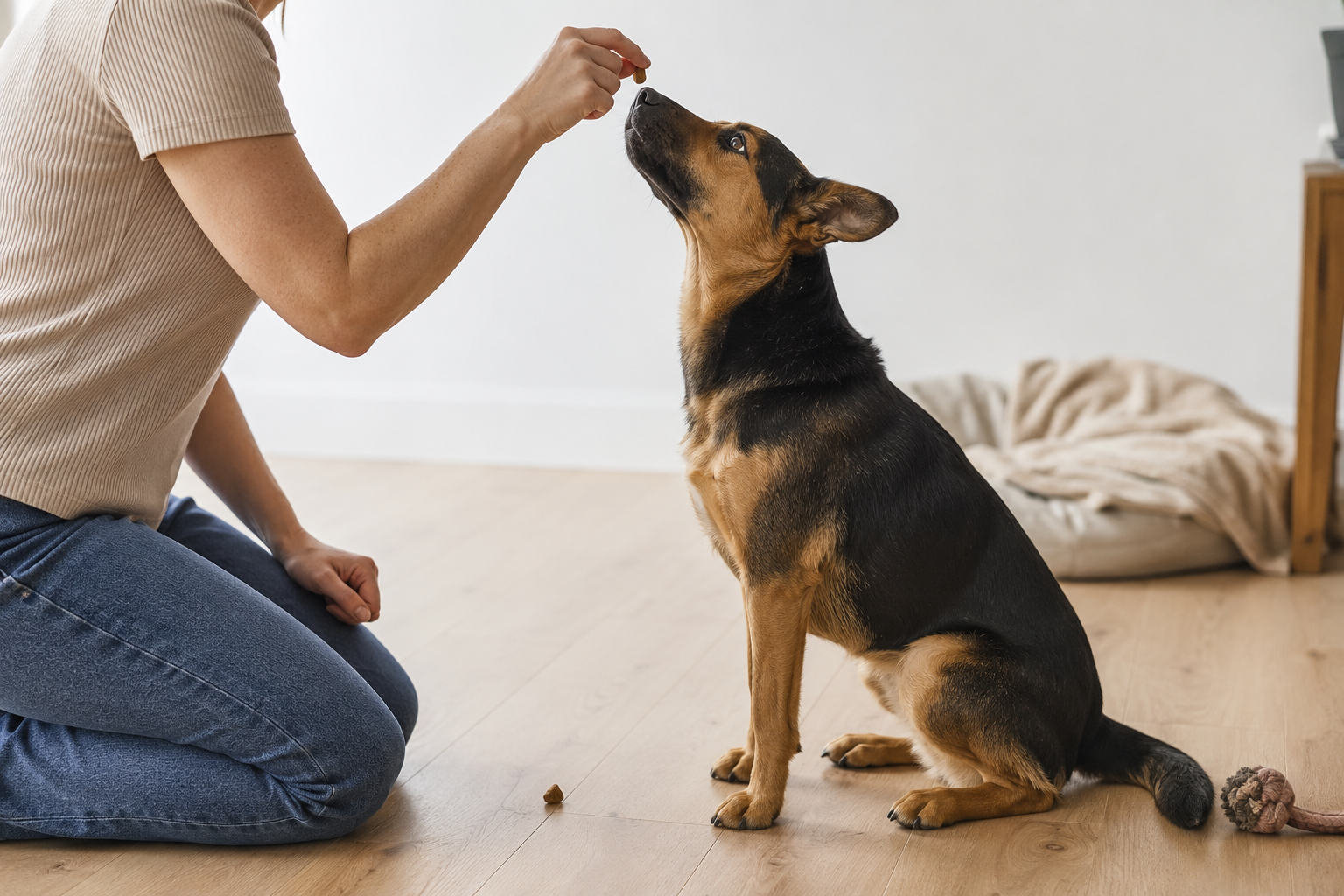
Sit is the foundation cue for stay, down, and impulse control in general, which is why it belongs on the first-month list even though it is not the first thing to build. The luring method is simple: hold a treat just above your dog’s nose and move it slowly back over their head, so their rear drops as their nose lifts. The instant they sit, mark it (“Good sit!”) and pay. Then make it a habit of the whole house, reward casual sits all day, and start asking for one before meals, walks, and at every curb.
6. A tired brain, not just a tired body
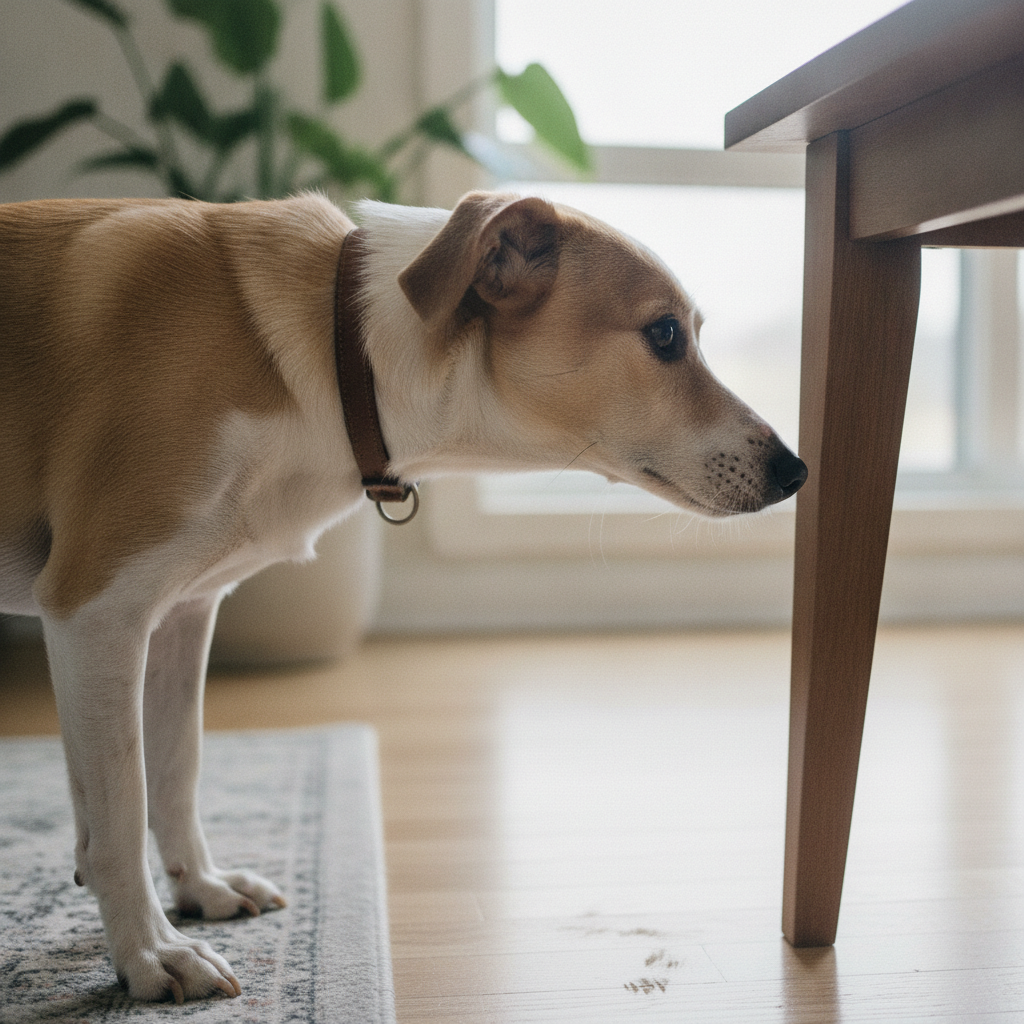
Finally, the piece that protects everything above: a mentally bored dog will find trouble no matter how much you have trained them. Both kinds of exercise matter, and the mental side is the one most owners skip. You do not need elaborate games. Letting your dog stop and sniff on walks is the single easiest form of enrichment there is, because a dog’s nose is doing extraordinary work, and a good sniff is genuinely satisfying to them.
Layer in puzzle toys and food-dispensing games that make your dog problem-solve for their kibble, especially on days you cannot get out much. For high-drive breeds, structured outlets like an agility setup channel energy that would otherwise go into your furniture.
The principle that ties it together
Read back over those six and notice what they share. None of them is really about the trick. They are about your dog learning that the rules of your home are consistent and that cooperating with them is always worth it. That is why the same principle, calm, repeated, well-rewarded consistency, shows up in every one.
“People think the first month is about drilling obedience, and then they’re frustrated when the dog ‘forgets’ it by week three,” says Dr. Nina Kohl. “What actually sticks in those early weeks is the pattern: I did the thing, good stuff happened, every time. Build that trust first and the individual cues almost train themselves. Skip it, and you’re bribing a confused dog forever.”
What the evidence adds
If there is one thing modern training research has settled, it is that reward-based methods, marking and paying the behavior you want, outperform punishment-based approaches on both results and welfare, producing dogs who learn faster and are less anxious. Everything in this plan leans on that finding: you are catching and rewarding good choices, not correcting bad ones. It is also why enrichment has moved from “nice extra” to “core need.” Behaviorists increasingly treat sniffing, foraging, and problem-solving as essential daily nutrition for a dog’s brain, not optional entertainment. Build your dog’s first month around rewards and enrichment, and you are not just teaching house rules. You are setting the tone for the entire relationship.