


The 8 Cat Breeds Most Likely to Actually Love You Back
A breed's reputation for affection is a probability, not a promise. Here are eight cats that stack the odds in your favor, sorted by the kind of clingy they are, plus the popular 'cuddly' breed we won't put on the list.

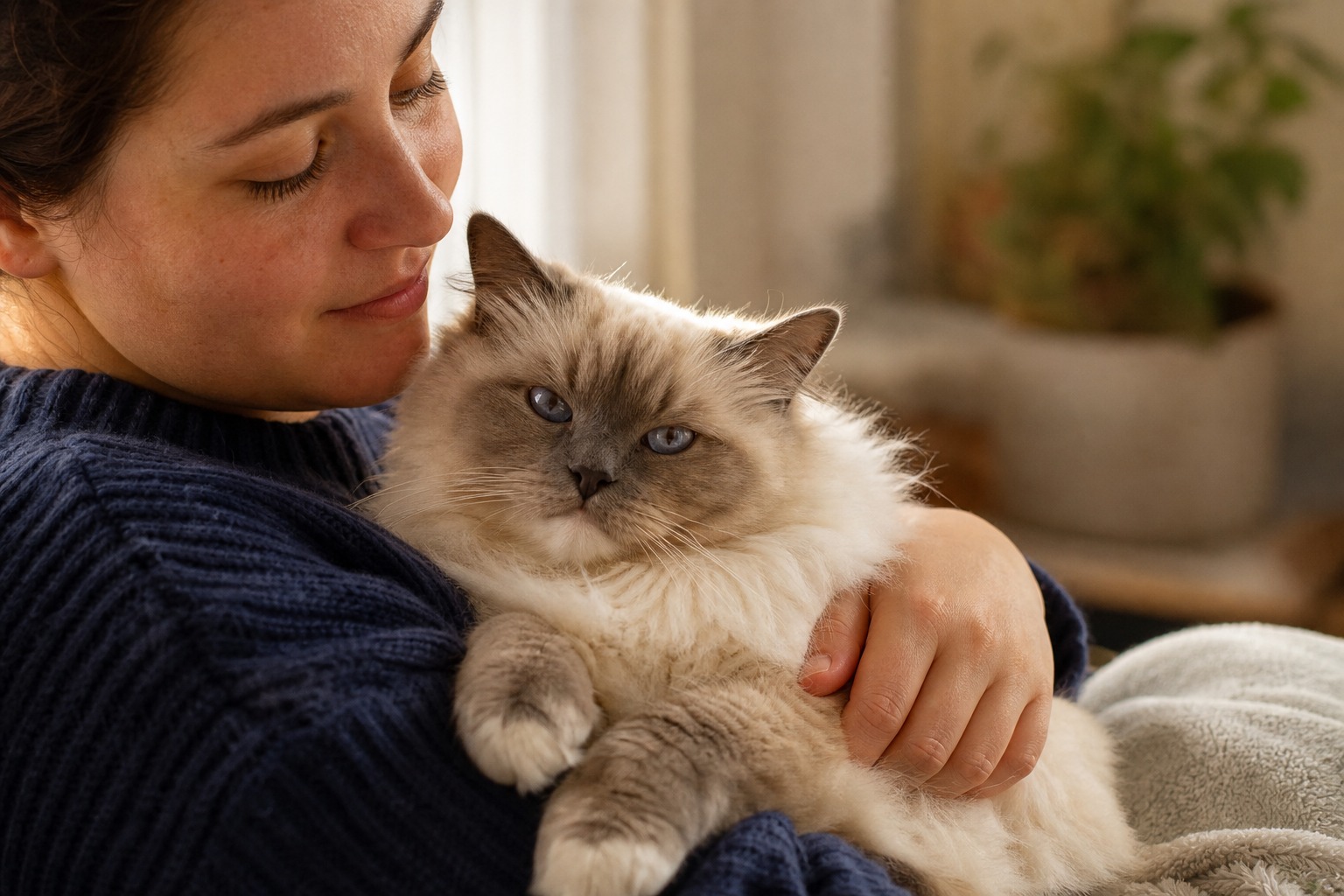
The whole idea of an “affectionate cat breed” comes with a catch nobody puts in the headline: breed only tells you the odds. It nudges the probability that a cat will flop into your lap or trail you to the bathroom, but plenty of Ragdolls are aloof and plenty of alley cats are shameless love sponges. Early socialization and a cat’s own personality outweigh pedigree almost every time. So read this as a way to tilt the table, not a shopping guarantee.
With that asterisk firmly in place, some breeds really do show up to the relationship more often than others. What’s more useful than a ranked list is sorting them by the kind of affection they hand out, because “cuddly” means very different things depending on the cat. A lap-limp Persian and a loud, demanding Siamese are both affectionate. They are not remotely the same roommate.
First, what “affectionate” even looks like in a cat
Cats don’t love the way dogs do, and measuring them against a Labrador sets everyone up for disappointment. Feline affection is quieter and more specific: a slow greeting at the door, a headbutt against your shin, kneading on your chest, a purr or a trill aimed at you in particular, or simply a cat choosing to sit within arm’s reach when the whole house was available. An affectionate breed is one that does these things more freely and more often. It is never a breed that does them on command.
“The biggest predictor of a cuddly adult cat isn’t the breed on the paperwork, it’s how gently and how much that kitten was handled in its first couple of months,” says Dr. Amara Solis. “Get that window right and an ordinary shelter cat will out-snuggle a pedigree that spent its kittenhood alone in a pen.”
The lap-limp cuddlers
These are the cats that want to be on you, preferably horizontal, ideally for hours.
Ragdoll. The name is the spec: pick one up and it tends to go boneless in your arms, which is exactly why this breed tops nearly every affection list. Ragdolls are big, mellow, and famously tolerant, often following their person around and asking for physical contact more than most cats bother to. They’re a strong match for someone who wants a genuinely hands-on cat and has time to give it. The tradeoff is that a Ragdoll left alone and under-stimulated can get needy and mopey; this is not a cat that thrives ignored.
Persian. Elegant, flat-faced, and low-energy to the point of being furniture with opinions, the Persian is built for people who want a calm lap companion rather than an athlete. They’re content to hang out with a favorite human all day and actively seek out attention and grooming. Two honest caveats: that long coat needs daily brushing or it mats into a vet visit, and the extreme flat-faced (brachycephalic) look that some Persians are bred for can bring tear-duct and breathing problems. A more moderate face is the kinder pick.
Exotic Shorthair. Essentially a Persian in a wash-and-wear coat, the Exotic keeps the docile, affection-seeking temperament and the round flat face but trades the high-maintenance fur for short plush hair. They’re laid-back, playful in short bursts, and usually love being held once they’ve decided you’re theirs. If you want Persian cuddliness without the grooming marathon, this is the one, with the same reminder to favor a moderate muzzle over an extreme one.
The velcro shadows
These cats bond hard to their people and express it by never quite leaving you alone, not on your lap so much as underfoot, on the counter, supervising.
Maine Coon. The gentle giant of the cat world, and a serious giant: adults can reach up to around 25 pounds. Despite the size, they’re famously friendly and dog-like, prone to following you room to room and inserting themselves into whatever you’re doing. They make wonderful family cats. The catch is scale, more cat to feed, more cat to house, and a coat that needs regular grooming, and this large slow-maturing breed carries some known heart and hip risks worth asking a breeder or vet about.
Birman. Silky-coated, blue-eyed, and bred specifically as a companion, the Birman tends to be sociable with everyone, other cats included, and happy to play with the whole household rather than fixating on one person. That easygoing, everybody’s-friend disposition makes them a great fit for busy homes with kids or other pets. They like company and can get lonely as an only cat in an empty house.
Burmese. Compact, muscular, and relentlessly social, the Burmese wants to be involved. They seek out play and attention, stay kitten-like well into adulthood, and are vocal about their feelings, so you always know where you stand. Ideal for someone who wants an interactive, engaged cat and won’t be annoyed by one that follows them like a small shadow. Not ideal for anyone hoping for a quiet, independent pet.
The loud, in-your-business ones
Affection here comes with a running commentary.
Siamese. Sleek, sharp-featured, and one of the most people-oriented cats there is, the Siamese bonds intensely and tells you all about it. They’re vocal, opinionated, bold, and very smart, which means constant interaction and the occasional outsmarting. This is the cat for someone who wants a chatty, involved companion and will actually talk back. It is the wrong cat for anyone who wants peace and quiet, and a Siamese left bored and alone can get loud and destructive.
Sphynx. The hairless one surprises people: under that striking, wrinkled, warm-to-the-touch exterior is one of the most affectionate, attention-hungry cats going. They cling, they cuddle for body heat, and they want to be part of everything. Just know that hairless doesn’t mean maintenance-free, Sphynx cats need regular baths to manage skin oils, protection from cold and sun, and they run up a bit of a care bill. For the right person, an unusually devoted lap-warmer.
The breed we’re leaving off, and why
You’ll find the Scottish Fold on almost every “most affectionate” roundup, and it’s true that they’re sweet, mellow cats that thrive on human company. We’re still not recommending you seek one out. The folded ears that make them famous come from a genetic mutation that affects cartilage throughout the entire body, a condition called osteochondrodysplasia, and current veterinary consensus is that every fold-eared cat carries it to some degree. It can cause painful, progressive joint disease, sometimes in young cats.
That’s not a fringe worry anymore. The Netherlands, Austria, and parts of Belgium and Australia have moved to ban breeding fold-eared cats, and major veterinary bodies have called for the breeding to stop altogether. Plenty of affectionate breeds don’t ask you to accept a lifetime of skeletal pain as the price of admission, so we’d point you to any of the eight above instead.
Affection isn’t breed-locked, and you can grow it
Here’s the reassuring part: you can coax more affection out of nearly any cat, pedigree or not. The rules are the same across the board. Let the cat make the first move rather than reaching for it. Watch for the “no thanks” signals, an arched back, flattened ears, a retreat, and back off when you see them, then try again later. When a cat is relaxed and near you, use treats to close the distance, and try gentle stroking or brushing, since grooming is a real bonding ritual for cats. Reward calm closeness, keep sessions short and positive, and over weeks you build a cat that seeks you out. Push too hard and you teach the opposite lesson.
What newer welfare news adds
The most significant recent development in this corner of the cat world isn’t about temperament at all, it’s about ethics. The push to end Scottish Fold breeding has gained real legal and veterinary momentum, with more jurisdictions restricting it and welfare organizations increasingly naming it as an animal-welfare problem rather than a quirk. The broader lesson is spreading to other extreme “cute” traits too, including the very flat faces bred into some Persians and Exotics, where the same look that reads as sweet can bring genuine breathing and eye trouble. The current guidance for anyone shopping for an affectionate breed is to weight health and moderate features as heavily as personality, and to remember that the most reliable route to a loving cat runs through early socialization and patient bonding, not through any single breed name.
References
- “Scottish Fold osteochondrodysplasia.” International Cat Care. https://icatcare.org/articles/scottish-fold-osteochondrodysplasia
- “Scottish Fold – Osteochondrodysplasia.” Universities Federation for Animal Welfare (UFAW). https://www.ufaw.org.uk/cats/scottish-fold-osteochondrodysplasia
- “Brachycephalic cats.” International Cat Care. https://icatcare.org/articles/
Leila Torres leads our Living coverage, from home life and travel to the products and rescue stories that come with sharing a life with animals. She edits and writes across the section, with a soft spot for pieces about the bond between people and their pets.
Meet our experts ↗Keep reading
 LivingHer Cat Has a Meow for Everything. It Rewired How She Makes Music.Jordan Ellis · 4 min
 LivingThe Bewitching History of Black Cats and HalloweenLeila Torres · 7 min
 LivingHow Many Cats Is Too Many? Vets Say You're Asking the Wrong Question.Nina Vasquez · 7 min
 LivingThe Cats in Her Art Aren't Decoration. They're the Coping Mechanism.Sasha Ford · 6 min
 TrainingYour Cat Doesn't Care About the Bathroom. They Care That You Finally Sat Down.Dr. Priya Nair · 8 min
 LivingI Spent $6,064 on My Cat in One Month. Only $94 of It Was Actually Cat Stuff.Nina Vasquez · 7 min