


Your Hair Treatment Can Kill Your Cat. The Bottle Isn't the Problem.
Minoxidil poisonings in pets have climbed nearly 1,000 percent in a decade, and almost none of them involve a cat drinking Rogaine. The danger is what's left on your hands, your scalp, and your pillow.

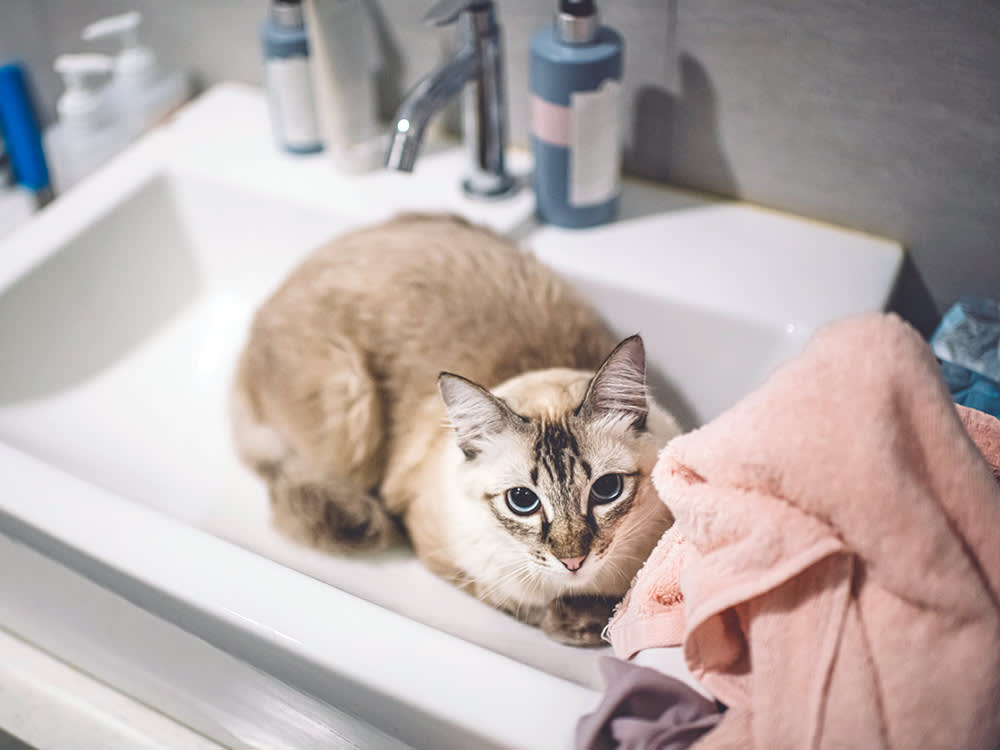
Almost nobody poisons their pet with a hair-loss treatment on purpose, and almost nobody does it by leaving the bottle open, either. The cat gets sick because she slept on the pillowcase. Because she groomed the arm of the person who applied it four hours earlier. Because she rubbed her face against a treated scalp on the way to the food bowl.
Minoxidil, the active ingredient in Rogaine, is highly toxic to cats and dogs, and the exposure route that matters is not the bottle. It is everything the drug touches after it leaves the bottle.
What it does to an animal
Minoxidil is a vasodilator. In a human scalp, that is the point. In a cat, it is a cardiovascular event.
Exposure can cause a severe drop in blood pressure (hypotension), a rapid heart rate (tachycardia), fluid building up in the lungs (pulmonary edema), and in serious cases, death. Small amounts are enough. This is not a drug where the dose only matters at the extremes.
A study published in 2021 looked at 211 cases of topical minoxidil exposure in cats and dogs between 2001 and 2019. Of those, 87 showed clinical signs of toxicosis. Among the animals that got sick, most developed moderate or major illness: 56.0 percent of dogs and 59.7 percent of cats. Roughly 12.9 percent of the affected cats died.
And those are only the cases that reached a poison control database. A great many exposures are never connected to a cause at all, because the owner has no idea the hair product is relevant and never mentions it.
“The owner tells me the cat is breathing strangely and the heart is racing, and we run through the house looking for lilies and antifreeze,” says Dr. Amara Solis. “Nobody thinks to mention what they put on their head, because it is on their head and not in the cat’s bowl. That gap is where these cases hide.”
The exposure routes, and why they are so ordinary
Nobody is applying minoxidil to a dog’s bald patch. Every one of these cases is an accident, and the accidents are boringly domestic.
Dogs get into the trash. That is the single most common route in the data: rooting through the bin and finding a discarded applicator or an empty bottle with drug still in it.
Cats groom. They lick a treated scalp, or the pillowcase that scalp slept on. They rub against your treated skin and then wash themselves. They get splashed during a spill, or step in one and clean their paws.
Dried does not mean safe. This is the point most people get wrong. Even after the product has dried, residue remains on the skin and hair, and a cat that grooms itself as compulsively as cats do will ingest it. Sitting where you rested is enough contact to matter.
Spray formulations drift. Less common, but a spray can settle on fur or be inhaled by an animal in the room.
Every one of those is a Tuesday, not an accident of unusual carelessness.
The number that changes the picture
Here is what has happened since that 2021 study was published, and it is the reason this is worth reading now.
A 2025 review found a 965 percent increase in minoxidil poisoning reports to the ASPCA Animal Poison Control Center between 2013 and 2024. Reports climbed from 20 in 2013 to 213 in 2024.
That is not a fluke of reporting. It tracks with how much minoxidil is now in American homes. Topical minoxidil has moved from a niche product into a mainstream one, and low-dose oral minoxidil is now widely prescribed off-label for hair loss, which puts a new object on a lot of nightstands: a pill bottle containing a drug that is dangerous to a dog by the mouthful.
If your household added minoxidil in the last few years, you are part of that curve, and the odds are nobody warned you.
So what do you actually do?
The instinct is either to panic or to dismiss it, and neither is right. Any house you walk into contains a dozen substances that would poison an animal that ate them. Chocolate. Raisins. Half the cabinet under the sink. We do not banish those things; we contain them.
Minoxidil is harder than most, because you cannot lock it in a cabinet. You wear it. Containment means changing your routine, not your storage.
Apply at night, with the pet out of the room. This does more work than anything else on the list.
Cover the treated area before you interact with your pet. Clothing, a wrap, a hat. Something between the drug and the animal.
Wash your hands thoroughly, every single time. Your hands are the delivery system.
Do not let your pet lick your skin, and do not let them lie on bedding or clothing that may have absorbed residue.
That last one is where this gets personal, and it is worth being honest about it. For a lot of people, sleeping with the cat is one of the best parts of having a cat. Some cats groom their people constantly, and giving that up is a real loss.
You do not have to give it up in every case. You have to choose. Either the drug and the animal are kept apart, reliably, every night, by someone who is tired and in a hurry, or they are not. If you know you will not maintain that separation, the honest answer is not to try to white-knuckle it. It is to talk to your doctor about something else.
The alternatives, honestly
Finasteride is the other highly effective treatment, taken as a daily pill. It is approved for men, and some providers prescribe it off-label to women, particularly after menopause when other options, including minoxidil, have not worked.
It is not risk-free. Reported side effects include sexual dysfunction, decreased libido, decreased sperm counts, tender or enlarged breasts, and depression including suicidal thoughts, among others. That is a real list, and it is a conversation to have with a doctor, not a comment section.
From the pet’s point of view, though, finasteride is a meaningfully different proposition. It takes a substantial quantity to hurt an animal, which means a pet that cannot get a pill bottle open is a pet in no danger. Vets even reach for it themselves on occasion, for certain urinary tract conditions. That does not make it safe to feed your dog. It means the margin is wide, where minoxidil’s is narrow.
The critical difference is not really the chemistry. It is the delivery. A pill lives in a closed bottle. A topical lives on your body, on your hands, and on your pillow, all day.
Minoxidil has its own human side effects worth knowing before you decide it is the easy option. Dermatologists list unwanted hair growth in places you were not aiming at, palpitations, tingling sensations, headaches, and allergic reactions. Fluid retention is on the list too, showing up as swollen legs and puffy under-eyes, and in rare cases as a dangerous buildup of fluid around internal organs.
Everything else is weaker. Oils, supplements, PRP injections, laser caps: all popular, all less effective than the two drugs above. Minoxidil and finasteride are still the FDA-approved treatments with the strongest evidence behind them, and swapping to an alternative without a real consultation mostly buys you a delay. Hair loss does not pause while you experiment.
If you think your pet has been exposed
Do not wait to see what happens. Symptoms may take hours to appear, and early intervention improves outcomes. The window where treatment is easy closes before the animal looks sick.
Call one of these, now:
- Your veterinarian, or the nearest emergency vet.
- ASPCA Animal Poison Control Center: (888) 426-4435
- Pet Poison Helpline: (855) 764-7661
Tell them exactly what the product was, the concentration, roughly how much, and when. If you still have the bottle, read the label to them.
Signs to watch for while you are getting help: lethargy or collapse, a racing heart, rapid or labored breathing, coughing, vomiting, pale gums, or a cat who is suddenly very quiet and very still. In a cat, breathing trouble is an emergency by itself, whatever caused it.
What’s new since this was written
The trend line is the story. That 2025 scoping review documenting a 965 percent rise in reports to the ASPCA’s poison center between 2013 and 2024 explicitly frames the situation as a call to action, because the exposure pathway is so easy to miss: the drug arrives in the pet by way of the owner’s skin, hair, and laundry, not by way of an open container.
The other shift is oral minoxidil. Low-dose oral minoxidil has become a common off-label prescription for hair loss in people, which means a lot of homes now have both a topical residue problem and a pill-bottle problem. A dog who gets into a bottle of pills is a different and more acute emergency than a dog who licks a scalp.
None of which means you have to choose between your hair and your pet. It means the separation has to be deliberate, every day, and that the moment you suspect an exposure, you call somebody instead of watching.
References
- Topical Minoxidil Exposures and Toxicoses in Dogs and Cats: 211 Cases (2001–2019) — Tater et al., Journal of the American Animal Hospital Association, 2021
- Minoxidil toxicosis in cats and dogs: A scoping review and call to action — Journal of the American Academy of Dermatology, 2025
- Risks of minoxidil toxicity for household pets — Dermatology Reports, 2025
- Animal Poison Control Center — ASPCA
Common questions
My cat licked my scalp hours after I applied it. Is that a problem?
Treat it as an exposure and call a vet or a poison line rather than waiting. Dried residue still carries the drug, and grooming is the most common route of exposure for cats.
How long after exposure do symptoms show up?
Symptoms can take hours to appear, which is exactly why waiting to see what happens is the wrong plan. Early treatment produces better outcomes.
Do I have to stop using minoxidil if I have pets?
Not necessarily. Most households can manage the risk with hard separation: apply at night, cover the treated area, wash your hands, and keep pets off the bedding. If you cannot maintain that, talk to your doctor about alternatives.
Is finasteride safer around pets?
It is toxic only in much larger amounts, so a pill kept in a closed container is a far smaller day-to-day hazard than a topical you wear on your skin. It has its own human side effects, which are a conversation for your doctor.
Not a substitute for your vet. Our guidance is educational. For urgent symptoms, contact a vet or emergency clinic right away. Editorial standards
Dr. Kohl is a board-certified veterinary dentist with a particular interest in preventive oral care. She reviews all dental health content at The Pet Times and contributes practical guides on home dental routines, professional cleaning, and oral disease prevention.
Meet our experts ↗Keep reading
 Health & Wellness'Just a Quick Walk' Can Give Your Dog Heatstroke. Here's the Playbook.Dr. Priya Nair · 9 min
 Health & WellnessWhen a Hurricane Comes, the Deadly Mistake Is Having Nowhere to Put Your PetDr. Ravi Mehta · 6 min
 First Days8 New-Pet To-Dos That Only Matter at 2 A.M.Dr. Nina Kohl · 8 min
 Health & WellnessIt's Illegal to Cook a Dog in a Car. In Most States, It's Still Illegal to Save One.Dr. Priya Nair · 8 min
 Health & WellnessThe Holiday Decorations Most Likely to Land Your Pet in the ERDr. Mara Chen · 8 min
 Health & WellnessThe Pain Cream in Your Medicine Cabinet Can Kill a Cat Who Never Touched ItDr. Ravi Mehta · 4 min