


The Prettiest Litter Box Cover Is Useless If Your Cat Boycotts It
Before you buy the mid-century litter cabinet, find out whether your cat even wants a lid. A cat-first guide to covers, enclosures, and all-in-one boxes, plus the research on covered versus open.

Affiliate disclosure. This article contains affiliate links. We may earn a small commission if you buy through a link, at no extra cost to you. How we handle recommendations.
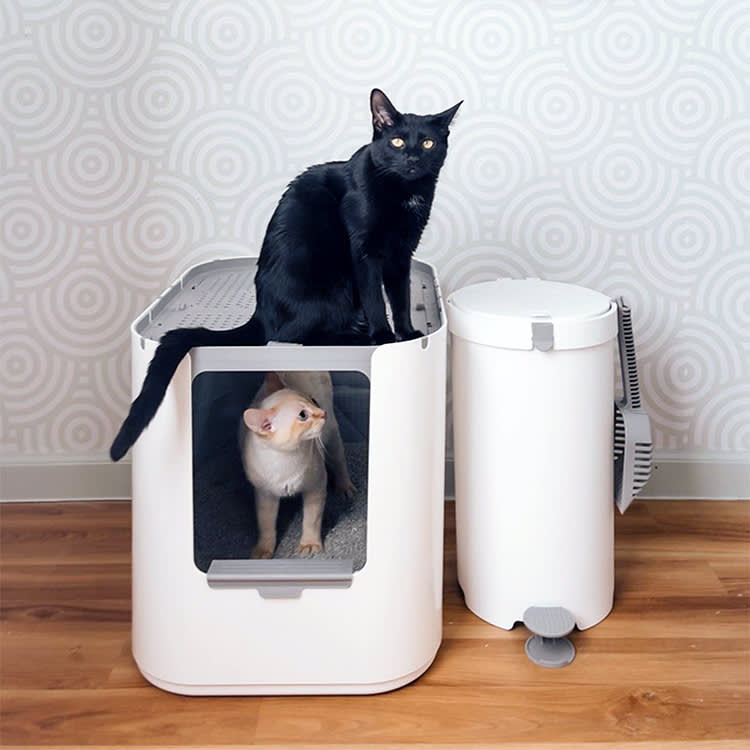
There is a specific kind of heartbreak reserved for cat owners: you spend real money on an enclosure disguised as a chic side table, you assemble it, you slide the box inside, you step back to admire your handiwork, and your cat pees on the bath mat two feet away in silent protest. The cover was for you. The cat did not sign off.
That is the whole problem with shopping for litter box covers. It is marketed as a décor decision, and it is really a behavior decision. Get the second part wrong and no amount of ash-veneer plywood will save you. So before we get to the picks, start where your cat starts.
First question: does your cat even want a lid?
We assume cats crave privacy in the bathroom because we do. The evidence is thinner than you’d think. Researchers at Ross University gave 27 healthy cats two boxes side by side, one covered and one open, and watched for two weeks. Only about 15 percent clearly preferred the covered box, another 15 percent clearly preferred the open one, and the rest were basically indifferent. In other words, most cats don’t care nearly as much as their humans do, and a meaningful minority actively dislike a hood.
There is a reason some cats balk. In the wild, a cat relieving itself is vulnerable, so they like a clear line of sight to spot anything sneaking up. A cover takes that away. It also traps odor, which a fastidious cat notices long before you do, and most commercial covered boxes are cramped, less than one and a half times the length of the cat inside.
“The single best test is to offer both and see what your cat chooses,” says Dr. Mara Chen. “I’ve had clients swear their cat needs privacy, and the cat picks the open box every time. Watch the paws, not the Pinterest board.”
None of this means covers are bad. It means the cover has to earn its place with your particular cat. If yours is a shy, easily startled type who bolts at the doorbell, a snug hood may feel like a safe den. If yours likes to survey the room, force the issue and you’ll be scrubbing the floor.
Second question: do you have enough boxes at all?
Before you optimize the look of one box, make sure you own the right number. Feline vets and the American Association of Feline Practitioners point to the N+1 rule: one box per cat, plus one extra. Two cats means three boxes. Even a single-cat home does better with two. Cats guard resources, some like to pee in one box and poop in another, and a spare prevents the standoffs that lead to accidents. A gorgeous cover on too few boxes is still too few boxes.
Now, the picks, grouped by what you actually need them to do.
If you just want easy scooping
A hood that lifts or flips beats one you have to wrestle off every day.
The So Phresh Flip Top Cat Litter Box Hood ($36) is extra-large with a top that flips open, so you scoop without dismantling anything. A carbon filter helps with smell, and clips and a handle let you carry the whole thing when you’re hunting for the right corner.
If you already own a Litter Genie box, the Litter Genie Litter Box Hood ($30) drops right on. A swinging door gives your cat an easy in and out plus a little seclusion, and there’s a scoop holder on the back, which is a small thing that makes the daily chore marginally less grim.
If you want it to disappear into the room
This is where “litter box furniture” shines: pieces that read as a cabinet or side table and happen to hide a box.
The Snughome Cat Litter Box Enclosure ($101) goes further and doubles as a cat tree, stacking a scratching post, a perch, and a napping spot on top of the litter compartment. Slide the box into the base and you’ve turned one appliance into a whole activity center, which is a smart use of square footage in a small place.
Beyond specific models, the category is worth knowing: mid-century side tables with a hinged door and a reversible entrance, planter-style boxes that hide among your real houseplants with an activated-carbon filter, and slatted wooden cabinets whose gaps let air move so odor doesn’t pool. All of them ask you to supply your own box and, usually, a screwdriver.
If your cat wants a cozy den
Some cats relax with soft enclosure rather than hard furniture. The RYpetmia Cat Litter Box Enclosure ($46) is a curtained, tent-like cover that a reviewer compared to pitching a tent, which is roughly what it looks like. Slide the tray in and out, hang the scoop on the side hook, and let the curtains keep stray litter and dust from launching across the room while your cat gets their seclusion.
If you’d rather buy the box and cover together
Skip the guesswork about fit with an all-in-one.
The Amazon Basics No-Mess Hooded Corner Cat Litter Box ($55) tucks into a corner as a triangle, uses a charcoal filter, and pops open at the top for cleaning. The PawHut Hooded Cat Litter Box ($50) looks more like a tiny house, with a front door, a top exit, and a pull-out drawer at the bottom for scooping. Both are fully enclosed to keep splashes and smells contained, so they suit cats who’ve already told you they’re fine with a lid.
A note on the self-cleaning crowd: if you own a dome-style automatic box like the Litter-Robot, you don’t need a cover at all. The dome is the cover, and it cycles itself.
If you’re feeling crafty
You can also make one. An IKEA cabinet hack, a repurposed storage chest, or a thrifted trunk with a cat-sized doorway cut in can all become a one-of-a-kind cover for a fraction of the retail price. Search a few tutorials, measure twice, and cut a hole big enough that a full-grown cat can walk in without ducking.
The bottom line
Choosing a cover is really three small decisions stacked on top of each other: does your cat tolerate a hood, do you have enough boxes, and only then, which style fits your home. Get the first two right and almost any of these covers will work. Get them wrong and the fanciest enclosure on the market becomes an expensive place your cat refuses to go. When in doubt, buy nothing, set out one covered box next to one open box, and let your cat tell you what they want. They will.
References
- Grigg, E. K., Pick, L., & Nibblett, B. (2017). Litter box preference in domestic cats: covered versus uncovered. Journal of Feline Medicine and Surgery.
- American Association of Feline Practitioners & Cornell Feline Health Center. Litter box guidance and the N+1 rule.
Common questions
Does my cat actually want a covered litter box?
Maybe not. In a controlled study, most cats showed no strong preference between a covered and an open box, and the ones who did split evenly. Cats feel exposed while eliminating and like to watch for threats, so some genuinely dislike a hood. Offer both and let your cat vote with their paws.
What if my cat refuses the covered box?
Believe them. The clearest sign a cat rejects a covered box is that they stop using it. If that happens, switch to a high-sided open box, which contains scatter without boxing your cat in.
Should I worry if my cat doesn't bury their poop?
Usually no. Plenty of healthy cats leave it uncovered, and littermates can differ. It's only worth a second look if a cat who always buried suddenly stops, which can signal discomfort or a litter-box problem.
How often should I clean a covered litter box?
Scoop at least once a day, and more if you can. Covers trap odor, so a hooded box needs more diligence, not less. Wash the whole box out about once a week.
Sara Lim leads our Product Picks coverage, testing and comparing the things pets and their owners actually use. From everyday essentials to home-and-style finds, she focuses on honest, useful recommendations rather than hype.
Meet our experts ↗Keep reading
 Living"Eco-Friendly" Cat Gear Is Mostly a Sticker. 6 Swaps That Aren't.Nina Vasquez · 8 min
 Health & WellnessA Blind, Paralyzed Cat Isn't a Tragedy. It's a Setup Problem.Dr. Nina Kohl · 7 min
 Living'Pet-Safe' Is a Marketing Word. Read the Label Instead.Dr. Nina Kohl · 7 min
 Product Picks6 Eco Cat Swaps That Don't Feel Like a SacrificeSara Lim · 5 min
 Product PicksThis Brand Tests Cat Furniture in Cat Cafés. One Week There Equals a Year in Your Home.Sasha Ford · 6 min
 Product PicksThe Tofu Litter That Ended My Cat's Bathroom BoycottDr. Priya Nair · 4 min