Let’s clear this up first, because it will save you money and it may save your dog weeks of misery: there is no home remedy that cures an itchy dog.
That sounds bleak. It is actually the most useful sentence in this article, because once you stop shopping for a cure, the pantry stuff becomes exactly what it is good at being. Oatmeal, omega-3s, a cool rinse, a onesie: these are comfort measures. They lower the volume on a symptom while the actual cause gets found and treated. Used that way, they help enormously. Used as a substitute for a diagnosis, they let a fixable problem turn into a skin infection.
So here is the practical version: what each remedy really does, when it backfires, and the line where you stop experimenting and pick up the phone.
Why your dog is itching in the first place
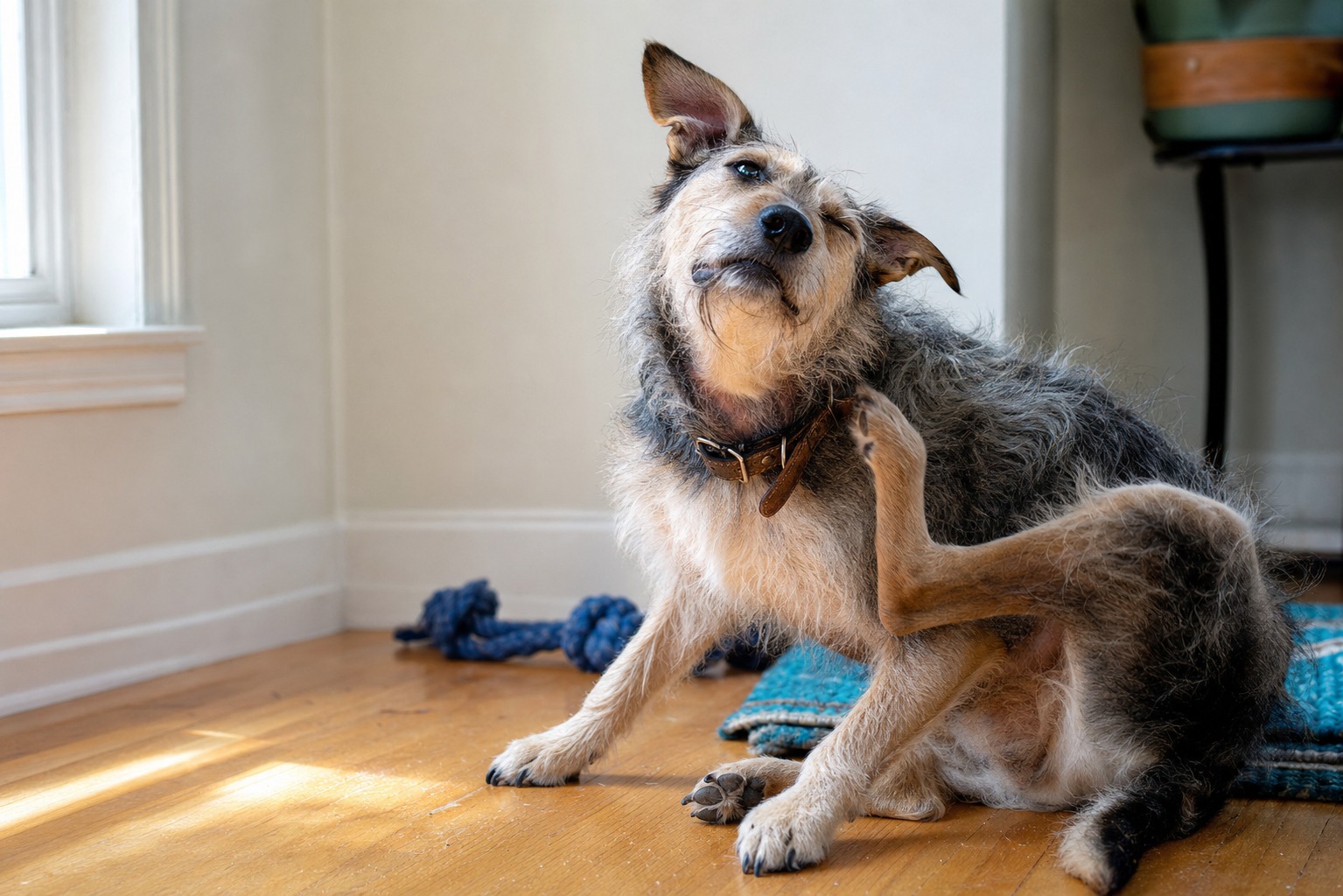
The clinical word is pruritus, and it is one of the top reasons dogs end up at a vet’s office at all.
The causes are a long and unglamorous list: parasites (fleas, ticks, mites), bacterial and yeast infections, plain dry skin, environmental and food allergies, hormonal disease, autoimmune conditions, and, occasionally, certain cancers. The complication that trips up almost every home-treatment plan is that dogs frequently have more than one at once. A dog with environmental allergies scratches, breaks the skin barrier, and grows a secondary bacterial infection on top of it. Now you have two problems, and the shampoo you bought addresses neither.
That stacking is why so many home remedies “stop working” after a week. They were never treating the thing that was driving the itch.
The three questions that decide your next move
Before you try anything below, look at your dog and answer these.
Is the skin still intact? Redness, scabs, open sores, bald patches, greasy or flaky skin, or a distinctly bad smell all mean the barrier is broken and something is likely growing in it. That is a vet visit, not a bath.
Is the itch interfering with life? A dog who cannot settle, who wakes to chew, who cannot get through a walk without stopping to scratch, is a dog in real discomfort. Mild and occasional is one situation. Frenetic is another.
How long has this been going on? More than a few days without improvement, and the home-remedy phase is over.
“The mistake I see most is a well-meaning owner buying themselves three weeks with oatmeal and coconut oil while a yeast infection quietly takes over the belly,” says Dr. Nina Kohl, DVM. “By the time the dog gets to me, we are treating a skin problem plus everything the scratching built on top of it. If the skin is broken or the smell has changed, you have already left home-remedy territory.”
The 11 that are worth your time, sorted by what they actually do
Not all of these will work for your dog, because they address different mechanisms. Match them to the situation rather than running through the list.
Things that calm inflamed skin right now
1. A cool oatmeal bath. Lukewarm water, never hot, with a colloidal oatmeal shampoo or a medicated shampoo your vet has prescribed. Colloidal oatmeal has genuine anti-inflammatory activity on irritated skin, and the physical rinse removes the pollen and dander sitting in the coat. This is the single best thing you can do on a bad night.
2. A cooled chamomile rinse. Chamomile has been studied for anti-inflammatory and antimicrobial properties, and a cooled, weak tea applied to a mildly red patch is safe and soothing. Let it cool completely. Do not put warm liquid on inflamed skin.
3. Skip the blow dryer. Heat dries the skin and the dryness feeds the itch. Towel-dry and let your dog finish in the air. If a dryer is unavoidable, run it cool and keep a hand’s width of distance from the coat so you are not cooking the skin you are trying to calm.
Things that address the trigger
4. Year-round flea and tick prevention. Do this first, before anything else on this list. A single flea bite can set off weeks of itch in a flea-allergic dog, and “I didn’t see any fleas” is not evidence. If you have skipped months, check the dog thoroughly and get back on schedule.
5. Booties and a onesie. If the itch is seasonal, or spikes after a walk in a particular park, you are probably looking at environmental allergy. A lightweight bodysuit and boots put a physical barrier between the allergen and the skin, and they cut down what gets tracked into the house on the paws.
6. A genuinely hypoallergenic diet. If food allergy is on the table, this is the fix, and it is also the one most likely to be done wrong. Many bags marketed as hypoallergenic do not meet the requirements that make an elimination diet work, and plenty are cross-contaminated in production. The diets that actually work are usually prescription. Do this one with your vet or do not do it at all.
Things that support the skin over weeks, not hours
7. Omega-3 fatty acids. Fish oil and similar supplements support the skin barrier and can modestly reduce itch over time. This is a slow lever. Give it six to eight weeks before judging.
8. Probiotics. Beneficial bacteria colonize the gut and the skin, and supplemental probiotics mixed into food may help rebalance that population, supporting immune function and reducing inflammation. Evidence is promising rather than settled.
9. Hydration. Well-hydrated dogs have better-hydrated skin. If your dog eats only kibble, adding wet food, or stirring a little broth into the bowl, is an easy way to raise fluid intake.
The two that come with a warning label
10. Diluted apple cider vinegar. A 1:1 mix with water makes a mild antimicrobial solution, genuinely useful as a paw soak for a dog growing yeast between the pads, or for wiping out skin folds. It will not cure an established infection. And it must never touch open, raw, or broken skin, where it burns.
11. Coconut oil. The fatty acids may support coat and skin, but there is no conclusive research showing it relieves itch. It is also very high in fat, and dogs lick it off. Ingested in quantity it causes weight gain, digestive upset, and in some dogs pancreatitis. Clear it with your vet, use very little, or skip it.
One more, only with permission
An over-the-counter antihistamine such as Benadryl gets recommended constantly on the internet. It helps some dogs a little and does nothing for most, and the dose matters. Ask your vet before you give it, not after.
When the vet takes over
Any of these means stop and book the appointment: itch lasting more than a few days without improvement, a bad odor, bumps, open wounds, hair loss, flaking, or redness that is spreading.
At that point the goal is no longer comfort. It is correcting the underlying problem so the skin can heal, and the medications for that are genuinely effective. Depending on the diagnosis, that can mean antibiotics for a secondary infection, steroids, immunosuppressants and immune modulators, antihistamines, medicated shampoos, or topical sprays. Use them exactly as directed. Stopping an antibiotic early because “the skin looks better” is how you get the relapse.
And if you are grinding through months with no progress, ask for a referral to a veterinary dermatologist. Skin disease is complicated enough that it has its own specialty, and the advanced testing they offer is often what finally names the thing.
What newer research adds
The single biggest change for itchy dogs in the last decade is that itch control got genuinely good, and it happened outside the pantry.
Lokivetmab (sold as Cytopoint) is an injectable antibody that targets IL-31, one of the specific signals that tells a dog’s nervous system to itch. It is not a steroid and it does not suppress the whole immune system. And in September 2024, the FDA approved ilunocitinib (sold as Zenrelia), the second oral JAK inhibitor cleared for allergic and atopic dermatitis in dogs, joining oclacitinib (Apoquel). Elanco’s trial data put clinical remission of itch at 77 percent of dogs on ilunocitinib. In September 2025 the FDA removed the label’s original warning about live-virus vaccine risk, which had been the drug’s main practical obstacle.
Here is why that belongs in an article about oatmeal baths. Twenty years ago, the trade-off for a badly itchy dog was long-term steroids and the weight gain, thirst, and organ strain that came with them, which is exactly why owners went hunting for kitchen alternatives. That trade-off is much smaller now. If your dog’s itch is bad enough that you are researching homemade creams at midnight, the honest advice is that the modern prescription options are worth a conversation, and the bath is what you do while you wait for the appointment.
Bottom line
- Home remedies are complements. Without treating the cause, most topicals will not move the needle on a serious itch.
- Chronic itch is managed, not cured, and often means lasting changes to diet or routine.
- This is a frustrating category of disease precisely because it rarely has a quick fix. That frustration is normal and it is not a sign you are doing it wrong.
- If you are stuck, a veterinary dermatologist has tests and treatments a general practice does not.
References
- Collins, Brian. “Atopic Dermatitis.” Cornell Richard P. Riney Canine Health Center, 2024. vet.cornell.edu
- Reynertson, Kurt A., et al. “Anti-inflammatory activities of colloidal oatmeal (Avena sativa) contribute to the effectiveness of oats in treatment of itch associated with dry, irritated skin.” Journal of Drugs in Dermatology, vol. 14, no. 1, 2015, pp. 43-48. pubmed.ncbi.nlm.nih.gov/25607907
- Tresch, Milena, et al. “Medicinal plants as therapeutic options for topical treatment in canine dermatology? A systematic review.” BMC Veterinary Research, vol. 15, no. 1, 2019, p. 174. bmcvetres.biomedcentral.com
- “FDA Approves New Treatment for Allergic Skin Conditions in Dogs.” U.S. Food and Drug Administration, CVM Update, September 2024. fda.gov
- “New canine itch medication: Interpreting label claims and warnings.” American Animal Hospital Association, NEWStat. aaha.org