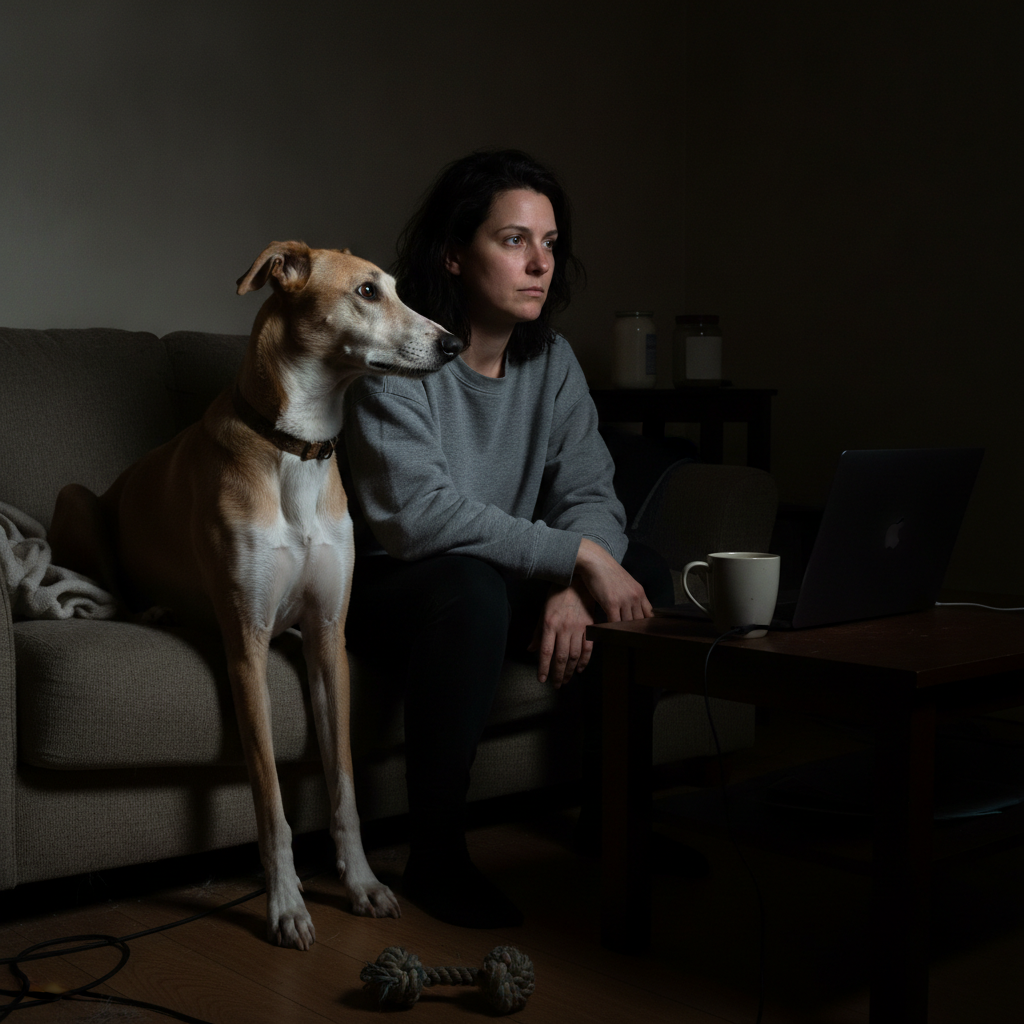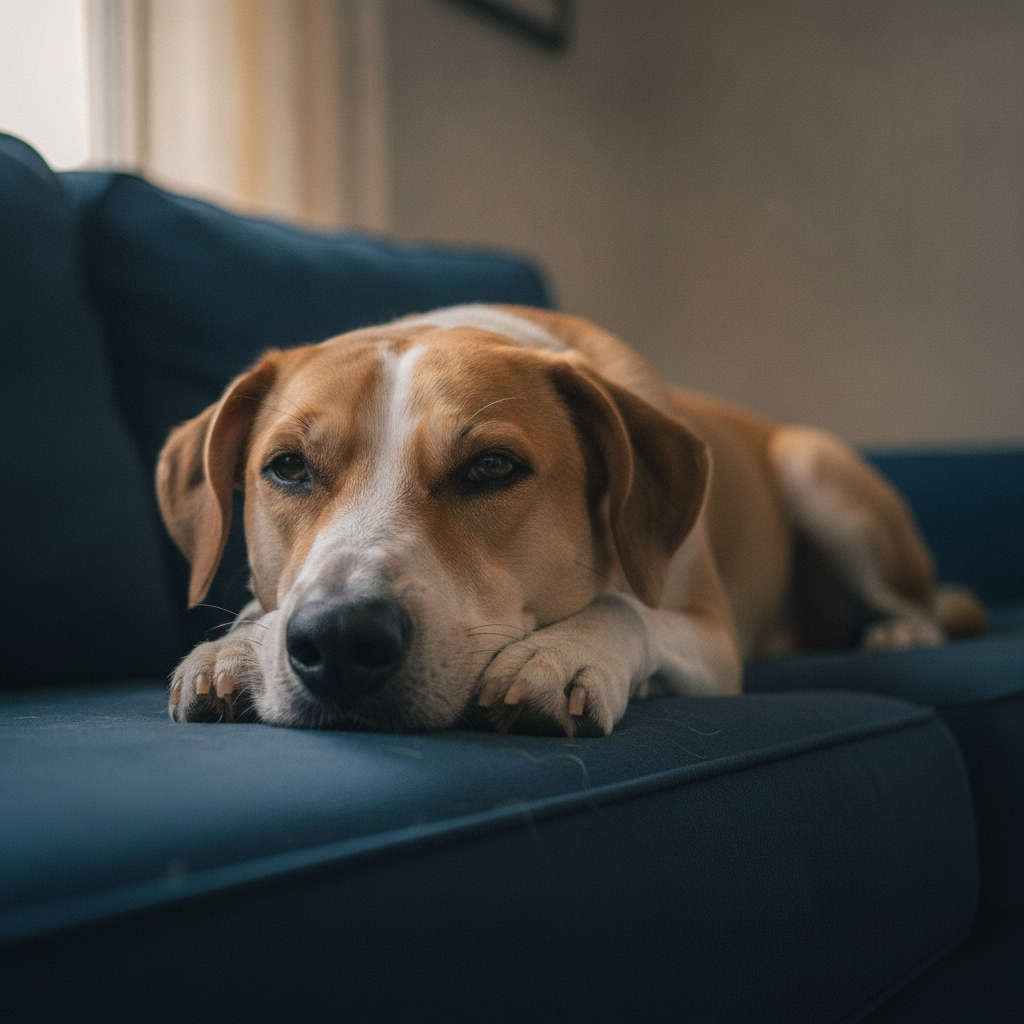
You glance over and there’s your dog, lying down with their chin resting on their paws, eyes following you around the room. It’s an unbearably sweet look, and the human brain reads it instantly as sad. We project a little rain cloud over the whole scene. But most of the time, that dog isn’t moping. They’re just comfortable, and quite possibly pleasantly worn out.
It’s an easy misread, and it’s part of a bigger habit we have of assuming we know what a dog’s body is saying. We take a wagging tail as proof of friendliness and a bark as a single fixed message, when both are more complicated. The chin-on-paws pose is one more case where the obvious human interpretation and the actual dog experience don’t line up.
Why the pose fools us
An upbeat, relaxed dog is easy to read: open mouth, bright eyes, loose and bouncy movement. That exuberance broadcasts a good mood so clearly that nobody worries about it. The confusion creeps in when a dog goes quiet and still, because calm and sad can look surprisingly alike to us.
A dog with their head down on their paws has a closed mouth, which reliably makes any dog look less cheerful than one panting happily. Their eyebrows shift as their eyes track around the room, which can lend a pensive, worried air. And the sheer lack of energy in the pose is easy to mistake for gloom. Stack those up and you get a dog who looks forlorn while feeling nothing of the kind.
What resting actually signals
Here’s the reassuring part. A dog who has chosen to lie down is, in most situations, telling you they feel safe. Dogs don’t tend to settle into a relaxed down when they’re frightened or on edge; a scared dog is tense, alert, and looking for options, not draping their chin over their own foot. So the very act of lying down and staying there is usually a marker of ease, not misery. More often than not, a dog resting with their head on their paws is relaxed and content, and that’s exactly what you want to see.
This pose shows up especially after a dog has worn themselves out in the best way, a long walk, a good play session, a romp with another dog. What looks like the blues is frequently just the deep, satisfied fatigue of a dog who got to be a dog today.
“I spend a lot of time talking owners down off the ledge about a dog who’s simply resting,” says Dr. Mara Chen. “The chin-on-paws look pushes every human sympathy button we have. But if the dog chose to lie down, their body is loose, and they’ll pop right up for a walk or a treat, that’s not sadness, that’s a happy, tired dog. Real distress doesn’t usually relax into a nap.”
When to look closer
None of this means you should ignore a dog who seems genuinely off, and the way to tell the difference is to widen your view. Don’t diagnose a mood from one snapshot; watch the whole body over time.
Genuine unhappiness or stress tends to show up as tension and withdrawal rather than a cozy sprawl. Warning signs worth noticing include a tucked tail, ears pinned back, a tightly closed, tense mouth, “whale eye” where the whites show as the dog looks sideways, lip-licking or yawning out of context, pacing, hiding, trembling, or flinching. Just as telling are changes in the ordinary stuff: a dog who stops eating, loses interest in play or walks they normally love, or seems flat for days rather than minutes may be dealing with pain, illness, or a real behavioral issue, and that’s worth a vet visit.
The single mellow evening of chin-on-paws by the couch, though? Let them enjoy it. Odds are they’re having a perfectly nice time.
What newer research adds
The instinct to over-read our dogs’ faces is well documented, and it usually runs in the sad direction. Studies of how people interpret canine expressions have found that owners frequently attribute complex negative emotions, guilt being the classic example, based on postures that don’t actually mean what we think. The so-called guilty look, ears down and gaze averted, turns out to be a response to our body language and tone, not evidence of remorse. The lesson translates directly to the chin-on-paws pose: our reflex is to see an inner sad story, when the dog is often just responding to the moment, or simply resting.
The practical fix is the one good trainers keep repeating. Read clusters of signals across the whole body, watch how they change over time, and weigh what the dog does, whether they eat, play, and settle, over what their face momentarily reminds you of. Do that, and you’ll spend a lot less energy worrying about a dog who’s perfectly content with their chin on their paws.
References
- Hecht, Julie, et al. “Behavioral Assessment and Owner Perceptions of Behaviors Associated With Guilt in Dogs.” Applied Animal Behaviour Science, vol. 139, 2012. https://doi.org/10.1016/j.applanim.2012.02.015
- Chin, Lili. Doggie Language: A Dog Lover’s Guide to Understanding Your Best Friend. Summersdale, 2020.