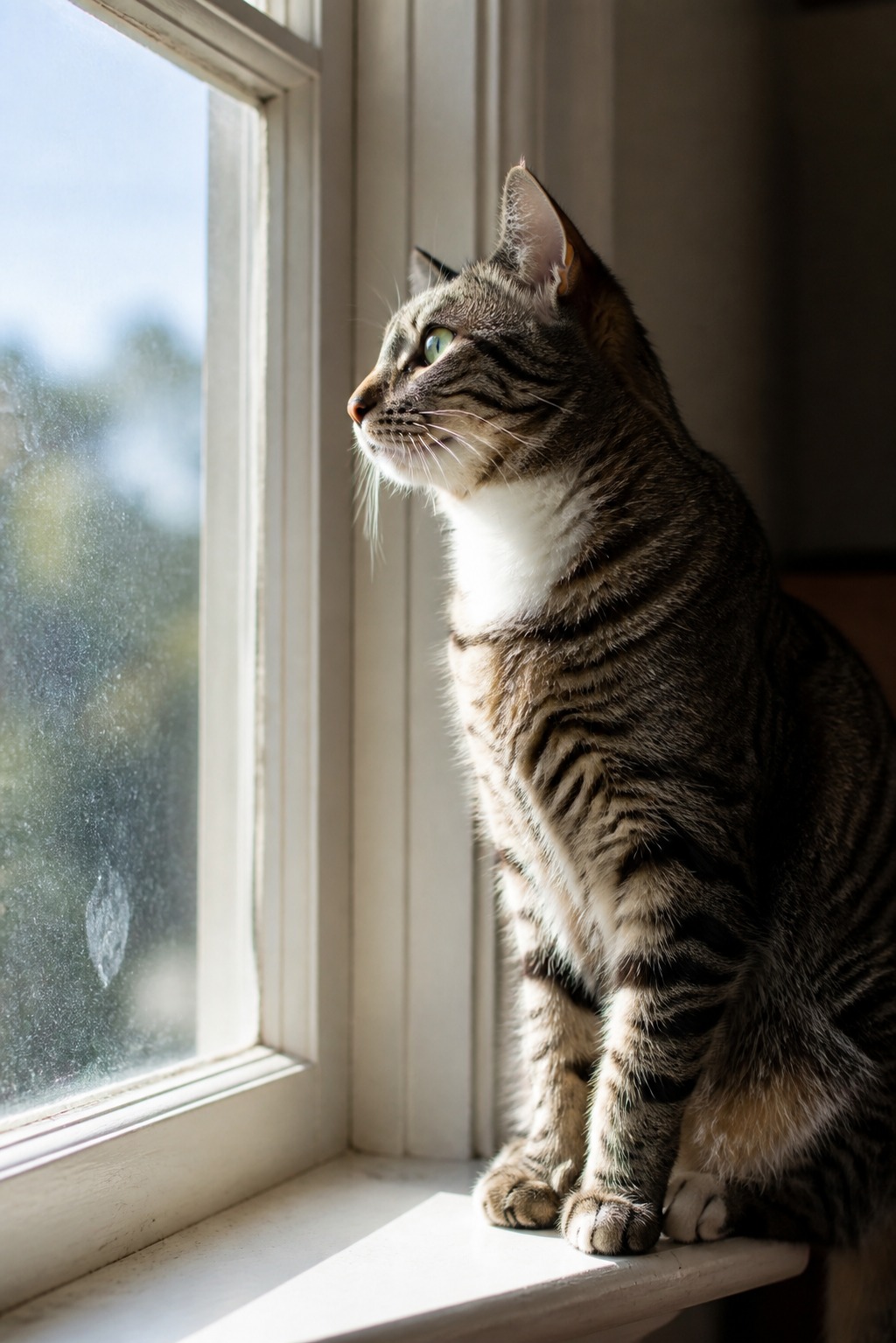
Every cat parent learns the guilt trip early. Your cat sits at the window, watching birds and squirrels move freely down the street, and makes those small, pointed sounds at the door. It’s easy to read that as a plea you’re cruel to deny. Cats are born to roam and hunt, so surely a little time outside is only fair?
It’s a real question, and it deserves a real answer rather than a scolding. The honest version is this: the outdoors offers genuine enrichment your cat craves, but the risks it carries are severe and heavily one-sided. Once you see the trade clearly, the goal stops being “in or out” and becomes “how do I give them the good part without the lethal part.”
Why your cat wants out so badly
Every cat is different, and whether yours dreams of the neighborhood or is content on a windowsill comes down to personality. But the pull is instinctive. Cats evolved outdoors and are wired to explore, hunt, patrol, and play, and outdoor access delivers a flood of stimulation for all five senses that’s genuinely hard to replicate inside. In your cat’s mind, their territory may extend well past the walls of your home, which is exactly why being stuck indoors can feel, to them, like an injustice.
“I never argue with owners that the outdoors is enriching, because it is,” says Dr. Priya Nair. “The problem is the math. The enrichment is real but replaceable, and the risks, a car, a coyote, a virus, are often permanent. When I frame it as a trade rather than a rule, most people land in the same place: give the cat the stimulation, engineer out the danger.”
What the outdoors actually costs
A free-roaming cat is exposed to a long list of dangers that simply don’t exist for an indoor cat.
Disease. Like people, cats catch more illness the more they mingle, and an outdoor cat meets other cats who may be unvaccinated or sick. Some of what they can pick up is fatal. Common threats include feline leukemia (FeLV), feline immunodeficiency virus (FIV), feline distemper (panleukopenia), upper respiratory infections, and feline infectious peritonitis (FIP).
Parasites. Less deadly but still miserable: fleas, ticks, ear mites, and gastrointestinal worms, plus ringworm, a fungal skin infection that can pass to the humans in your home. These can cause skin infections, vomiting, and diarrhea, and some can spread through the household.
Traffic and predators. Cats don’t have instincts tuned to avoid cars, and they’re struck constantly. They’re also hunted as often as they hunt, by feral cats, loose dogs, and wildlife like coyotes and foxes, depending on where you live.
Poisons and getting stranded. Curiosity leads cats into garages and sheds stocked with antifreeze and rodent poison. And the cartoon image of a cat stuck in a tree is real, sometimes for days, with dehydration or a bad fall at the end of it.
The toll on wildlife. A cat’s prey drive doesn’t switch off just because they’re well-fed. One cat on a hunting spree is nothing; the cumulative effect of outdoor and stray cats is not. A 2023 global research synthesis found that free-ranging domestic cats eat more than 2,000 species of animals, including hundreds that are of conservation concern. In much of the world cats are a non-native predator, which is why many people consider unsupervised outdoor access an ecological problem as much as a safety one.
The benefits, and why they don’t require the risk
There are upsides worth naming. Cats with the run of the outdoors move more and tend to stay leaner, and the bodily and mental workout of roaming can head off boredom-driven behavior problems back inside. But notice that both benefits, movement and stimulation, are things you can supply safely indoors. The exercise advantage is real; it’s just not worth a car or a coyote when a wand toy and a daily play session get you most of the way there.
The modern middle paths
You don’t have to choose between a frustrated indoor cat and a free-roaming one at risk. Several options split the difference.
- Start with the basics. If your cat does go out at all, a microchip and a collar with an ID tag dramatically improve the odds of getting them back. Keeping them in at dusk, night, and dawn cuts predator encounters.
- Build a catio. A “catio,” an enclosed patio, balcony, or secure outdoor structure, lets a cat experience the outdoors with constant, independent access and none of the danger. They range from a window-mounted box to a shed-sized enclosure, and there are collapsible and fenced-yard options if you’re short on space or budget. Any enclosure needs enrichment inside it, with places to climb and hide.
- Leash-train them. Plenty of cats take happily to a harness and leash, which lets you supervise outdoor adventures start to finish.
- Bring the outside in. Interactive toys and real play sessions, scratching posts scattered around the house, cat trees and perches (far safer than actual trees), and “cat TV,” a bird feeder or bath positioned outside a window, all deliver stimulation without a door ever opening.
What’s new: bird flu changed the calculus
Since 2024, a highly pathogenic strain of avian influenza (H5N1) has been circulating widely in wild birds, poultry, and dairy cattle in the United States, and cats have proven unusually vulnerable to it. Outdoor cats are at risk through contact with infected birds and other animals. Notably, though, the most publicized feline cases came through food: cats sickened and killed after eating raw or undercooked meat and unpasteurized dairy, including several commercial raw pet-food products that prompted recalls, with at least one strictly indoor cat infected this way. It’s one more reason major veterinary groups advise against raw diets, and one more entry on the ledger against unsupervised outdoor roaming. If bird flu is active in your area, keeping your cat’s outdoor access contained, and their food cooked or commercially prepared, is the cautious call.
Before you open the door, it’s worth sitting with the trade one more time. The longing at the window is real, and so is your cat’s need for stimulation. But with a catio, a leash, a few good toys, and a window with a view, you can answer that need without betting their life on the neighborhood.
References
- Foreman-Worsley, R., et al. “Indoors or Outdoors? An International Exploration of Owner Demographics and Decision Making Associated with Lifestyle of Pet Cats.” Animals, 2021.
- Tan, S.M.L., et al. “Uncontrolled Outdoor Access for Cats: An Assessment of Risks and Benefits.” Animals, 2020.
- Lepczyk, C.A., et al. “A Global Synthesis and Assessment of Free-Ranging Domestic Cat Diet.” Nature Communications, 2023.
- Avian Influenza A (H5N1) in Cats — American Veterinary Medical Association