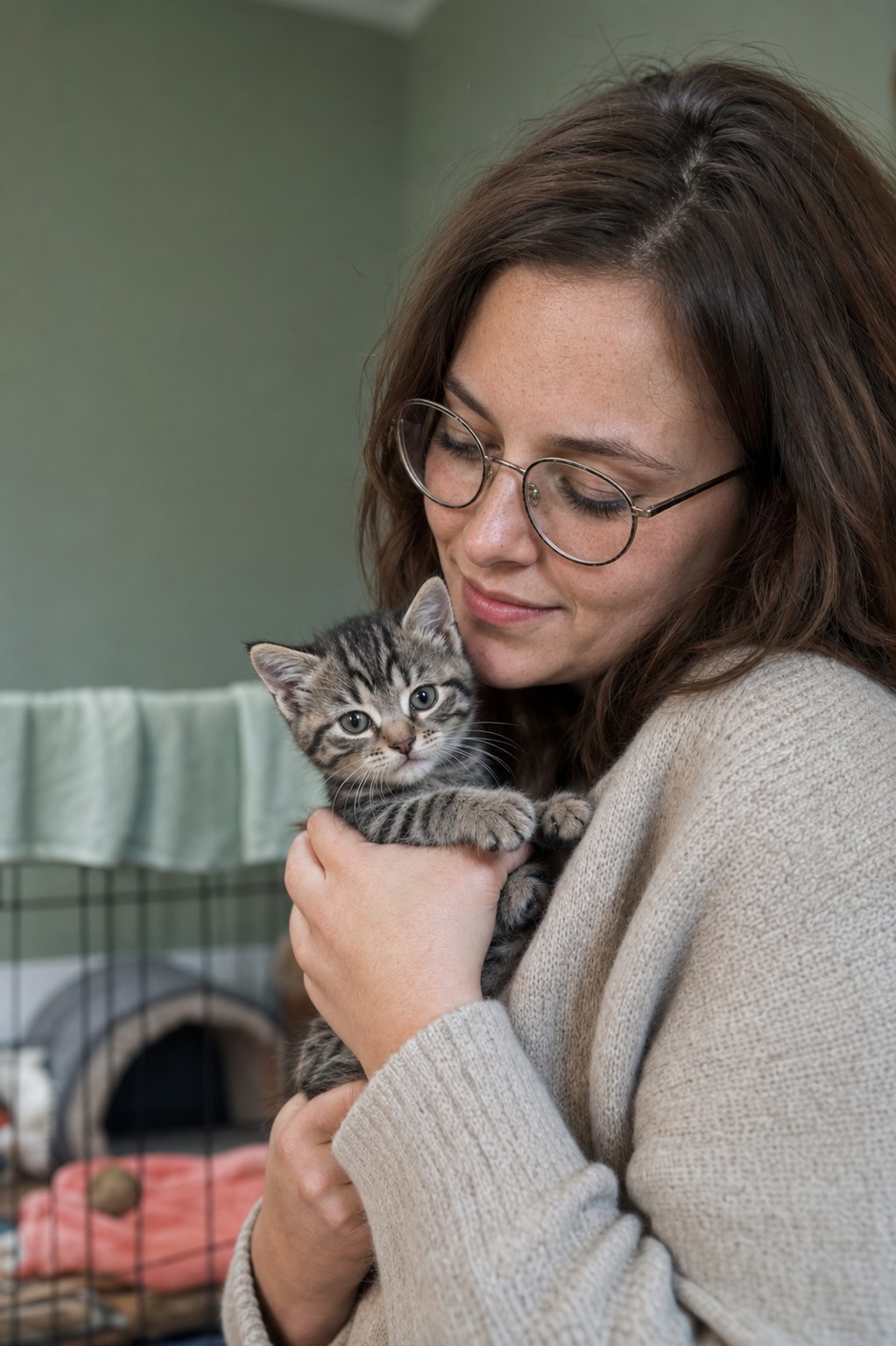
People ask me whether fostering a kitten is hard, and the honest answer is: it depends on a single number. Not your experience level, not the size of your apartment, not even how many kittens you take. The one variable that reshapes everything, how often you feed, what you buy, how much sleep you lose, and how high the stakes run, is the kitten’s age in weeks.
A three-week-old bottle baby and a seven-week-old fuzzball are barely the same assignment. So before you say yes, learn to think in weeks. Once you do, the rest of fostering falls into place.
First, finding kittens to foster
This part is easy, especially in a city. Shelters are almost always short on foster homes, and the shortage peaks during kitten season, the warm stretch from roughly March through October when litters pour in. Tell your local shelter you want to foster, and if they don’t have kittens that day, they can usually point you to a rescue that does.
The scale of the need is real. One frequently cited analysis found that cats five months and younger made up nearly half of all cats entering shelters and about a quarter of total shelter intake, and the true share is likely higher, since plenty of kitten programs never report to national databases. Most of those kittens start life outdoors; the humane educator Hannah Shaw, widely known as Kitten Lady, has long pointed out that the overwhelming majority of shelter kittens are simply found outside by ordinary people and brought in.
That last fact carries a warning. If you find a litter yourself, don’t scoop them up on reflex. Well-fed, clean, quiet kittens usually have a mother nearby who is caring for them, and pulling them can do more harm than leaving them. Kittens who are thin, dirty, crying, or exposed to danger are the ones who likely need rescue. Watch first, then make the call.
The bottle babies (roughly under 4 to 5 weeks)
This is the deep end. Neonatal kittens can’t regulate their own temperature, can’t eat solid food, and can’t be left alone. Expect to feed every two to three hours, day and night, which is why anyone with a rigid out-of-the-house schedule needs a plan for coverage before saying yes.
The non-negotiable rules here are about food and warmth. Never give a kitten cow’s milk or human baby formula; use a proper kitten milk replacer from a pet store, with a kitten bottle. Bottle-feeding is a genuine skill, and it is worth watching a reputable tutorial and lining up an experienced mentor, a vet, a shelter contact, or a seasoned rescuer, before your first feed. Keep them warm on a covered heating pad set to low, with an unheated area to crawl to.
And if you have any say in it, keep the babies with their mother. When kittens are under about five weeks, they still depend on nursing, and a nursing mom does the round-the-clock work far better than any human can. Fostering a mom with her litter is, in almost every case, the easiest and best outcome for the kittens.
The in-between weeks (about 2 to 7 weeks): the window that shapes the cat
Here is where fostering pays a dividend most people never think about. Between roughly two and seven weeks, kittens move through the prime socialization window, the period when good, gentle experiences wire them to become confident adult cats. This is not the same as simply exposing them to a lot of stuff. It means positive encounters, with different people, sounds, surfaces, and gentle handling, without ever overwhelming or frightening them. A kitten socialized well in these weeks is far more likely to grow into a cat who does fine with people, kids, dogs, and being picked up. Rush it or scare them, and you can set the opposite in motion.
Practically, this is also when the supply list comes alive. Once kittens pass two weeks, offer a shallow litter box with just a thin layer of litter. By three to four weeks, as they wean, add a shallow water dish, younger kittens don’t know how to lap and still need bottle-feeding. Food choice depends on age and health, so take direction from your shelter or vet rather than guessing. If cost worries you, don’t let it stop you: many rescues supply food, litter, and blankets to fosters, and neighbors are often glad to donate.
Nearly there (8 weeks and up)
Older kittens are the lowest-maintenance foster you can take. They eat on their own, use a box reliably, and mostly need attention, play, and a safe place to grow. Kittens are generally ready for adoption around eight to nine weeks, once they’ve reached a healthy weight and been spayed or neutered. If you take a young litter, plan for about a two-month arc from arrival to adoption. (If a kitten turns out to be a “foster fail” and stays with you, the commitment is more like fifteen to twenty years.)
Solo or a litter?
Fostering one kitten sounds simpler, and in some ways it is: fewer supplies, less food, all your attention on one tiny face. But kittens learn how to be cats from other kittens, and a human, however devoted, can’t replicate feline play and correction. A kitten raised alone, without other young cats around, can turn nippy or develop other behavior problems, a pattern common enough to have a name, single-kitten syndrome, and such kittens are more likely to be returned after adoption. A litter costs more in food and litter, but the kittens tire each other out, sleep in a warm heap, and teach each other manners. When you reach out to a shelter, tell them whether you can take one kitten, a full litter, or a mother with her babies.
The safe room, not the whole house
You don’t need to kitten-proof your entire home. You need one small, warm, closeable room that keeps the kittens separate from other animals and out of trouble. A playpen or crate inside that room helps. Then think like a kitten looking for danger: an open toilet or trash can to fall into, a curtain to scale, a toxic houseplant to chew, a gap in the furniture to vanish into. Close those doors before you open the crate.
Getting them adopted
Start advertising early, well before the kittens are actually available at eight weeks. Take good photos, and share their age, their story, their names, and anything an adopter would want to know, on social media, neighborhood boards, flyers, and adoption sites. Then vet your applicants seriously. Ask who lives in the home, people and pets, whether they’ve had cats before, and what they’ll do if they can no longer keep the kitten. That last one is close to a trick question: the only right answer is that the cat stays a permanent family member no matter what. Charging an adoption fee, commonly somewhere around $75 to $200 depending on where you live and what’s included, isn’t about the money; it screens for people who are serious.
Saying goodbye
Nobody warns you enough about this part, which is why “foster fail” entered the vocabulary in the first place. Letting a kitten go is hard, and if you have kids, prepare them early that the goal was always adoption. Reframe it honestly: handing your foster off to a good home isn’t losing them, it’s the mission succeeding. Ask the adopter for photos and updates if they’re willing, it soothes the ache, and then, when you’re ready, do the thing that heals it fastest: foster again.
What newer research adds
The core challenge of kitten fostering hasn’t changed, most kittens are still born outdoors, and the youngest, orphaned, and sickest remain the most fragile, which is why neonatal survival is the hardest part of the job. What has shifted is the infrastructure around fosters. Shelters have leaned hard into dedicated kitten nurseries and community-foster networks precisely because sending vulnerable kittens home with trained volunteers keeps them out of crowded shelters where they’re most at risk during the spring-to-fall surge. If you foster today, you’re likely to find more support, supplies, mentorship, and on-call advice, than a foster would have found a decade ago. Lean on it.
“The number that should drive your decisions is the kitten’s age, because it sets the whole schedule,” says Dr. Priya Nair. “A neonate is a round-the-clock medical commitment. A seven-week-old is a socialization project. Match the age to the honest amount of time you have, and everyone, including you, has a better outcome.”
References
- Journal of Applied Animal Welfare Science, “A Prospective Study of Growth Rate, Disease Incidence, and Mortality in Kittens Less than 9 Weeks of Age in Shelter and Foster Care”
- Shelter Animals Count, The National Database
- Hannah Shaw (Kitten Lady), neonatal kitten care and fostering resources