There is a belief, widely held and rarely examined, that a beautiful home and a dog are mutually exclusive. You can have the velvet chair or you can have the animal. Pick.
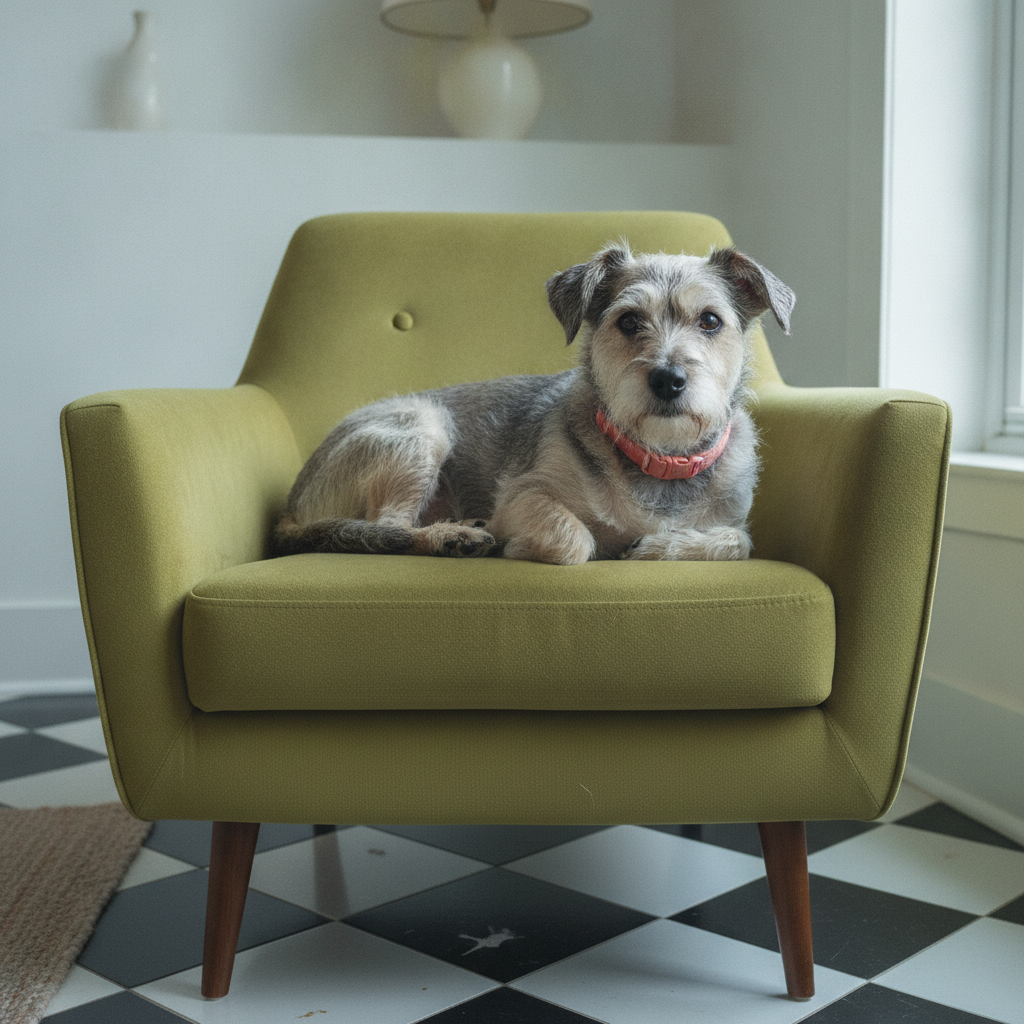
The people who actually make beautiful homes for a living do not believe this. Jonathan Adler, the potter and designer whose name is on a whole eponymous design company, and his husband Simon Doonan, the writer, fashion commentator, and Making It judge, live in interiors that are the opposite of dog-proofed: lacquer, high-gloss color, graphic black-and-white floors, ceramics on every surface, a velvet chair in a green you would describe as unrepentant.
They also live with a rescue mutt, a small apricot dog named FoxyLady, adopted from the North Shore Animal League. Twelve pounds. Sheds. Lies on things.
Both facts are true at once. Which means the tradeoff most people accept was never a real tradeoff. It was a materials problem, and they solved it.
The dog came second, and that matters
Before FoxyLady there was Liberace, who was with them for fifteen years. After he died they waited about eighteen months before adopting again.
That interval is worth naming, because it is the least-discussed part of dog ownership and the most useful. The pressure to “get another one” arrives within weeks and comes from people who mean well. A year and a half of not being ready is a completely normal answer. So is three months. The correct interval is the one where you are adopting a dog rather than auditioning a replacement.
When they did adopt, they went to a shelter. This is a couple who could commission literally anything, and what they wanted was a mixed-breed rescue with an opinion.
The actual design lesson: buy for the failure mode
Here is what a home like theirs is quietly doing that a “dog-proof” home is not. It is not avoiding damage. It is choosing surfaces where damage is either invisible or reversible.
Pattern hides more than color does. A speckled, terrazzo-ish, graphic, or high-contrast surface absorbs hair, crumbs, and paw marks in a way that a flat expanse of pale linen simply cannot. This is why designers’ homes look unbothered: the pattern is doing janitorial work.
Washable beats “stain-resistant.” A treated fabric buys you an afternoon. A cover that comes off and goes in a machine buys you a decade. This is the single highest-leverage swap in a dog household, and it applies to sofas, chair cushions, dog beds, and rugs.
Hard floors want traction, not perfection. Glossy floors are a joy to look at and a hazard to a dog running at them. Runners and washable rugs solve the slip problem and the noise problem at once, and a low-pile flatweave takes fur out with one pass of a vacuum where a shag does not.
Height is a design tool. Ceramics, glass, trailing plants, and anything with a tail-height profile go up. Not away. Up. The room stays maximalist; the breakables move out of the strike zone.
Buy the thing you will not mourn. The vintage rug you would be genuinely devastated to lose does not belong in the room where the dog sleeps. That is not a compromise, it is triage, and every designer does it.
“The households where the dog and the house are at war are almost always the households that bought delicate things and then asked the dog to behave like furniture,” says Dr. Nina Kohl. “Change the sofa, not the dog. It’s cheaper, and it works.”
The FoxyLady rules, reverse-engineered
You can read a lot about a household from what its dog is allowed to do. In this one, the dog:
- Follows the working human, parking wherever Doonan happens to be writing. Dogs orient to whoever is stationary and boring. If you want your dog off the good chair, be the more interesting piece of furniture.
- Is not dressed up. Adler and Doonan are two of the most flamboyant dressers in American design and the dog wears nothing. Costume is a human hobby; a dog’s tolerance for it is not consent.
- Rides along, multi-residentially. Shelter Island, Palm Beach. A dog who travels well is a dog who was taken places early and often, in low-stakes doses, before anyone needed her to.
- Adds, in the family’s own affectionate framing, a patina to the rugs. Which is a very stylish way of saying: the rugs were chosen with this eventuality in mind.
What’s new since this was written
The design market caught up. Performance fabrics, which a decade ago meant scratchy outdoor upholstery in six sad colors, are now standard across mainstream furniture lines, including velvets and bouclés that were previously the first casualty of dog ownership. Machine-washable rug brands have gone from a novelty to an entire category. It is now genuinely possible to buy a good-looking, saturated, high-design sofa with a removable, launderable cover, which was not true when this couple started building rooms around a dog.
If you have been telling yourself you cannot have the house you want because of the animal, the honest answer in 2026 is that the constraint moved and you did not. The dog was never the problem. The upholstery was.
References
- North Shore Animal League America. animalleague.org
- American Kennel Club. “How to Dog-Proof Your Home.” akc.org
- Cornell University College of Veterinary Medicine. Preventing Slips and Falls in Senior Dogs. vet.cornell.edu